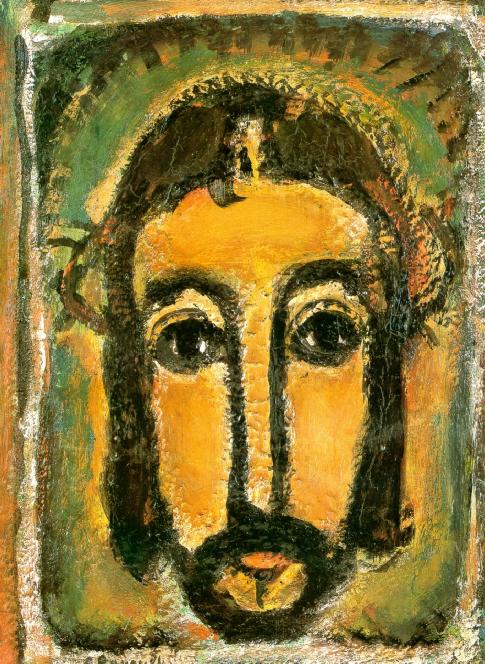
Head of Christ


Yesterday in class I shared with my students what I called an “appreciation” essay by a Romanian painter named Joel Klepac. The object of Klepac’s enthusiasm was the French post-Impressionist (to the extent that he is categorizable) George Rouault, who happens to be my favorite painter as well. Specifically, it was one of Rouault’s “head of Christ” paintings, of which I would guess the artist did hundreds.

Klepac’s enthusiasm for his subject is contagious, which is precisely why I chose to share his essay, as for me the acid test of an appreciation essay is the extent to which it infects the reader with the author’s positive feelings. A quote:

Next I was escorted into a large shared office where Rouault’s “Head of Christ” had been carted to wait for me, placed on a chair. At first I experienced the disorienting feeling of suddenly being face-to-face with a celebrity, but little by little the painting opened its doors. Deep blues and greens, reds, smears of black, and yellows are piled together; years of tortured layers a half inch thick in some areas. Christ’s head is slightly tilted. He has an elongated nose and small mouth, and the ears almost disappear in the black outlines of the head. But it is His eyes that were most startling. In those 45 minutes, Christ’s eyes pierced me. Somehow gathered behind them were all the tears of the boys on the street of Romania whom I have come to know, all that inner pain, those graphic histories of abandonment, mocking, and abuse. And here I also saw my own poverty, my loneliness, fear and lost relationships. There is nothing of the cheap plastic smile that one finds on so many sentimentalized images of Christ. Rouault’s Christ looks me in the eyes until he finally has my attention, and says, “I suffer with you. I love you.”

I am not a religious man. To say I don’t believe in God (or his resurrected son) doesn’t quite go far enough: I don’t believe in believing. I could, like some, finesse this and say that, while I don’t believe in a personal or personified God or in the resurrection as a fact, I DO believe in it as myth and metaphor: but that would be a lie, since one doesn’t have to “believe in” a myth or a metaphor; in so far as the word “belief” means anything there’s nothing to believe in, no reason to suspend impirical observation or judgment. No, believing in metaphors requires no leap of logic or faith. If a metaphor functions, it exists; and by extension it exists to the extent that it functions.

What I do believe in is the beauty of art and of metaphor and myth—which, if not works of art in and of themselves, are constituents or components of art. As fiction the story of Jesus can’t be beat. It has it all: drama, suspense, magic, tears, guilt, reversals, catharsis, poetic justice. There can be few if any images as powerful as that of Christ on the cross. And as a fictional character I can think of none more complex or subtle. Gatsby, Ahab, Lord Jim—none even come close.

It is the tactile substance of Rouault’s paintings that moves me most, that touches me like the skin of a lover. To encounter his paintings in the flesh is to encounter flesh: a flesh formed of layer upon layer of encrusted oil paint—so thick, so crusty, so organically rich in texture and spontaneity—like the patterns made by fallen autumn leaves, or any of the perfect accidents of nature, the one artist incapable of a false stroke. 

Rouault has always been one of my favorite painters. When I’m feeling low or insecure, when my writing doesn’t go well, when I can’t bear words any longer and want to sink into colors and shapes and texture, next to a walk in a forest, Rouault’s canvasses are the next best thing. His series of crusty crucifixions pleases me more than anything—in spite of their religious vehemence and my atheism, they please me.  It’s not that I don’t give a damn about Christ or the crucifixion; it is merely that I am more moved by the colors and the textures of Rouault’s paintings than by their themes or subjects. For me, the story is secondary, something that happened long, long ago if at all. But the painting itself is alive; the painted surface a kind of living tissue or flesh. No one ever did more with paint than Rouault—or with color, for that matter. Between recklessly bold swipes of thinned black, viscous reds, yellows and greens ooze like blood and puss from a festering, gangrenous wound. Perhaps because Rouault had been a glazier in his early life his critics tend to compare his paintings to stained glass windows. But for me they are more like divine autopsies, pious corpses spread out and splayed with a palette knife on canvas—stained windows of blood, flesh, bone and gristle. As Christ redeemed man by rescuing him from his sins, Rouault’s paintings redeem Christ by rescuing Him from the abyss of cliché.

Posted in Dreaming on Paper, Uncategorized | Leave a comment

“Finished”

Yesterday I “finished” a draft of a new novel.

Finished? What does that mean—especially when I know from experience that I’m likely to do another three, four, five, maybe even fifteen drafts? And just what qualifies as a draft, anyway?
Was it Paul Valery who said, “A poem is never finished, only abandoned”? Trust me, the same can be said of a novel—or a play, or a painting, or an essay. At some point we’ve done all we can do; at least, we feel as if we’ve done all we can do. And at that point we have two choices: two walks away temporarily, or to walk away for good. But we must walk away.
All that’s implied by the word “draft,” therefore, is that it is something you will walk away from, but only temporarily. It exists merely to be returned to. It is neither finished nor abandoned, but exists in a sort of twilight state between these two phases. You might call it the beginning of the end, or the end of the beginning. 
The last novel I wrote took me fifteen years. I don’t mean fifteen years wall-to-wall (in that case, the “walls” would need to be padded); I mean fifteen years on and odd. Still, if I added all the hours and days together spent working on that novel during those years, I would not be surprised to discover that they would fill five to six years—with just barely enough time left over for meals and sleep.
Five to six years working full time to create a novel which, when it finally sold, earned me an advance of . . . well, I won’t say exactly how much money I got. Suffice it to say that it’s hardly enough to live on for a year. In fact, it’s hardly enough to live on for half a year. And I don’t mean in New York City; I mean somewhere like Cleveland, Ohio. Or maybe Somalia.
In few words I probably earned about .25¢ per hour. But hey—who’s counting?
And yet I have to tell you that with each new revision of that work, I felt renewed: I felt as though I have been granted a new lease on life, a new chance to make good of something that I had already sacrificed so much time and effort on. This time (I said to myself at the onset of each revision), this time I’ll get it right; this time my efforts will not be in vain. I shall be redeemed. 

Redemption—what does it mean? In the case of my novel, it means a contract that will pay me (once all advances are collected) 25¢ per hour plus expenses on a ten city reading tour. And the glory of seeing my words finally put to bed in print. Yes, that’s the real payment: to see one’s vision at last realized, one’s words set to type on and printed good quality paper between well-designed covers. To be able to say to those who have witnessed your years of slogging struggle, “My book is published. It exists. It has its own life now. BUY IT!” And—most of all—to hold in one’s hand the product of that struggle, all those years of effort and disappointment and tears and ages bent over a keyboard compacted into this small, dense object. A book! No longer trapped inside me as a series of worries and visions, but an independent entity, a thing with its own life. Yes, like having a child, sort of (I guess).
But for a writer one “child” is seldom enough. We are greedy that way. We want more and more progeny—as if the world isn’t already overpopulated with books; as if there’s weren’t already ten thousands times as many books as there are those willing to read them. What, I ask you, do we need another one for? 
We don’t. But some of us—like me—still need to write them.
Posted in Dreaming on Paper, Uncategorized | Leave a comment

Thinking on Paper

The more papers I read by my undergraduate students, the more I come away convinced of this: that their problems have less to do with the mechanics of writing (though many have problems here as well) as with the thinking that goes into a piece of writing. 

I’m not sure that a lot of my students really understand what is meant by the verb to think. That the word is a verb gives us a strong clue to set out with. Thinking is a process; it doesn’t simply happen, or happen simply. It is NOT easy, nor is it meant to be, any more than lifting weights, running a marathon, or doing a valve job is meant to be easy. It takes time; it takes effort. Thinking is an active process. It is work. It requires effort.
Though they say they hate to write, what many of my students reveal to me (in writing to me about their relationship to writing) is that they resent and resist the process of thinking. They resent the necessary effort. It hurts their brains—just as lifting weights hurts other parts of the body. Anything we do to improve our minds “hurts our brains.” To grow in any way is to experience—if not pain–discomfort. If it doesn’t hurt, then you’re not growing.
What my students have said to me very candidly in their papers—though this may not have been what they thought they were saying—is that they want to learn and grow; they want to become better at writing, as long as it doesn’t hurt. In other words, as long as it requires a modest effort or, better still, no effort at all.
Sorry, folks: growth doesn’t work that way, and neither does learning. If your parents didn’t teach you that, then I’m sorry. But you’ll learn it now. You get back what you put in.
As for thinking (and I’m talking here not about daydreaming or random thoughts or feelings, but about analytical thinking, the kind of thinking that looks into ideas, that examines and inspects them, that digs for deeper truths), it takes us beyond our perceptions, beyond common knowledge, beyond assumptions and opinions toward something deeper, toward—hopefully—ideas that we can genuinely claim as our own. Or, at the very least, thinking takes us beyond the ideas and opinions that we already have to new ideas and opinions. 
To think, one must question. When one makes a statement, when one says, for instance, “I hate writing about boring topics,” one should ask oneself, on behalf of the reader but also one one’s own behalf, a) what are these topics and b) what makes them boring? By way of the first answer one student of mine wrote in a paper, “boring subjects like Shakespeare” and left it at that—as if it were plain as day that Shakespeare is a boring subject—as if this were knowledge as common as the roundness of the earth. Well, maybe a majority of college undergraduates feel this way. But even that doesn’t make it true (truth, by the way, is not a popularity contest).
If my students were to examine this statement, this idea, this notion that Shakespeare is boring, if he or she were to think about it, he or she might realize that root of the boredom lies not in the subject  of the sentence “Shakespeare bores me,” but in its object. It is the “me” who supplies the boredom, not Shakespeare (whose plays have been amusing people for 400 years, and thus, whatever else he is, is not “boring”). What my student experiences when asked to write about Shakespeare is not boredom but mental and intellectual paralysis: he (or she) has nothing to say, or rather he is unwilling or unable to pierce the thick hide of insecurity that divides him from his own perceptions and feelings, and therefore unable to get at what lies beneath. The thing that bores him is not Shakespeare but himself as he sits there with a mind as blank as the page in front of him. To say in such an instance that Shakespeare is boring makes about as much sense as saying “the blank screen on my computer is boring me.” It’s not my mind that’s empty—it’s the computer!
Thinking hurts. But it hurts less the more we get used to doing it, and many of my younger students are not used to thinking analytically. They have managed to go through twelve years of lower education with little if any true engagement with that process. Instead they have spent their time memorizing things, learning by wrote, passing tests and getting grades. Thinking has not been a part of the curriculum. They are not used to it, and those who ask them to think are asking them to use muscles that burn with the slightest strain. In this way among others the system has failed them. 
The good news is that these muscles can be developed at any point in life. It’s a simple matter of being willing to endure a modest amount of “pain” (I put the word in quotation marks, because, really, it’s not even as painful as a small headache). To think is to ask a series of questions that takes us deeper and deeper into whatever subject we are looking into. If we write, “I have no time for writing,” the question to ask then is: why? And then we discover, perhaps, that we have more time than we thought. Or we discover that our lives are truly such that we have no time not only for writing, but for self-examination (this is true for many if not most people).
When I say that my students don’t know how to think, I hope they don’t take this as an insult. It’s not meant to be: it’s only meant to be an observation. It is not a negative comment on their intelligence. I find most if not all of my students to be intelligent; some are witty as well; a few are wise beyond their years. But the resource of thinking has not been developed in them. They pass judgments and make statements in writing that clearly show this. They don’t question themselves. They are content with having an opinion and feel no need to challenge or defend it. They want to “express themselves,” which, translated, means they don’t want to have to take any responsibility for their ideas or sentiments, to have to verify or back them up with any evidence or facts: indeed, they resent this requirement. “If it’s my opinion it’s my opinion,” they say. “I don’t need to defend or argue it!” No—and you can be ignorant, too; I suppose that’s your right. But that ignorance won’t serve you or society. It will only serve to blind you to your own blindness. It will protect you from ever realizing how ignorant you are. This is the strategy of the ostrich that buries its head in the sand to protect itself from its predators. In this case the predator is ignorance; the enemy is self-awareness; the thing most feared, paradoxically, is that one might actually learn something that might really protect one.
Students, together let us help and encourage each other to think. Let us become thinkers, and be not just better writers for it, but better people. That’s my goal for you all in this class. If you learn to write, that’s good; if you learn to think analytically—and better still to make a habit of thinking—that’s better. That’s powerful.

Posted in Dreaming on Paper, Uncategorized | Leave a comment

Welcome to Interesting Times

Remember the Great Depression? The stock market crash of 1929? Ticker tape machines? Men jumping out of windows? Bathtub Gin? Giggle water? Al Capone? Neither do I; I wasn’t even born. But I don’t feel too bad and you shouldn’t either. Because though we missed out on the Great Depression, thanks to the greedy, stupid people who run our financial empires you and I are soon to be treated to the New, Improved, Even Greater Depression.

As the Chinese curse puts it: may you live in interesting times.
Today Federal Reserve Chairmen Ben Bernanke pleaded his case before Congress, asking them (us) to front them—run that figure by me again?—$700 billion (I don’t even know how many zeroes that is) dollars to loan to those poor nice people on Wall Street: that’s right, to the very people who got us into this mess.
An analogy comes to mind. You and I are passengers in an airplane known as the US Economy (really the global economy, but let’s not quibble). The pilots in charge of that economy are, or have been, the financial wizards of Wall Street. Thanks to their bumbling, the plane is in a free fall and about to crash. There are a dozen parachutes on hand., locked in a safe. Question: who should get them? The pilots who doomed the plane, or the innocent passengers who trusted them with their lives?
For parachutes read: 700 billion dollars of our taxpayer money. Going to Wall Street. To bail them out. And (excuse me) what do we get in return for this loan? Besides a lump of coal in the Christmas stocking?
Already the powers—meaning the Wall Street institutional and banking lobbies—have balked at having any “strings” attached to this loan (like being forced to cut the salaries and bonuses of executives of firms on the receiving end). You might rightly ask just how is it that they are in any position to balk at anything? Is it not said that beggars can’t be choosers? And does not desperately needing $700 billion dollars qualify one as a beggar? And yet they want no strings. In fact one institution had the nerve to say, in few words, “If you force any such restrictions on us, we’ll refuse the loan.” To which I can think of only one appropriate response—unutterable here. Heaven forbid they should have to cut down on their fleets of BMWs and Mercedes and wear watches worth less than our cars.
Imagine you or I strutting into one of their banks and asking for a loan with nothing more to offer as collateral but a bunch of worthless mortgages on properties impossible to sell. They’d laugh—or call security.

But they don’t just want our money; they want it no strings attached.

And they’ll likely get it. Remember, this is Congress we’re talking about, Congress that’s being solicited, and by institutions represented by powerful lobbies: by the very people who fund the campaigns of Congressmen. The fix is in: the strings are attached and the beggars are pulling them.
What will make this depression greater than the Great Depression? Aside from the very real possibility that it will be deeper, longer, and spread across the entire globe? That it was so predictable, and so preventable. Anyone with eyes to see who had been looking could have seen it coming long ago. Those who were saying, less than three weeks ago, “The situation is contained; the worst is over,” knew better; they had to know better. I’m talking President Bush; I’m talking Bernanke; I’m talking all the talking heads of Wall Street. A moron could have told them otherwise, that when you build a financial empire on bad mortgages, and then sell those bad mortgages to other banks and institutions, and they sell them to portfolio managers, and so on, you are building your empire on sand and it will collapse. Once the first wave hit, they had to know it was the end, that the whole house of cards would tumble down. They knew it, and said and did nothing. Because they figured in the end only those at the very bottom would lose theirs. It’s called a Pyramid Scheme. Or, on Wall Street, business as usual.
If this $700 billion loan goes through, every taxpayer in America will have entered into that pyramid scheme at the very bottom. We will be left holding the bag for all the greedy dumb sons of bitches who filled the bag with bad debt. The French are laughing at us; so are the Germans. They say they told us so. They ‘re right; they did.
I am reminded of a passage in a book by a favorite author of mine. His name is Nelson Algren, and the book is called A Walk on the Wild Side. In it Algren writes of that other depression, one that we may soon look back upon with wistful eyes (like trains and movie stars, depressions were so much better back then!). Here’s Algren on that Depression:
The Ladder of Success had been inverted; the top was the bottom, and the bottom was the top. Leaders of men still sporting gold watches were lugging baby photographs door to door with their soles flapping. Physicians were out selling skin lighteners and ship captains queued in hope of a cabin boy’s mop and pail.
Offices of great fire insurance companies went up in smoke, which seemed no more than just. When the fire department—long unpaid—cleared off, little remained but scorched files, swivel-chairs on which no one would ever swivel again, lovely heaps of frosted glass, and all that mahogany.
All that mahogany that hadn’t helped anybody but brokers after all. Then the brokers began jumping off rooftops with no greater consideration for those passing below than they’d had when their luck was running. Emperors of industry snatched all the loose cash on which they could lay hand and made on fast last run. Lawyers sued one another just to keep in practice.
The more things change . . .
Back then, at least, the brokers and bankers had the decency to jump. Now they run screaming to Uncle Sam for $$$. Instead of snatching loose cash they snatch the taxpayer’s purse.
Welcome to Interesting Times.
Posted in Dreaming on Paper, Uncategorized | Leave a comment