I first saw the Man in Blue in June. He was crossing the bicycle seat factory parking lot. I watched him from the top of Cheese Hill through the binoculars I’d inherited from my father. It was ten o’clock on a Sunday morning. The church bells were tolling.
Cheese Hill was the limestone cliff jutting out of the earth behind what had been the Sutton Hat Factory Works before it burned down and its scorched brick walls were absorbed by the Apex Bicycle Saddle Company. On its chalky summit we Back Shop Boys would gather to inventory the day’s possibilities. We could pedal our bicycles into town and guzzle from the town hall water fountain, the coldest on earth. We could rob old man Mulvaney blind in his five & dime store, with two of us distracting him while the other two pinched Matchbox cars, comic books and fudgsicles. We could go down to the bank of the Brim River and watch the latest garbage float by, or set fire to model battleships and destroyers, or catch frogs or—if no frogs were available and pokeberries were in season—start a pokeberry war, or cut down cattails and twist their brown velvet shafts in our fists and send the cottony seeds flying. We could check out the latest junk cars behind Dan’s Sunoco station, or snatch Pepsi empties from the stacked crates behind the Doughboy Restaurant, collect the deposits at the First National supermarket and treat ourselves to ice cream floats at Hat City Drugs. Or we could climb a barbed-wire fence and sneak onto the grounds of an abandoned hat factory and, with Skunky’s CO2 pellet gun, shoot out some windows (if there were any windows left to shoot out). When all else failed we could always pass alternative judgments on behalf of the Postmaster General on people’s mailboxes. Among some of our choice alternatives:
Spit on by the Postmaster General
Pissed on by the Postmaster General
Given the Finger by the Postmaster General
Told to Fuck Off by the Postmaster General
(If words failed the Postmaster, we could always light an M-80 and toss it in.) These were just some of many colorful ways to be bored in Bowler.
At the cliff’s base, behind the factory, there was a shed in which malformed bicycle seats were stored until they could be melted down and formed into new, healthy ones. The shed’s corrugated tin roof offered a perfect target for the “bombs” of pale yellow limestone that broke off in crumbly, cheese-like chunks. We’d toss them and wait for the factory guard to come out of his hut and shake a trembling fist up at us, which gesture we would meet with outthrust palms and shouts of “Sieg Heil!” or “Hail Hitler!”
We called ourselves the Back Shop Boys because all of our fathers once worked in the back shops of hat factories: Wes “Paps” Papadopoulos, Victor Szentgyorgyi (pronounced “Saint George”), Wade “Skunky” White (nicknamed following an unpleasant encounter with a skunk)—and Gilbert Slocum, member by proxy through me, Gilbert who spoke only three words, whose thick glasses and shadowy baseball cap visor could not hide a pair of eternally crossed and bulging eyes, Gilbert whose nose never stopped running, whose plaid shirtsleeves (when he didn’t roll them up) were always stiff with snot, whose skinny forearms (when he did) were glazed with the stuff as if by a coat of varnish. Gilbert who back in those barbaric pre-p.c. days wasn’t mentally “challenged” or “disabled” or “deficient” but “retarded” or, as we usually put it, a retard. And that’s when we were feeling generous.
Gilbert didn’t care what we called him as long as nothing stood between him and his “hot-dog,” the optical illusion of a floating bullet of flesh formed by touching the tips of his index fingers together and staring at them cross-eyed (easy for Gilbert to do). The three words were a hot dog. He said them over and over, always with the same tone of amazed discovery, as if witnessing the phenomenon for the first time. He would try to eat the damned thing, snapping at it like a crocodile with his severe overbite, biting his own fingers and crying out in pain. At first we all found this—and the crying fits it inspired—amusing. But like all Gilbert’s tricks it got old fast. Now, seeing him about to chomp down on himself, I’d swat his big-eared, crew-cut, encephalitic head.
I alone had permission to swat Gilbert; no one else could swat him, permission granted to me by myself in consolation for the loss of privacy and esteem I suffered as a result of having Gilbert as an appendage. It was for my father’s sake that I’d befriended Gilbert, or pretended to, a favor to him for his former boss, Herbert Slocum, back shop foreman at the Caxton-Dumont Hat Works. Following the factory’s fiery end, and Mrs. Slocum’s death three weeks later of complications from diabetes, Mr. Slocum fell into a deep depression. He fed Gilbert bologna sandwiches and oatmeal and drank his way through weekends. Gilbert’s clothes grew tattered. He started to smell. My mother fed him and ironed his clothes. My father let him join us in our pursuits, riding the mini-trolly, bearing witness to a few hat factory fires. I became Gilbert’s de facto brother.
At first the other Back Shop Boys protested. What are we supposed to do with this retard? But certain advantages to the situation soon presented themselves. Gilbert was good for a laugh. He was also a perfect target for the barbs that we would otherwise have launched at each other, an inert object to lash out at times of dissonance or strife. The others could call him “mooncalf” or “lamebrain” or “blubberhead” or any of dozens of other colorful compound pejoratives. They could call him anything they liked. But they couldn’t touch him. If they touched him I’d be all over them.
Gilbert and I got there before the others, who all went to church. To amuse myself meanwhile in my knapsack I had my latest space comics, my purple Dunkin Imperial yo-yo, my How and Why Wonder Book of Planets & Interplanetary Travel, my Ruby Ray squirt gun, and my Space Orb Kaleidoscope (“Space Orb, Eye in the Sky!”) which, if you look at a planet through it, provided glimpses of aliens from Venus, Mercury, Mars, Saturn and all the other planets (though the “aliens” were crude cartoons and more silly than anything.)
And I had my binoculars (1943 Bausch & Lomb Navy issue 7 x 50s, Serial # 251908). With or without them from the top of Cheese Hill I could see all of Bowler. Beyond the bicycle seat factory the central stretch of Main Street unfolded, with, from left to right, the Bowler Hobby Shop, Mulvaney’s five and dime, the Empress movie theater (where Birdman of Alcatraz was playing), the hardware, drug and jewelry and other stores, their facades obscured by clumps of trees. To the far right the view was framed by the railroad tracks and, parallel to them, the Cavanaugh Fuel Oil Storage Tanks, arranged from smallest to largest, like the metal canisters my mother kept flour, tea and sugar in; to the left by Bowler Junior High, with its copper topped cupola and fierce lightning rod. Winding like a copperhead through this view was the Brim River, whose mercury-laden waters would eventually drown half the town.
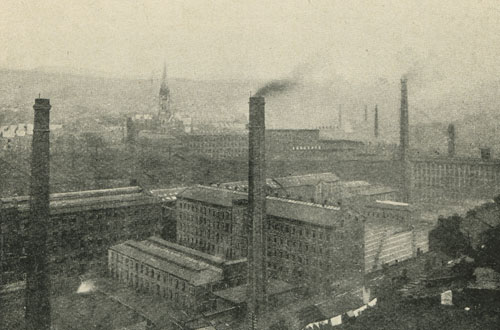
But of all the landscape’s features none stood out more than the town’s smokestacks, nine all together, brick middle fingers poking into the dingy Connecticut sky. Through my binoculars I could read the names in faded black and white down their brick sides, MALLORY, KNOX, SUTTON, BENNET, CROFUS & CORBET, MERRIMAC, LEE, CAVANAUGH, CAXTON-DUMONT. They rose taller than the town’s tallest trees, taller than the junior high school cupola, taller than the steeples of the Congregational, the Lutheran, the Episcopal, the Presbyterian—even the Catholic Church. Once those smokestacks darkened the sky with soot and prosperity; now only their shadows darkened the air, black shadows stretching across parking lots and playgrounds, bending over rooftops and car hoods, reaching into people’s back yards and bedrooms, creeping with the hours of the day, like the hands of a giant, gloomy clock.
As I scanned the landscape a blue shape entered my field of vision. A man walking. In itself this wouldn’t have been that extraordinary, except that in Bowler nobody walked, nobody of driving age who wasn’t mentally impaired or deranged or demented or damaged somehow or other. To be a grown man and walk in Bowler was to be a target of infinite and not very subtle conjecture, especially among us Back Shop Boys, who had nothing better to do.
The man wore blue coveralls and had a gray crew-cut and a beard. He walked with a limp using some sort of cane or walking stick. He crossed the bicycle seat factory parking lot. I watched through my binoculars as he walked into town and out of sight.