A Lake of My Own

Wednesday, August 1, Milledgeville, Ga. It’s about seven-thirty. I got up as usual at six, with the light from outdoors peeking in through gaps in my curtains and walked over to my desk at the perch of the loft, to look out through one of the two big triangular windows facing the lake, the surface of which is like brushed aluminum, but with a faint warm greenish-gray patina. This is my favorite time of morning, my favorite time of day, when the lake is like glass, a surface waiting to be inscribed, and the world is mute with expectation, with hope and promises.

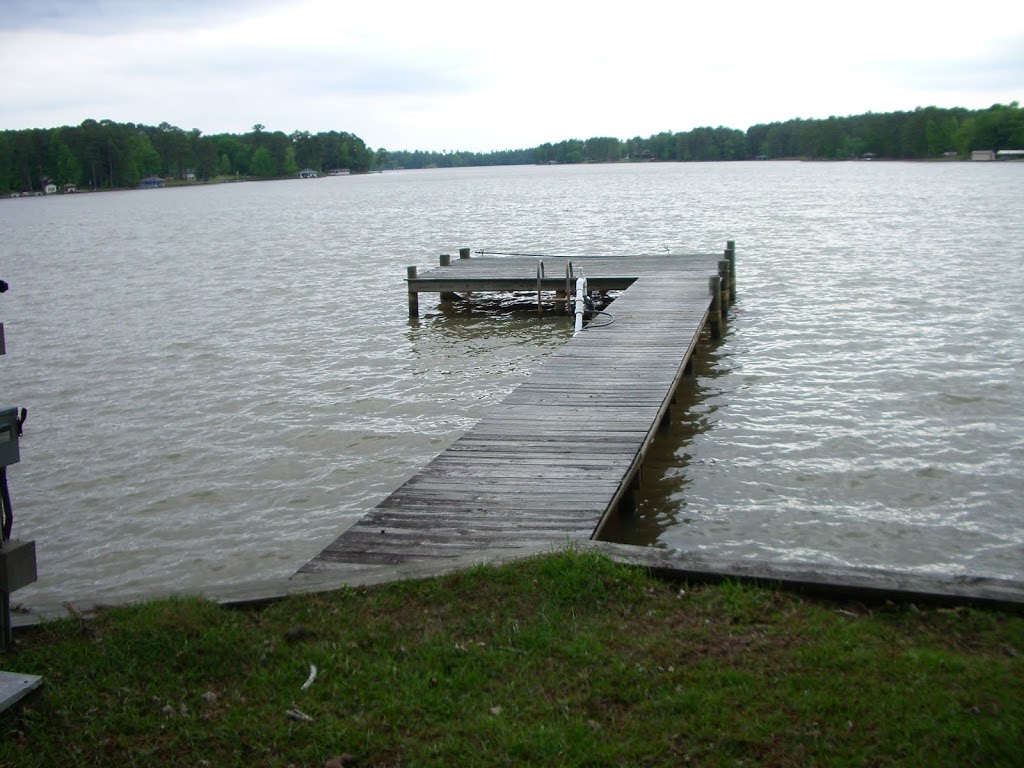
Sometimes I’ll begin the day with a swim out across the inlet and back, a distance of a little less than half a mile each way. I go down to the dock with my towel, goggles, and bright yellow swim cap. There’s a heavy wooden Adirondack-style chair on the dock over the backrest of which I drape my towel, then I snap on my cap and goggles and lower myself via a rusty ladder into the glassy, Coke-bottle-green water The spiders have been busy all night, spinning their webs across the ladder to catch May flies and other insects, and I do my best not to destroy their work, though sometimes it’s not possible, and I don’t care to jump in the water first thing in the day.

At that hour the water is warmer than the air. It feels almost like bathwater, with a thin layer of fog hovering over it. I paddle out to the front of the dock, sight my target—a stand of pine trees across the way—and head out doing a swift crawl, counting each stroke. I don’t know why I count, except that somehow it adds to my momentum and makes the way across swifter. Since I started swimming here three years ago, I’ve tried to count the exact number of strokes required by me to reach the other side, and have yet to do so successfully, since always, no matter how hard I try to concentrate, at around a hundred fifty strokes I lose track. The best I’m able to estimate is that it takes me somewhere between 180 and 200 strokes to cross, a figure that means little to me and will mean even less to you, though it does give me a way to judge my progress and choose, should I wish to, intervals at which to rest.

Since it’s early morning there are no boats out. One has to be careful about powerboats when swimming. Their drivers don’t always look where they are going. This is especially so when they’re pulling water skiers and also with jet skiers—that loathsome race of subhumans. It should come as no great surprise if someday I’m struck dead out there in the middle of the inlet by a jet skier, and yet I’ve already made my peace with that possibility, preferring it by far to death by automobile accident or heart attack or any other death on dry land. Even if at the hands of some moron on a jet ski still, let me die in the water, out on my lake.

When I’ve counted around 190 strokes I can be pretty sure that if I stop and put my feet down they’ll touch a soft, sandy bottom, and they do. Beyond the stand of pines there’s a modest dwelling, a cottage fronted with a screened porch. The grass there is overgrown. I have never seen anyone at or near the house, and suspect that its owners have put it up for sale. Meanwhile the shoreline between the pine trees is a favorite hunting ground for herons. Often, as I stand at one end of my swim, I’ll surprise a blue heron there, just in time to see him spread his great smoke-gray wings and alight into the pale morning sky. Once, a few days ago, I had a chance to watch one for a while—while he watched me, this queer, yellow-headed monster rising from the water. Then he beat his wide wings and was gone.

Then back to the dock, to my chair and towel. There is enough privacy out here most of the time so that, if I wanted to, I could swim in the raw. As it is, by Georgia standards, my skimpy Speedo (or its equivalent) is comparable to full public nudity (except at the Olympics I don’t think anyone down here has ever seen a grown man in a Speedo). However tempting it is, not wishing to risk an confrontation in with my neighbors, I stick to my Speedo.

Back at the house, having hung up my gear on a cast iron Victorian hanger screwed into the wall near the door, I put on my house togs—a pair of drawstring pants, clogs and a T-shirt—and fire up a pot of espresso. The stove’s electric, one of those flat-topped modern jobs in which the elements are invisible. Still, it works pretty well. There is also a microwave in which I simultaneously heat up a half-cut of milk—close to boiling, but not quite. With hot latte in hand I stroll down to the dock again. I never get tired of the lake and the dock. I have not yet entirely gotten over their immediate and constant presence here in my life and hope not to. They are the perfect means by which to greet the day. There are times, too, when in the midst of some dreary or tedious chore I will look up from my desk and out the window to see the lake waiting for me, spread out there in front of me like some eager and never satisfied lover, and I’ll drop everything to attend—sometimes grudgingly—to her wishes. The point is that the lake is always there, always willing, always inviting, and it seems a pity to deny it. Even in the rain sometimes I swim, as long as there’s no thunder anywhere. (Right now, writing this, I have to resist the urge to step away and tend to this other calling. I cannot be both writer and swimmer at once. I have to choose between duties and desires.)

It has been over two weeks since I arrived again here in Georgia, in my new home. The moving van pulled up on the 14th of July, Bastille Day, and today is the first of August. I am settled in, pretty much, but also unsettled. There’s the sense of having arrived in a place so perfect that the “arrival” feels close-ended, permanent, as if I’ve come not only to the end of my struggles but to the end of all worldly ambition. It has made me — not complacent, exactly, since a predisposition toward dissatisfaction and struggle is too deeply ingrained in me—but it has filled me with a morbid turpitude with respect to almost everything other than “putting my house in order”—a phrase chosen advisedly and in full awareness of its irony. There’s a sense in which perfection is like death, or—to put it the opposite way—in which the creative force is powered by the drive toward attaining that unattainable summit of perfection. We are inspired by what we hope to but can’t possibly achieve. This keeps us honest, restless, active, while keeping a distance between us and our ultimate destiny: death. To be satisfied is dangerous if not lethal. This is why the best artists often have such messy lives. Those little (and often not-so-little) bits of perfection achieved on canvas on with words are but countermeasures, temporary stays against life’s overwhelming and insurmountable losses and deficiencies. Yeats presents us with the choice between perfection of the art and perfection of the life: no, the poet says, we can’t have both. Here, on the shore of this lake, I feel as if I have achieved, or am in danger of achieving, a perfection of the life. Insofar as that is true I feel no desire to create. I feel arrived; I feel empty.

*   *   * 

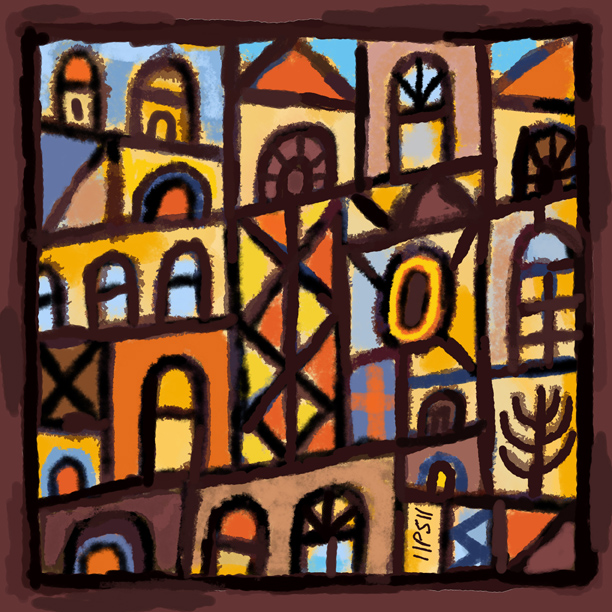
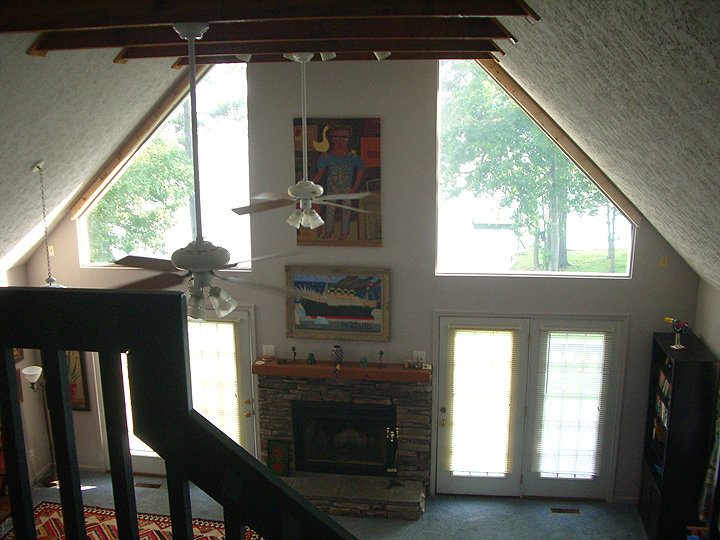
Still, there’s been work to do: putting “one’s house in order” is no mean feat, not when the house is a work of art. And so I’ve been painting walls. The other day I painted the bannister leading up to the loft, as well as the loft railing fronting my desk. For each of these I chose a different, complementary color: a deep sea blue for the bannister leading up, and an equally rich warm magenta for the loft railing. Like voices in harmony the two colors interact, gliding in and out (and over and under) each other. The walls under each of the railings I painted in correspondingly complementary hues: warm magenta under the sea blue railing, sea blue under the magenta railing, so the overall effect is no longer that of a two-part harmony but more like a string quartet, with two or three paintings hung on both walls adding human voices to the instrumental harmonies. On the central main wall, which rises up to the rafters, over the mantle of the stone fireplace I’ve hung two large paintings, a horizontal one of the Titanic in its fateful approach to the iceberg, and a vertical self-portrait of the artist, in splotched painter’s clothes, wielding his brushes and looking either angry or frightened. To both sides of these painting, in the narrow space dividing each triangular window from the French doors that open to the wooden deck, I’ve hung a set of wooden oars, complete with rusty oarlocks, bought from Ebay. A hand-painted Moroccan vase (an urn, really) sprouting dry eucalyptus twigs of various autumnal shades and centered on the wooden mantle piece completes the effect while scenting the room’s air with a faint odor of mentholated musk.

As for the rest of the room, which with its cathedral ceiling embraces dining room, living room, and kitchen, I’ve spread rugs (a vermillion and yellow kilim for the dining room, a blue and red druri for the living room) over the gray-blue carpeting, while in the kitchen teams of espresso cups of various styles and shades hang from hooks over and around the stove. There is still no dining or living room furniture; these are due to arrive in a week or so: a brown imitation leather sofa from K-mart, and plain, modest dining room furniture in a maple finish, and a two-tone black and cherry server (to go against the magenta wall under the sea blue bannister). Up in the loft, meanwhile, I’ve painted all but one wall butter-yellow, to contrast with the dark Guyanaian fabric drapes and a colorful Indian spread over an old maple bed that was left here when I moved in. I pushed my oak mission desk up against the loft perch facing the big windows, and next to it a two-drawer file cabinet. Since the pitched roof drops down to shoulder height at my right, I’ve lined the butter-colored wall there with a series of low “Verona” shelves, where I’ll store my works-in-progress, a dictionary, thesaurus, and other reference materials to be kept close at hand, as well as a small radio (since the one downstairs can’t be controlled by remote from up here). There are jars of pens and paper clips everywhere, and straw wastebaskets, and brass hooks. Atop the staircase I’ve hung three of my father’s charming slipshod paintings of Rome: one of the Piazza Navone, one a view looking down the Spanish steps, and one of St. Peter’s (there was a fourth painting in the series, but it was destroyed by water in a basement flood).

The last room apart from the basement is the master bedroom, which will serve as my guest room/valet and which I’ve painted the same butter yellow as the loft, with red curtains hung in its three windows, and tall stained shelves filled with books vying for space with the chest of drawers and a dresser. (The idea of putting bookcases in bedrooms first came to me when I visited the writer and historian Walter Lord, author of, among other things, A Night to Remember, the classic book on the sinking of the Titanic. Lord, who had Parkinson’s disease, could no longer broach the stairs in his apartment, and so they’d moved his bed into the library where he slept surrounded by ceiling-high tiers of books. Something about sleeping among so many books, in a library, appealed enormously to me. Ever since I’ve made sure to include bookshelves in my sleeping arrangements.) Since there was no room for it in the closets I screwed my tie-rack to the back of the guest-bedroom door.

And that’s it about my home, just about, except for the basement, which is unfinished but where someday I hope to create an art studio. For now, it’s where I store my art supplies as well as a dozen big cardboard crates stuffed with about a hundred and fifty paintings (the rest I’ve scattered around the house). With more lights strung in it and with its two sets of paned doors letting in some natural light along with a truncated (by the underside of the porch deck) view of the water, it will make a decent studio. The though of painting appeals to me enormously at the moment, in part if not mainly because I’m not writing, not wanting to write, not caring so much about words as about colors and shapes and arrangements of those things. Then again, as my friend the poet told me the other day, nothing is easier not to do than writing. It is the most avoidable of all tasks, and possibly the least natural. Illustrating the ineffable is, to put it plainly, a pain in the ass, a pursuit at the far—if not the furthest—end of our humanity, utterly at odds with our baser animal instincts. The hunger it satisfies isn’t a natural hunger, which may help explain why writers are always running to the refrigerator, or wanking off, or jumping in lakes—anything to relieve the “pain” of ignoring those appetites in favor of an appetite (if it can even be called that) that’s entirely artificial, entirely man-made. To the extent that such a hunger exists we’ve invented it to complement and augment our neuroses.
Posted in Dreaming on Paper, Uncategorized | Leave a comment

Writing vs. Painting

I’m a lucky man. I paint, and I write. The two blessings seldom visit me simultaneously; usually I have to choose between them, like choosing between two lovers. One of those two lovers is of a sentimental and playful disposition, brimming with joy, light, and sweetness; the other is dark, brooding, at times even forbidding. Although she smiles from time to time, her smiles are laced with irony and often with bitterness and despair. She can never stop thinking.

Before I ever started writing I was a visual artist. I say “visual artist,” though that’s too highfalutin a term for drawing pictures of ships and skyscrapers. It seems to me that I could always draw, from the very beginning, that I never had to learn, not really. I was born (so it seems) with the ability to “see” perspective; although my father tried to explain it to me in technical terms, he didn’t have to explain to me what I could very well see with my own eyes, that the rails of the train tracks converged at the horizon, while the tops of the telegraph poles grew shorter. Where other people saw straight lines I saw angles and curves. Not long ago, a well known writer tried to explain to me how, prior to the invention of the camera obscura, the artist Van Dyke could never have “gotten” the perspective of a chandelier in one of his paintings, that such things could only be grasped by the photographically trained eye, which in turn could only exist with the invention of photography or its equivalent. To this I thought (but didn’t say) humbug: in Van Dyke’s or any other time I could have drawn that chandelier.

I don’t mean to brag. My ability to draw is nothing to brag about. It’s just something I happened to be born with, the way some people are born double-jointed, or with perfect pitch. That said, I can’t deny the great joy that drawing has always given me, how often a pen or pencil and paper have rescued me from boredom and ennui (how would I survive those monthly university department meetings without my doodles?). When traveling, I’ve considered a sketchbook and watercolors as indispensable as my toilet kit, credit cards, and passport. Don’t leave home without them. There were times when, having set out to do a watercolor in the morning, hours later in the middle of the afternoon I’d awaken as if from a trance, my face sunburned, my back sore, having lost myself completely in my painting-in-progress. I count such hours the happiest of my life. The painter in the midst of his work is impervious to suffering. He or she is a truly happy person. I can think of no place I’d rather be than in the realm of constructive oblivion that is painting a picture.

There—in that realm bounded by four points on a single plane—I exert total, dictatorial authority; I’m in charge. I get to achieve something close to perfection, or at least to aim for it. Within that circumscribed realm no one else can tell me what to do, or whether what I’m doing is wrong or right. When it comes to painting, I consider myself above and beyond criticism. When people like my paintings, I’m pleased. On the other hand I couldn’t give a damn what the “experts” think. I already can guess that most “real” painters would find my work superficial if not entirely irrelevant, that they would dismiss my paintings as products of a technically proficient amateur, one entirely unversed in the protocols (and politics) of the academy, who doesn’t “get it.” Of course these days the very notion of an “academy” in art is frowned upon—especially by those who belong to it. Once, at a communal dinner at an artist’s colony on an otherwise deserted island in Maine, at a table full of conceptual artists (one of whom, I remember, was constructing a clock from the carcasses of dead lobsters) I dared to invoke Picasso’s name, eliciting jeers and head-shakes: did I not know that Picasso was “out”? “He’s just a painter,” one of the artists remarked disparagingly. Painting was Out; Dada was in. But they didn’t belong to any academy.

Never mind. I like to paint and I paint what I like. I paint to give and receive pleasure. When I mix tint into a gesso ground, when I size a board or a canvas, when I paint shape over shape, color next to (or into or over or around) color, when I thicken the paint to a heavy paste, or thin it so it runs and bleeds, when I add sand or ink or sawdust or chalk, when I scrape one color away to reveal traces of the color underneath, when I butt up a delicate line against a heavy form, or a heavy line against a delicate form, when I key the colors so close and low it’s as if they are whispering secrets to each other, until I add a splash from beyond their range, a high-octave red or a blazing yellow that adds a piercing scream to all those mumbles and whispers . . .  all done in the spirit of play, the spirit with which children make mud pies or build sandcastles on the beach. There’s no pain in painting, not for me. None at all.

I can’t say the same for writing. Writing hurts. It distresses me. You have to think when you write. (You have to think when you paint, too, but it’s a different kind of thinking, it’s thinking without words; it’s a purely physical process void of any language other than that of colors, textures, shapes, values—closer to dancing than to what writers do).

There are days when I wonder why, given a choice between painting and writing, do I choose to write? Why would any sane person, given that choice, choose that way? What on earth compels me to forsake the joyful realm of pigments and shapes for the stilted black and white universe of words and so-called “meanings”—when deep down inside all of us know perfectly well that, assuming meaning is to be found anywhere in life, language is surely the last place to look for it.

Why, then, do I bother writing?

The only answer I can give is that I write because writing is so hard, that the challenge of drawing (I use the word advisedly) meaning from words is irresistible precisely because it’s impossible, because after all words can only express thoughts, ideas, concepts, symbols—man-made and artificial things. Whereas paint is color; shapes are shapes; lines are lines; textures are textures. They don’t stand for anything (they can stand for things, but they don’t have to). As much as we take words into our hearts and love them for themselves, for the way they look and sound, in the end they can only stand for things beyond words. They are not the ends but only a means.

But then that ‘s what makes them so achingly beautiful. Because they are so difficult, so clumsy, such an inconvenient, inefficient means toward expressing feelings and creating beauty, like trying to build the Taj Mahal out of chewing gum and toothpicks. Pigments and grounds were given to us; we dug them out of the ground. Words we had to invent from scratch. As clumsy, inefficient, and inelegant as they are, for better or worse, words are the only medium we can truly claim as our own.

That makes them irresistible.

Posted in Dreaming on Paper, Uncategorized | Leave a comment

Yes You Can Go Home Again, More or Less

It is early morning and I am back. Back at my house on the lake. Back here in Milledgeville, where I lived three years ago. Back at my loft perch overlooking the blue-green water through big, triangular windows.

For four years I have been a nomad, living out of a few suitcases, moving from state to state, from New York to Georgia to New York to Florida. And now I’m back. I’m home. 
Here are my books on the shelves, here are my paintings on the walls. Here are my cups and saucers behind cabinet doors and hanging from hooks over the stove. Here are my pans and my potholders. Here are my rugs, my blankets, my towels. 
What is home if not a feeling? It’s both more and less than all the things that belong to us, and the place where we keep them. Isn’t it? And yet even with all my things gathered here, there are still parts of me “living” in other places, in other cities, in other states, in other worlds. Part of me is still in storage in the past; while another part of me books rooms in future motels. For sure there is such a thing as home but it exists simultaneously in many places, and we can never occupy them all at once, and so we always feel a little torn apart, a little unpacked, a little displaced, a little unresolved. 
Each day here begins with a swim. I put on one of three bathing suits (each with its own hook), grab my towel and goggles and go down to the dock. I greet the water. Hello, water. I climb down the rusty ladder. In the mornings the water surface is mirror-like and cool. I taste its sweetness against my lips. I swim out across the inlet. One-hundred and ninety-three strokes. I’ve counted them. 
When I get to the other side I stand in the sandy shallows. Often I’ll come upon a heron who does his fishing there on the piney shore, camouflaged by a tangle of gray roots. Once I came within several yards of him before he saw me–this strange creature with a yellow head rising out of the green water. His wings spread wide as he soared away. 
I keep three swimsuits so that one will be reasonably dry at any time during the day. 
And what do I have to say for myself now that I’ve arrived here at last, now that I’m finally “home”? What does it mean? 
I want to say I feel at home here, but what is closer to truth is that my loneliness feels at home here: that if I’m destined to be lonesome, then here is as good a place as any, maybe the perfect place.
Posted in Dreaming on Paper, Uncategorized | Leave a comment

“Midbrow in Paris”

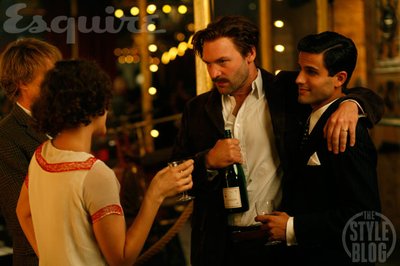
For some time people had been saying that Woody Allen had shot his artistic wad. For me this has been true pretty much since Annie Hall, a film whose aggressive clichés were tempered (if that’s the right word) by Allen’s colorful neuroses, adding some breaths of fresh air to what would otherwise have been a pedestrian boy-meets-girl / boy-loses-girl story. After Crimes & Misdemeanors, I stopped bothering with Allen’s movies: by then he was well into his serious phase, and already I’d made up my mind that the words “serious” and “Woody Allen” didn’t belong in the same sentence. However, based on the recommendations of some friends whose opinions I respect, and several strong reviews of his latest film according to which, apparently, he has broken a long string of mediocrities, I decided to give Mr. Allen another chance.

Alas, Allen’s latest project merely exposes his long-running fraud. For all its superficial innocence, Midnight in Paris is a deeply cynical movie, shameless in its exploitation of his die-hard fans’ wish to take Mr. Allen—and, by extension, themselves—seriously. When not indulging in it outright, Allen has made his long career out of either plunging headlong into or skirting around the edges of lampoon. Or—less charitably—out of fooling otherwise reasonable people into mistaking for art what is, at best, burlesque and (at worst) utterly derivative.

Midnight in Paris tells the story of a “hack” Hollywood screenwriter’s (played as well as possible by Owen Wilson) wish to write a novel and (paradoxically, given the vehicle that conveys him) to be taken seriously as an artist. On a visit to Paris with his wealthy fiancée, at midnight, by means of a chauffeur-driven yellow 1920 Peugeot, Gil is transported to the Paris of Fitzgerald, Hemingway, Stein, et al., to the “golden age” wherein Modernism was born. No sooner is this cute, clever, and extremely trite premise established than the movie descends (not that it has much altitude to fall from, having so far been nothing but a Cook’s slideshow tour of the City of Lights) into a hodgepodge of the most condescending clichés and stereotypes of that period, with Fitzgerald as Yuppie glamour boy, Zelda as air-head, Hemingway as pugnacious boozer, and Gertrude Stein as Bohemia’s answer to Aunt Bee.

As grotesque and insulting as these stereotypes are, in the hands of a better, less lazy auteur they might, at least, have offered some intelligent if negligible fun. Instead, by virtue of his miraculous carelessness, somehow Allen manages to render these characters not only trite and superficial, but stupefyingly dull. When not wielding a bottle of Calvados and spouting bad parodies of his own prose, Hemingway either invites his listeners on safaris or challenges them to boxing matches. Gertrude Stein, arguably the most brilliant literary mind of her generation, has nothing intelligent to say—but then neither do any of the characters (even Picasso, never at a loss of words in real life, finds himself utterly speechless, his hairdo doing all his acting for him).

But then—and though this is a movie about a man who finds himself transported to an age that, arguably, may have crowded more geniuses into one room than any other—except when gratuitously spouting familiar quotations (“the past isn’t dead; it isn’t even past”—Faulkner), none of the characters in this film ever speaks an intelligent word. The closest Allen comes to intelligence is pedantry, explaining why he’s most in his element when creating pedantic characters, like the fiancée’s paramour, Paul. Yet even true pedantry is beyond Allen’s supremely limited grasp. In waxing pedantic about Monet’s water lilies, the best our snobby expert can do is spout vapid chestnuts out of a undergraduate art student’s notebook about “closure” and the “roots of abstract expressionism.” Later in the film, the already trite premise having descended to a deeper level of triteness (with the characters transported to the Paris of Moulin Rouge and the Impressionists), pressed to arrive at the last “golden age” before the belle époque, the best that Allen (via Degas and Gaugin) can come up with is the Renaissance, as if the Enlightenment, among other “golden” epochs, never happened. But then a grammar-school mentality might not know about, let alone remember, the Enlightenment.

Some will argue that this is irrelevant to a charming, lighthearted comedy, but where is it written that to be funny, let alone “lighthearted” or “charming,” a movie has to be stupid? In fact, in any one of Owen Wilson’s recent comedies (and I include the Jackie Chan films) I guarantee you that you’ll find, in approximately proportionate amounts, not only more intelligence and less pretension, but more humor.

The sad truth is there is no intelligence in Midnight in Paris, which exploits and insults its viewers’ innocent wish—shared by the main character—to rub shoulders with brilliant minds. Instead, we brush up against wax figures stuffed with heinous clichés, the kind designed to comfort middlebrows of the lowest sort—those who want to seem sophisticated without having to sacrifice their familiar, superficial comforts, or face up to their limitations. Hence, Hemingway the drunk; Fitzgerald the playboy; Picasso the womanizer; etc. Bottom line: it’s okay to appreciate “great artists,” so long as its understood that they also happen to be bums and jerks. It’s a film custom-tailored to elicit knowing chuckles from latent philistines.

On one level I agree with the critics: Midnight in Paris isn’t another mediocre film by Woody Allen. It is, to quote Paul Fussell, Bad with a capital “B.” It is the worst kind of middlebrow art: that kind that passes itself off successfully as the real thing. Hermann Göring famously said, “When I hear the word culture, I reach for my gun.” From now on, whenever I hear the words “Woody Allen,” I will reach for whatever is left of culture, and hold on with all my might.

Posted in Dreaming on Paper, Uncategorized | 8 Comments