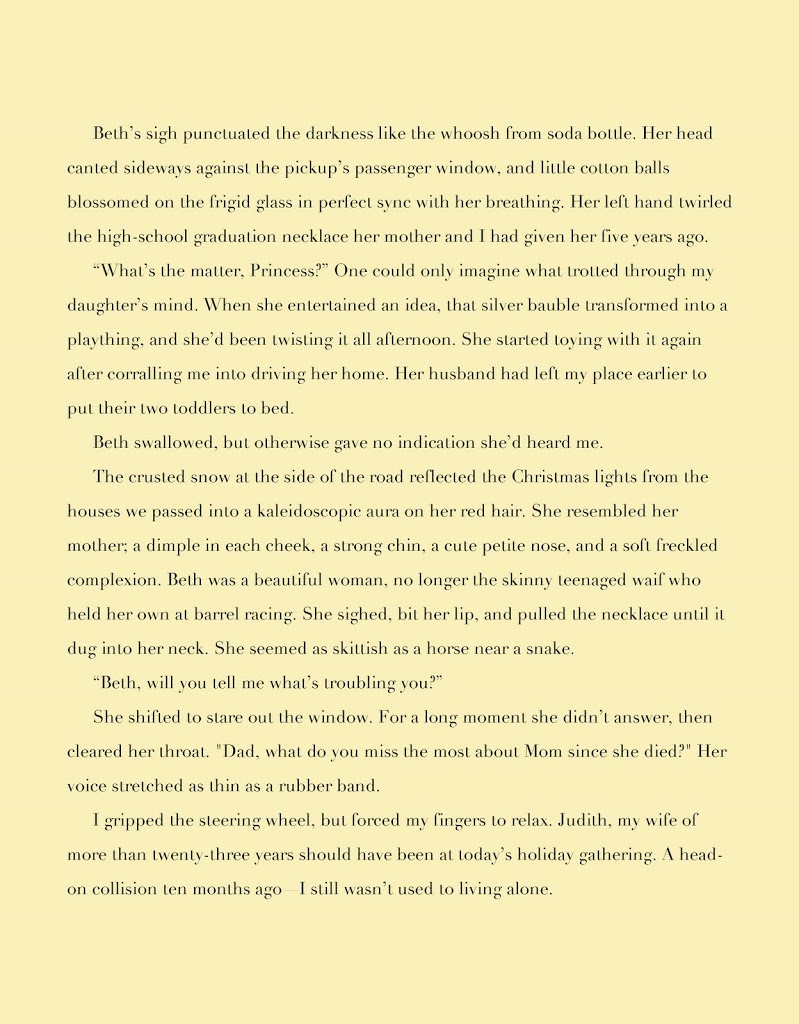
 Like most creative people I have a healthy distrust of rules. But when it comes to writing fiction there’s one rule I feel comfortable about giving to my students and applying myself: “Never state what’s implied.” The inverse (“Never imply what’s stated”) is as sound. But since a fiction writer’s purpose is to show and not to tell, the first version applies more. In this scene much that’s stated is implied.
A widower and his daughter, Beth, are bound for a holiday gathering—the first since Beth’s mother, Judith, died in a car crash. Something is bothering Beth. This is made evident to her father through Beth’s sighs and swallows, and by how she worries a necklace her mother and father gave her as a high school graduation gift five years before. At last her father asks, “What’s the matter, Princess?” To which after more sighing and shifting Beth replies, “Dad, what do you miss the most about Mom since she died?”
The central conflict here is so thoroughly embodied in that question that much of what comes with it feels redundant, an effort to dramatize what’s implicitly dramatic. The question isn’t merely the crux of the scene; it is the scene, and all the sighing and squirming and shifting is gilding the lily.
The passing scenery adds something; the snow and the Christmas lights give us the season and ground the situation in a solid setting. On the other hand, Beth’s description feels forced. From the narrator father’s point-of-view in the shifting darkness of his truck, he might note the play of lights on her hair, and see the neckless digging into her neck. But “Beth was a beautiful woman, no longer the skinny teenaged waif who held her own at barrel racing” is intrusive, more the words of Beth’s anxious author than of her concerned, driving father.
That description, like much of the content in this opening, teases suspense where none has been established; heightens conflict where there is no conflict. If, on the other hand, Beth’s query were to preceded such descriptions, they would then color and evoke Dad’s interior world as he drives and ponders.
“Dad, what do you miss most about Mom?”
We were on our way to the Schmucker’s Christmas party in my pickup truck when my daughter put the question to me . . .
Here, through squirms and sighs, the author has tried gamely to dramatize the daughter’s plight, when the drama expressed by her question belongs to the father who must answer it—and who awakens every morning to the answer.


