Ordering Chaos

Among a fiction writer’s greatest challenges: how to evoke chaos while still making sense. The phrase “making sense” here is key, since ultimately the question boils down to whose sense is being rendered.

If the chaos confronting the reader is genuine chaos as experienced by the point-of-view character or characters—as opposed to an inadvertent, accidental, and hence inauthentic chaos arising from the author’s lack of command over his or her materials—then that chaos is welcomed, or anyway not entirely pointless.

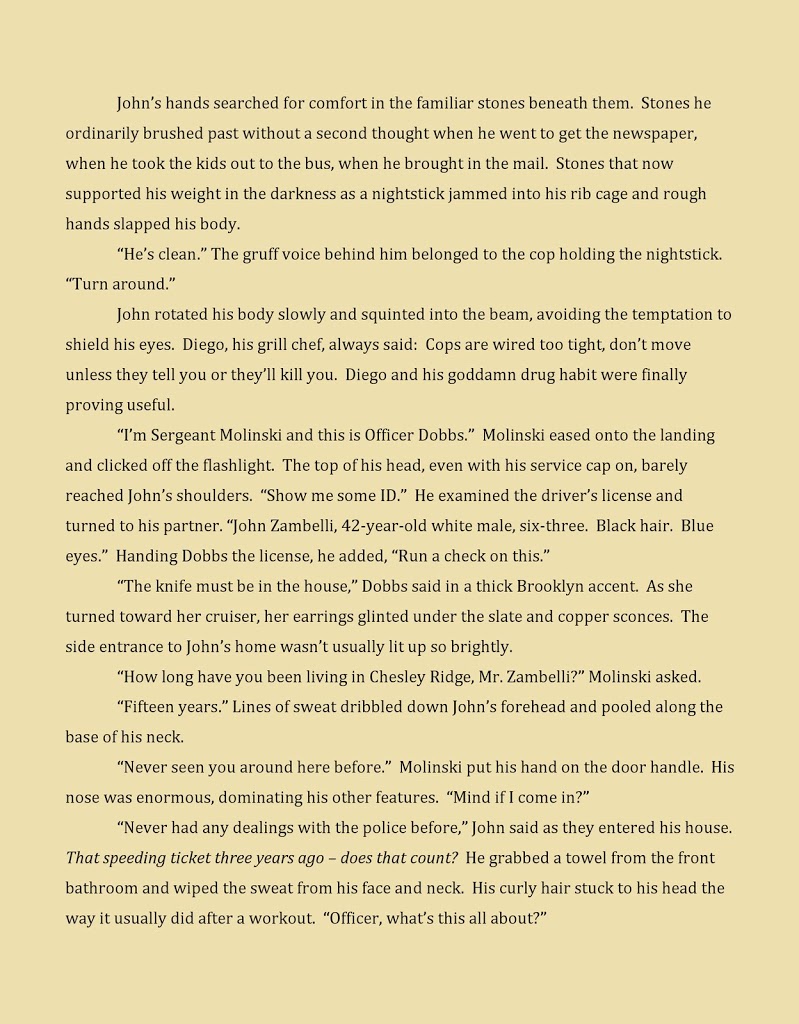
In the given passage, one evening on his way home John Zambelli is rudely met by police officers who are, let us say, disinclined to ask questions first. In its particulars the scene is convincingly and vividly rendered. We are treated to the “rough hands” and “gruff voice” of Sergeant Molinski as he frisks his quarry, who lies prostrate across the paving stones of his front walkway. As the Sergeant works him over, a second officer, a woman named Dobbs, jabs her nightstick into John’s rib cage. Satisfied that Zambelli is unarmed and having duly blinded him with a flashlight, the officers learn his identity.

All of this is presented clearly enough for me to furnish this summary. Yet in the passage as written there are small points of confusion. In the opening sentence, we are told “John’s hands searched for comfort in the familiar stones beneath him.” From this we reasonably conclude that he is either on all fours or lying flat on the stone path onto which he has presumably been shoved hard. Did John have a chance to see his assailants before they tackled him? Unclear. But a moment later, where the gruff voice says, “He’s clean,” we are told—from John’s point of view—that the voice comes from “behind him” and that it “belong[s] to the cop holding the nightstick.” It’s logical, then, to conclude that John has not only glimpsed his attackers, but is able to positively identify them as police officers. In fact he’s already done so, since in the first paragraph he describes the object being jammed into him as a nightstick as opposed to an unidentified blunt object.

Two paragraphs later, after John has “rotated his body slowly” to confront the officer’s flashlight beam, Molinski “ease[s] onto the landing and click[s] off the flashlight”, allowing John his first real glimpse of the cop, whose “service cap . . . barely reached John’s shoulders.” For this to be so the Sergeant would have to be very short indeed, considering that John still lies or sits on the ground.

These are small issues in a scene that, for the most part, is neatly written. The disorientation that has John Zambelli experiencing the “familiar stones” of his front walkway as alien objects now that they touch his hands rather than his feet is nicely observed. But however well established, John’s viewpoint isn’t followed through consistently such that we see, feel, hear, and touch as John does; so that his confusion makes complete sense, so that we know, for instance, that he is standing and not sitting or lying when he compares his height with that of his attacker. It’s a very small issue, but small issues like it add up and give way to larger problems: namely a lack of sufficient immersion on the author’s part in her viewpoint characters’ perspectives, and the attendant overall murkiness resulting thereof.

The difference between ordered and disordered chaos is one most readers may not notice, but they’ll still feel it. Since fiction’s goal is to convey experience, even a very slight mishandling of POV will result in an obscuring or dilution of the fictional experience. An orchestra needs a conductor. What’s being orchestrated in a work of fiction is the reader’s senses through those of her fictional character or characters. When POV is mishandled, the instruments keep playing their parts, but the symphony is discordant. If that analogy won’t do here’s another. Reading fiction in which the viewpoint isn’t perfectly handled is like kissing a beautiful person with bad breath. You still get the kiss, but it’s not the kiss that might have been.
Posted in Uncategorized, Your First Page | 5 Comments

A Rude Awakening

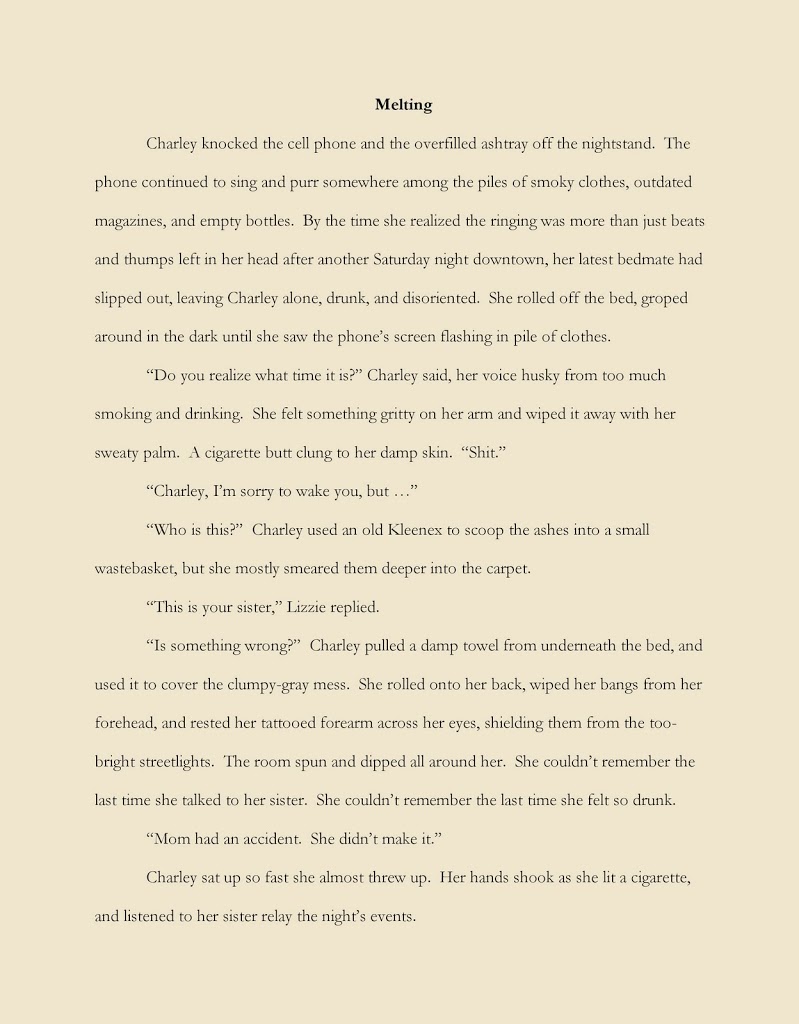
Deep into her alcohol-ridden sleep, a woman is summoned by the ringing of her cell phone. Phone calls deep into the night rarely portend good things, and the given scene offers no exception. Here, via her sister, the phone delivers the news that the woman’s mother has died in an accident.

The scene is rendered vividly, with loving detail lavished on both the condition of Charley’s bedroom (“among piles of smoky clothes, outdated magazines, and empty bottles”) and of her drunk (“The room spun and dipped around her”), disorderly, and disoriented body to which a cigarette butt clings.

But some of the vividness here works against the material by violating the author’s presumed intent: that of rendering this moment from deep within the mental state of her protagonist. I’m reminded of some American movies where the director feels compelled to “caption” everything with broad gestures such that intelligent viewers feel insulted. Here, the caption reads “Rude Phone Awakening,” and the scene proceeds to see too it that we “get it”—and we do, but what we get is more clichéd than need be, while the inclusion of certain details is more intrusive than organic.

Since the scene is written in close third person, presumably we inhabit the protagonist’s viewpoint. But in the same opening paragraph that has Charley wondering if the ringing she hears is “the beats and thumps left in her head after another Saturday night downtown,” we’ve already been told that the ringing is that of her phone. Later in the same paragraph we learn that Charley’s bedmate has “slipped out,” but in her freshly awakened state Charley can’t know this, or she can know it only once her senses have provided her with that information. The attempt to evoke a character’s subjective state is in conflict with the author’s wish that we readers should understand exactly what is going on. The author wants it both ways, and risks achieving neither.

The same disconnect between author and heroine invests the next paragraph, where Charley answers the phone with words that belie her disoriented state—or has she just looked at the time on her cell phone? We don’t know, nor do we hear through Charley the voice at the other end of the phone. Her sister and she have not spoken for some time; but wouldn’t she still recognize the voice? At any rate, even in her hungover condition, she would find it familiar. (It also begs the question: what were the caller’s first words?).

Other details—like the piles of clothes and bottles in the bedroom and the mounds of cigarette ash—likewise seem more the product of overzealous art direction than of a character’s sensory experience (contrast the first invocation of “piles of smoky clothes” with the later rendering of the same clothes by the light of the phone’s flashing screen—what the character experiences).

In an effort to pump-up an inherently dramatic scene’s atmosphere, mood and drama, the author forsakes her protagonist’s viewpoint, sacrificing authenticity, and serving up a Hollywood version of her scene. Less would be more:

While reaching for the phone she knocked down her ashtray.

“Charley—it’s Lizzie.”

Her hands shook as she lit a cigarette. By the phone’s flashing screen she saw the piles of clothes next to her bed.

“What time is it?”

“Mom had an accident.”

The room spun and dipped. Charley could not remember the last time she spoke to her sister, or the last time she’d been so drunk.

“She didn’t make it,” Lizzie said.

Posted in Uncategorized, Your First Page | 3 Comments

Waiting for the Abbot

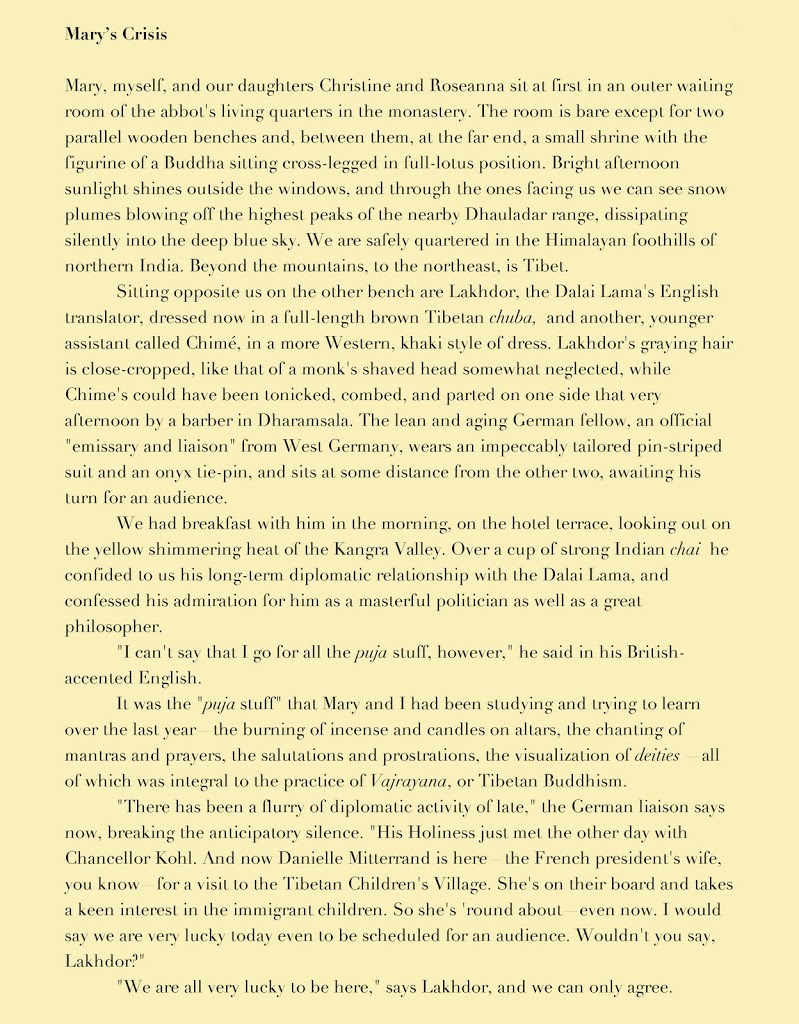
How do you generate drama or elicit any kind of interest—let alone excitement —from a scene the main action of which consists of a group of people sitting in chairs? That’s the challenge that the author of this memoir presents himself with. The story takes place in Tibet, where the author, his wife, and two daughters are visiting one of the monasteries in the Kangra Valley, presumably on a pilgrimage. They are not alone. With them in the abbot’s waiting room is the Dalai Lama’s English translator, wearing a “full length brown Tibetan chuba,” as well as a younger assistant, and a German “emissary,” an older man in a pinstriped suit. They form a motley crew.

This is hardly the first narrative to open with a scene of people waiting. It’s been done before, and to great effect. Norman Mailer’s first novel, The Naked and the Dead, opens with a group of soldiers waiting, essentially, to face death. They’re supposed to be sleeping, but

Nobody could sleep. When morning came, assault craft would be lowered and a first wave of troops would ride through the surf and charge ashore on the beach at Anopopei. All over the ship, all through the convoy, there was a knowledge that in a few hours some of them were going to be dead.

To make for an engaging opening, a “waiting scene” need not hold such high stakes. In The Disenchanted, another novel written in the same period, author Bud Schulberg presents us with Shep Stearns, a young, callow writer seated in the antechamber of Hollywood mogul Victor Milgrim, who, at long last, has called him to a meeting to discuss his next project.

It’s the waiting, Shep was thinking. You wait to get inside the gate, you wait outside the great man’s office, you wait for your agent to make the deal, you wait for the assignment, you wait for instructions on how to write what they want you to write, and then, when you finish your treatment and turn it in, you wait for that unique contribution to art, the story conference.

The rest of the chapter takes us back to Shep’s arrival in Hollywood six months before, and through those events that have led him to Milgrim’s waiting room. Eleven pages of backstory later, Shep finally enters Milgrim’s office.

And yet those pages—and the long wait suggested by them—are full of dramatic tension, since they inform us of what Shep has gone through to arrive at this point, and also what’s at stake for him. The rest of Schulberg’s brilliant but forgotten novel tells of Shep’s gallant efforts to keep Manley Halliday, a once great but fallen author (based on Fitzgerald) sober through their collaboration on a screenplay for Love on Ice, a college musical. Needless to say, Shep fails, and the rest of the novel chronicles Halliday’s hilarious but ultimately tragic descent into drunkenness and death.

The structure in this well-written memoir opening is similar, with the first paragraphs describing the pilgrims awaiting their audience with the abbot. But here, rather than take us through a flashback recounting the purpose and tribulations of their journey to this greatly anticipated moment, instead we are presented with a fairly innocuous breakfast meeting with the same abbot “on the hotel terrace” the morning before, in which “over a cup of strong Indian chai” the abbot boasts of his long relationship with the Dalai Lama, while dismissing as “all the puja stuff”— “the burning of incense . . .the mantras and prayers . . . the salutations and prostrations . . . ”—in short, the trappings of Tibetan Buddhism that the narrator and his family have come to Tibet to appreciate and study.

A “waiting scene” depends on having something to wait for. Here, the flashback fairly obliterates any tensions or expectations we—and the protagonists—might have entertained with respect to the anticipated meeting with the abbot. It lets the air out of the balloon, so to speak, so there’s nothing left to wait for.

It might be better to lead with the first meeting with the abbot, with anxieties and expectations still running high and not already discharged.

Posted in Uncategorized, Your First Page | 3 Comments

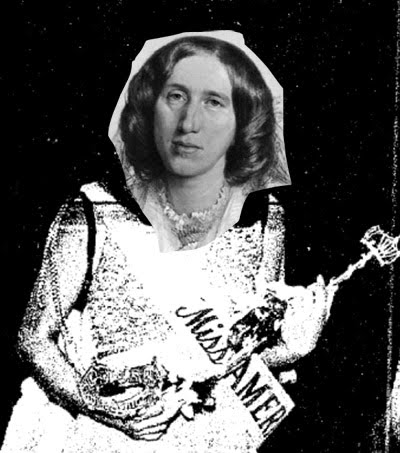
Miss Connecticut

She must have gotten on in Springfield while I slept. I awoke to find her sitting there next to me, wearing a zippered down coat and looking, as far as I could see, much too pretty to have landed there beside me on a stinking Peter Pan bus bound for Danbury from Brattleboro. I must have been twenty-two, twenty-three, something like that. 1980, or thereabouts.

As dusk settled on the tobacco fields and barns and crowded in on the tired bus, fusing together shapes in the dim cabin, we got to talking. I explained that I was returning from a visit with some of my high school chums in Vermont, all artists of one sort or another, all waiting tables or washing dishes. She with a hint of reluctance confessed to having been crowned Miss Connecticut a few weeks before, and being on her way to New York City, where she would spend three all-expenses-paid days at the Grand Hyatt hotel before boarding a plane for Miami to take part in the Miss America pageant there. Though in the darkness I couldn’t see it, I heard the smirk in her voice, along with a note of sad disbelief, as if she considered the whole affair ludicrous.

I myself had always thought beauty pageants silly, so why was I self-conscious sitting next to Miss Connecticut, as if she were a goddess or the Pope? In the darkness I imagined her in white taffeta with sash and crown, smiling for the cameras, her sparkling teeth throwing back the glare of flashbulbs. I cracked a bad joke about Bert Park’s dentures, to which she said, “Who?” betraying both our ages. We spoke of nothing for three or four miles before she turned to her book, and I to the dark window.

I wondered about physical beauty as applied to people. Is it really skin deep? Are physically attractive people not somehow superior to plain or ugly ones? I’d been reading Middlemarch, by George Elliot, and remembered her disastrous affair with the Darwinist Herbert Spencer, of his own conclusion that the end was a preordained by Elliot’s famous ugliness by her “heavy jaw, large mouth and thick nose”—qualities no intellectual attraction could redeem. “The lack of physical attraction,” Spencer admitted—bragged?—later, “was fatal. . . Strongly as my judgment prompted, my instincts would not respond.” I wondered how many potential lovers I’d never given the time of day to for similar reasons? Do believers read divine judgment in the distribution of beauty? What makes less sense than a contest where the participants exercise no skill, where the winner is determined by the performance not of the contestants, but of the judges?

The bus rolled on. And though it remained too dark for me to see her, and though I did my best not to be moved by the received wisdom of a silly contest, the more it rolled, the more beautiful my fellow passenger grew there next to me. Or maybe I’d been dreaming. Maybe she wasn’t so beautiful. Maybe she’d pulled my leg and had the face of a gorilla, or a lizard. But no, she was Miss Connecticut, and gave off the sweet, silent, secret, intoxicating essence of beauty.

By the time we pulled into Hartford she’d fallen asleep with her head on my shoulder. For the rest of the trip I didn’t budge. I was very uncomfortable, but felt like the luckiest man alive.

Posted in Dreaming on Paper | Leave a comment