The Year of 14 Jobs

One of the hallmarks of good writing is its power to suggest. This is true not only for poetry and fiction, but for works of nonfiction, too, for essays and memoirs, even sometimes for journalism. Conclusive statements may or may not always convince us. But when authors provide readers with the raw, visceral evidence from which such conclusions may be drawn, allowing us to reach them on our own, then the conclusions are a lot harder to argue with, since the only person we have to argue with is ourselves.

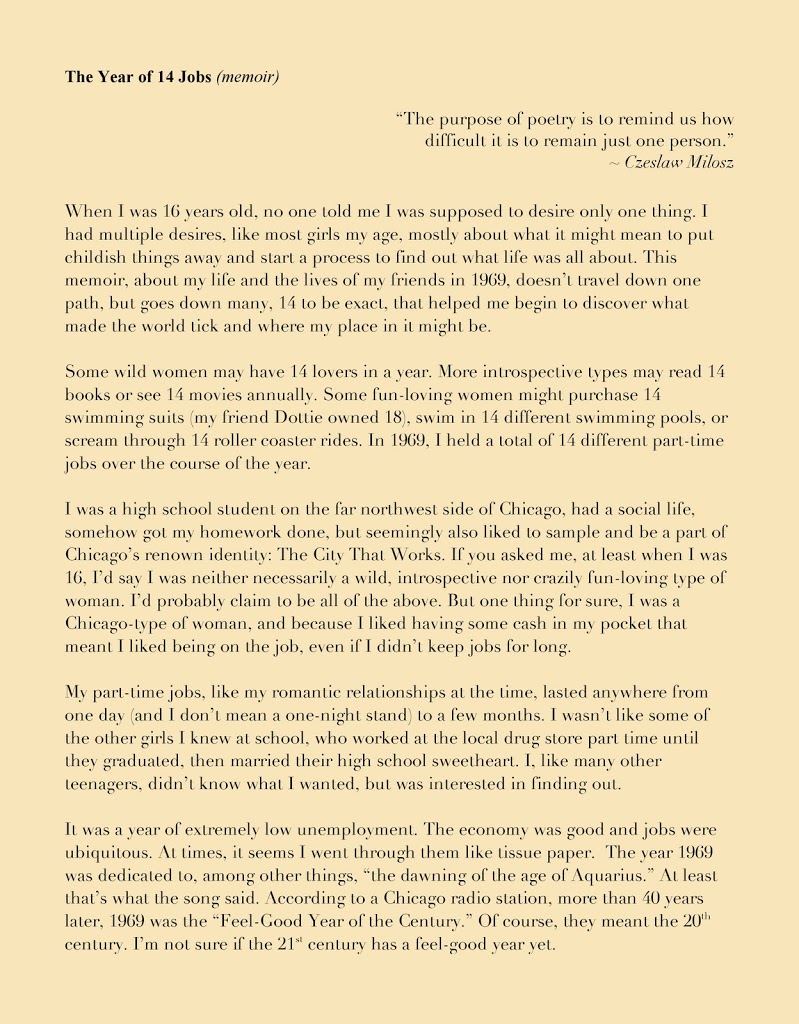
In this opening passage from a memoir-in-progress about a year in a woman’s life, everything is stated, and little if anything is implied. We are told, among other things, that during the course of that year she held fourteen jobs:

Some wild women may have 14 lovers in a year. More introspective types may read 14 books or see 14 movies annually. Some fun-loving women might purchase 14 swimming suits (my friend Dottie owned 18), swim in 14 different swimming pools, or scream through 14 roller coaster rides. In 1969, I held a total of 14 different part-time jobs …

The last sentence here (“In 1969, I held a total of 14 different jobs”) states the memoir’s central subject, which the passage as a whole puts into perspective, or tries to, with its series of obsessed women. At the same time the passage highlights the uniqueness of its subject: how many people do you know, male or female, who in the course of one year have held fourteen different jobs? On the whole the paragraph is well-written. It has the cumulative power of many such parallel constructions (“It was the best of times, it was the worst of times”. . . ). And it offers us something irresistible: an eccentric, struggling heroine.

Yet somehow the passage, and the opening as a whole, fails. The author seems less intent on dramatizing her material than on positioning and arguing for it, telling us not just what she has to offer, but why we should care. Because in a year other people may have fourteen lovers or fourteen books or fourteen bathing suits. But other people don’t have fourteen lovers. Which may or may not be true (you see how easy it is to argue with such statements?). And even if it’s true, do jobs compare with lovers—let alone with books and bathing suits? But even accepting the logic of the argument, it remains to be seen whether that argument justifies a memoir.

But analogies aren’t the point; the point is, or should be, that in a given year a young woman held fourteen jobs.

That point, or something like it, provided Charles Bukowski with the subject of Factotum, his second novel. It follows Bukowski’s alter-ego, Henry Chinaski, from one dreary, degrading, menial job to the next after he has been rated 4-F by the armed services and thereby exempted from serving in World War II. The novel consists of 87 brief passages or chapters, and an equal number of crappy jobs. The first passage begins:

I arrived in New Orleans in the rain at 5 o’clock in the morning. I sat around in the station for a while but the people depressed me so I took my suitcase and went out in the rain and began walking. I didn’t know where the rooming houses were, where the poor section was.

I had a cardboard suitcase that was falling apart. It had once been black but the black coating had peeled off and yellow cardboard was exposed. I had tried to solve that by putting black shoepolish over the exposed cardboard. As I walked along in the rain the shoepolish on the suitcase ran and unwittingly I rubbed black streaks on both legs of my pants as I switched the suitcase from hand to hand.

So begins Bukowski/Chinaski’s descent into the underworld of unemployment, with him cast to the very lowest circle, that of the unemployable. Note how, in opening his novel, Bukowski states nothing. He doesn’t announce his intended theme, let alone make a case for it. Nor is there any intent to force perspective on us before we’ve been presented with any matter (scenes, events, experiences) to put into perspective. Instead what we get here is the matter itself: a down-at-the-heels guy in search of a rooming house in the rain, whose search will soon turn to one for gainful employment. Meanwhile his luck, like the black shoe polish on his suitcase, is already draining into the gutters.

My suggestion to the author of this memoir is that she begin similarly, with concrete matter rather than with abstract statements. In due time we will learn that her fourteen jobs “lasted anywhere from one day . . . to a few months,” just as we will learn that the memoirist “wasn’t like some of the other girls [she] knew at school who worked at the local drugstore.” Such facts are best learned through experience. And the proper goal of the memoirist, no less than that of the novelist, isn’t to present information, but to render experience.
Posted in Uncategorized, Your First Page | 2 Comments

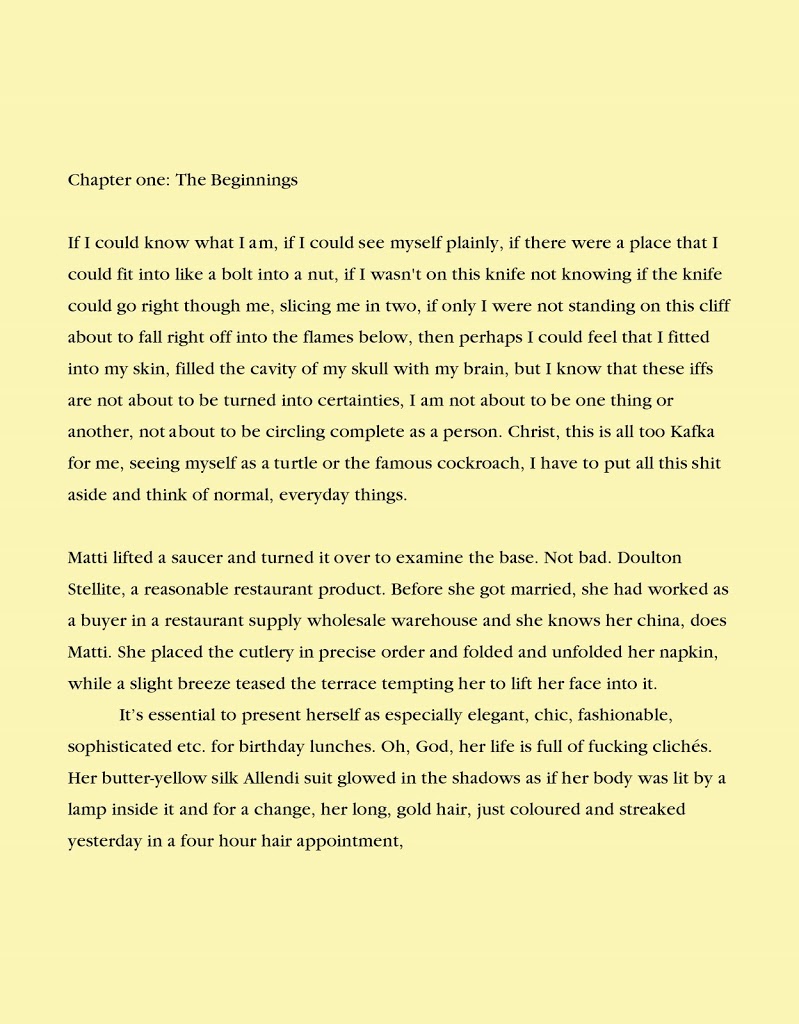
An Opening at Odds With Itself

Within the eight lines of its first paragraph, this opening scene presents readers with a melange of no less than ten metaphors for the narrator’s frustrated desire to belong fully to something, to “fit in.” The writing is passionate, poetic, full of spit and vinegar—but what is it for?

“If I could see myself plainly,” the narrator laments at the inception of this hyperextended metaphor, then proceeds to describe her spiritual condition in terms of a nut in a bolt, a knife blade, a cliff’s edge (overlooking flames), an empty skull, and something that “circles.” Having thereby exhausted nearly every available metaphor, she throws her hands in the air, declares the whole affair Kafkaesque, tosses two more metaphors our way (one reptilian, one insectine), and then abandons the whole metaphoric charade in favor of “normal, everyday” thoughts. Some readers may wish that she’d done so sooner. Whatever else it achieves, this opening paragraph convinces us, if we needed convincing, that, indeed, the narrator cannot see herself clearly.

But the real purpose served by this opening and others like it that I encounter often in novice works may be even more basic. Stated by means of another serial metaphor, it’s to get the author’s pen rolling, to blow some warmth onto the icy blank page, to get the narrative blood flowing. Others less charitably inclined may call it “throat clearing.” In any case, it should probably be cut: all of it. It’s there for the author, not for the reader.

The real beginning starts with Matti inspecting a piece of restaurant china at an event, a birthday lunch. Perhaps she’s an event planner of some kind. We don’t know, but she has a vested professional interest in the affair at hand and its dinnerware. To be sure she is dressed to the hilt in her Allendi suit that “glow[s] in [its] shadows as if her body was lit by a lamp inside it”—making me wonder how much it glows in its shadowless regions.

Here the writing is comprehensible and much more effective. Still, we don’t quite know what’s going on; we can only guess. And some information provided seems misplaced. Do we really need to know that, before she married, Matti worked as a buyer for a restaurant supply wholesaler? Maybe, but within the context of so much more that remains unknown, that bit of information seems more coy than generous, more tease than enlightenment. Most readers would prefer to know who Matti is and what she’s doing, rather than who she was and what she did.

In the final paragraph again the author seems to throw his hands in the air (“Oh, God, her life is full of fucking clichés)—a comment that doesn’t seem to attach itself to anything, unless birthday lunches are a cliché, or Allendi suits, or certain types of restaurant china. But my guess is that the charge of “cliché” is a preemptive strike by the author against her own material, as if by the end of this first page she’s grown disenchanted, and declares defeat even before the first battle lines have been drawn. In each of the two sections that pattern is more or less repeated, with the author undertaking a bold initiative, then questioning it, then renouncing her kingdom before the reader has even had time to engage in hostilities. The author is her own worst critic.

All this may result from jumping into the writing prematurely, without proper preparation (like knowing, for instance, what the story is about), thus ending up like the actor in his nightmare, naked on the stage with no script.

Posted in Your First Page | Leave a comment

The Season of White Flies

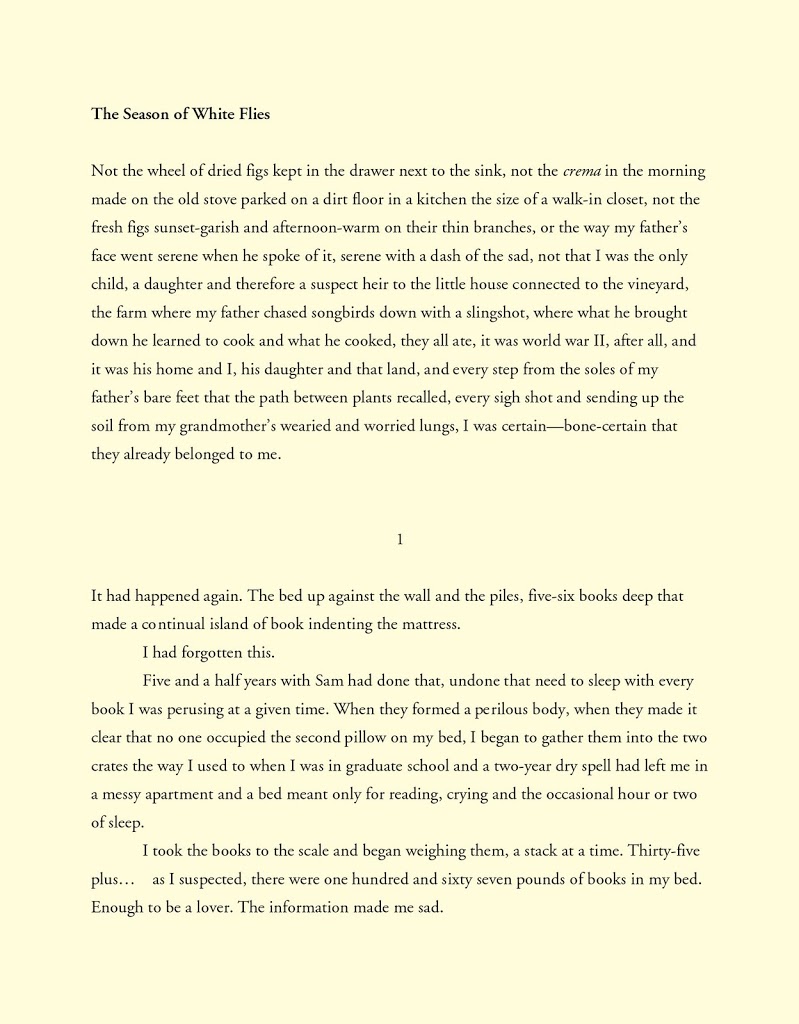
The first part of this opening of a novel confronts us with a host of negations bound by tortured syntax. Briefly, it tells us what the narrator, an only child, will (or won’t: see below) inherit from her (Italian?) farmer father.

For all its twists and tangles it’s an alluring passage, attractively written, with Biblically incantatory rhythms out of the Song of Solomon. Indeed, the set-piece passage, which serves more as an appetizer to the story at hand than as the main course, reads like a prose poem. Not the wheel of dried figs kept in the drawer next to the sink, not the crema in the morning made on the old stove parked on a dirt floor in a kitchen the size of a walk-in closet, not the . . . The temptation to keep quoting is strong; the words having the tug and energy of a strong tide. Like most good songs they seduce by their rhythms even when their meanings are difficult or obscure. Poets can get away with that, I suppose.

Then again, as Ezra Pound once said, “Poetry to be good poetry should be at least as well written as good prose.” (Pound also said “No verse libre for the man who wants to do a good job.” He said many good things, this poet who was tried for treason during WWII and kept for 25 days in a steel cage.) Based on Pound’s dictum one may take issue with this opening passage, since—though it succeeds as prose-poetry, fails at the level of prose. It fails for being at best unclear, at worst contradictory. Is the narrator inventorying those things that she feels “already belong” to her, or those that will not?

There is more than a bit of confusion at work here especially in the opening paragraph’s final clauses, which take us back to the same war that had Ezra spouting anti-Semitism on the airwaves, when the narrator’s father “chased songbirds down with a slingshot”—birds that “he learned to cook and what he cooked, they all ate”—”they” referring, presumably, to his family, and to the narrator (“it was his home and I, his daughter and that land”)—though on the other hand it strikes me that the narrator has yet to be born, that these are not her own memories but communal ones of her father, passed down to her by others. And thus the steps “from the soles of [her] father’s bare feet”—those of the boy with the slingshot—trod a path through the woods that in turn recalls. . . the father’s feet! This bit of poetic feedback gives way somehow to one of a grandmother’s “worried lungs” sending or shooting up their “soil” along with her sighs. By soil we may infer catarrh or something more sinister—chunks of the lungs themselves. It’s not at all clear, and I for one lack confidence that the confusion is mine and not the author’s. Of Wagner’s music Mark Train once quipped, “It’s not as bad as it sounds.” Of this passage I would say it’s not as good as it sounds—and it sounds very good. Its sweet music and sharp imagery are undone by sloppy syntax.

The second section of this opening is similarly compelling, and similarly challenged. Here the image is the singular one of a bed groaning under the weight of books that have displaced a romantic partner. The books are being gathered by the stack and, for reasons unspecified, weighed. Apparently, they have accumulated in the wake of a dissolved love affair or union. But here too a disregard for literal meaning in the name of poetry creates confusion and disorder where none is called for.

The scene opens with the bed groaning with books. The words “It had happened again” point to a sudden, unanticipated event, where in fact the books have accumulated over time. The next, one-line paragraph (“I had forgotten this”) suggests that the narrator has come upon this scene from a distance of time or space. From there we move to a mini-flashback of life with Sam, the narrator’s partner, with whom the need to accumulate books was “undone.” But the rest of the paragraph belies this topic sentence, telling how “when [the books] formed a perilous body” the narrator began to gather them (“. . . as I used to when I was in graduate school”). Thus we have three beds full of books to grapple with: the one before Sam, the one after, and one back in graduate school. Question: which bed are we lying in here, now?

Come to think of it, syntax has something in common with bedclothes. Though the author makes the bed, we, his readers, must lie in it.

Posted in Uncategorized, Your First Page | 2 Comments

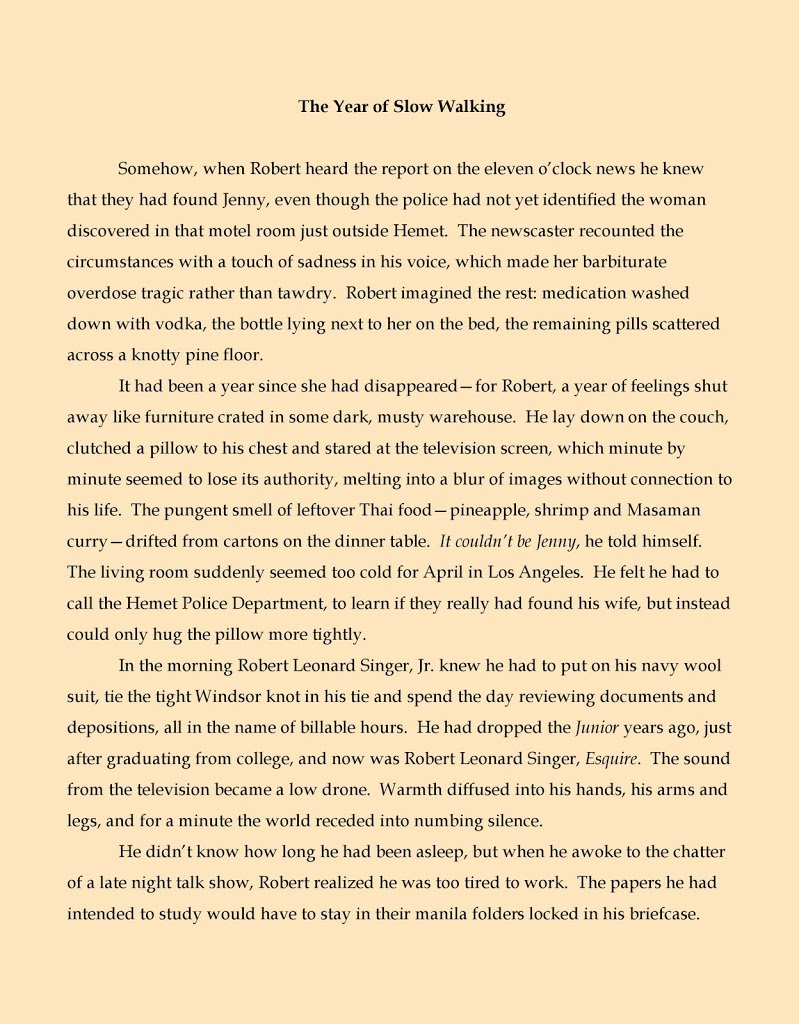
Discovering Jenny

While watching the evening news, a lawyer—Robert Leonard Singer, Esquire—learns of a woman found dead in her motel room, the apparent victim of a drug overdose. Authorities have yet to identify the victim, but Robert thinks he knows who she is. In fact he’s sure.

Her name is Jenny, and she disappeared a year before, “a year of feelings shut away like furniture crated in some dark, musty warehouse.” From this we infer that Robert and Jenny were close—involved in an intimate affair, perhaps, or a fling? At the next paragraph’s end we learn that Jenny was his wife.

Whatever relationship he had with Jenny, we know her disappearance—and now her apparent suicide—have both affected Robert deeply. Overcome by his emotions, or benumbed by them, he collapses onto his sofa, hugging its pillow “tightly” as the evening news murmurs on and the smell of leftover Thai takeout drifts his way from the dining table. Instead of attending to the dispositions in his briefcase, Robert drifts off to sleep. The page ends with him waking “to the chatter of a late night talk show” still in a torpid state and unable to work.

Though the events conveyed by this passage are sensational—a woman’s unexplained disappearance, the sudden discovery of her body in a motel room, her apparent drug-overdose suicide—the opening scene itself is as torpid as its main character. Robert listens to the evening news, lies down on his sofa, and goes to sleep. That’s an accurate if skeletal summary of the “action” here, such as it is. And though Robert’s descent into indolence is, presumably, triggered by grief, one gets the feeling—I do, anyway—that even on his best days Robert is not exactly a man of boldness and energy—witness the takeout cartons on his dinner table. He seems to have been depressed long before he switched on the television news. The news of his missing wife’s death plunges—though that may be too active a verb—him into a deeper indolence, one that, on the emotional altitude meter, drops him from something like two feet down to one and a half: not exactly an ear-popping descent.

But Robert’s emotional torpor goes beyond numbness into oblivion, to where, moments after learning of his wife’s death, having decided at some point to call the authorities and verify things, his thoughts wander to getting dressed for work in the morning, to tying “the tight Windsor knot on his tie and spend[ing] the day reviewing documents and dispositions.” From there his thoughts drift even further away, to a contemplation of his name, from which he has recently shed the “Junior” and replaced it with “Esquire.” But what in blazes has any of this to do with the shocking news of his wife’s dismal suicide? Nothing—which may be the point. We are witnessing the extent of Robert’s disconnect from his emotions. We’re dealing with an unhinged personality, with a man losing, or having already lost, part of his sanity to grief.

But since Robert’s feelings—along with that measure of his sanity—were already “shut away like furniture . . . in a dark, smutty warehouse” what we’re met with here is the spectacle of his musty, crated feelings sprouting a fresh layer of mold and mildew. And watching mold grow isn’t very exciting, even when the mold is fertilized by dramatic, sensational events.

Posted in Uncategorized, Your First Page | 4 Comments