Pure Flux: The Author Revisits His Murdered Darlings

Like Depression-era mothers, we fiction writers hate throwing things away. Instead of hoarding used Saran Wrap and dunked tea bags for rainy days, we squirrel away used words: titles, phrases, sentences, paragraphs—sometimes whole chapters or scenes—stuff that never made it into our finished stories or novels, or made the first cut only to be excised during the ruthless process of revision. Some of mine:

Story idea: A letter written from a far-away planet, in every sense an ordinary correspondence but with occasional passing references to alien weather, flowers, fauna, etc. A romantic letter from a lover in outer space.

Campaign against public buses masquerading as trolley cars.

Dust settled onto the knick-knacks, on the lids of canned fruit and tomatoes, on the brown shoulders of the gallon bottle of Taylor Cream Sherry, into the nooks and crannies of doilies, the braids of the rug, the folds in her Japanese fans, the slats of her blinds, the gold-pocked fabric covering the speaker holes of her brown Phillip’s radio, made of brown Bakelite.

Park Slope yuppie talk: “We’ve kept the grand ballroom intact and we have a library.”

Woman wetting dry dog’s nose.

The injunction telling us to “murder [our] darlings” says nothing about where or how to dispose of the bodies. And so many of us do with them more or less what Norman Bates did with his mother. Stuffed into sagging shelves, tucked into file folders and notebooks—reams of dead inspirations on yellowed paper, to be perused during fits of writer’s block, as if somehow our own dead words might spring to life and rescue us from artistic decrepitude.

WASP eating habits: potato salad, macaroni salad, borcht w/ yogurt, Russian salad. Mayonnaise fetish. Arterial sclerosis.

“Be careful going down those stairs.” Lights turned on and off. Sort of house people get murdered in. Smell of basements. Dust and debris. People who never throw anything out. “When it doubt, throw it out.” You can learn a lot about people from their basements.

Mr. B’s wife’s former husband Congressman.

Titles of books put on shelves. June suspects him of stealing book; sees it in his shoulder satchel; he thought Mr. B had lent it to him.

Jan. 21, ‘04—at Wave Hill (post being stood up by J —):

  • A biography (D. Schwartz)
  • A loose but nonetheless satisfying bowel movement
  • The sun striking the Palisades, heralding an icy walk home
  • The search among long shadows for my own; for a way to be in this world from which I’ve fled, or has it fled me?

Tell me you’ve never had so little faith in your power to generate new words that you’ve gone, in despair, after the old ones like a kid prying chewing gum from the bottom of a church pew. Tell me you’ve never been so creatively down at the heels that you’ve gone slumming in your own refuse heap for an inspirational bone or two. We’ve all done it, all of us who justify ourselves by filling pages with words. We excavate our verbal compost heaps in hope of finding a fresh carrot or potato growing there, and turn up nothing finer usually that orange peels, sodden coffee grounds, egg shells.

Yet sometimes amid the rinds and refuse a glimmer catches my eye. I’ll read a sentence with curiosity, admiration even, finding it full of surprises and delights, fragments equivalent to unpaired socks, and as useless.

X spilling his salad dressing, blaming the world for his clumsiness, cultivating his phobias like a squirrel hoarding nuts

I have never been enlightened in my life, not for a day, or an hour, or even a minute. Wisdom is not something that sticks to me.

When do we get to be artists?

“The frilly skirts of waves teasing the shore.”—Nabokov

Blue of:

  • —cheap cigar smoke
  • —blue whales
  • —distant mountains
  • —Siberian Husky eyes
  • —cardiac arrest
  • —frozen winter nights
  • —faded color movies

Black of:

  • —black holes
  • —subway grime
  • —metal stained fingers
  • —rubber bullets
  • —tarnished silver
  • —dried blood
  • —missing teeth
  • —wet streets at night
  • —eclipsed moons
  • —electrical tape

I dreamed of the plotless novel. Miller, Becket, Genet, Joyce, Durrell—all wrote plotless books. Why not me? Why bother with all the grim determination when great writers have shown that it can be done without? Prompting the following faulty syllogism: a) “Tropic of Cancer is a great novel.” b) “Tropic of Cancer has no plot,” therefore c) “To write a great novel, simply dispense with plot.”

Ergo, Pure Flux, the working title of my plotless book. Not only would there be no trace of plot, there’d be no characters, so settings, no scenes, no useful information, and few if any worthy ideas, nothing of psychological, historical, scientific, or social significance. A pure book, unsullied by such things, consisting entirely of fragments detached from whatever meaning[s] they might have had within a given context—as pure and without external reference as, say, an abstract expressionist painting. Archibald McLeish wrote, “A poem should not mean but be.” My novel would mean nothing and furthermore be unrelated to or representative of anything above, beyond, or outside itself, the verbal equivalent of a Rothko or Richard Pousette-Dart.

“Like trying to preserve soap bubbles.”

All these people who think water will save them.

He breathes rare air.

Beckett counting his farts.

He lay splayed on the rock with his eyes closed, the noon sun painting abstract masterpieces under his eyelids. The sun warm, the air cool, no sound but the wind through the trees, the honking of geese, a distant dog bark.

I feel this close to being an artist.

So long as things are in flux, everything is possible. As soon as they solidity all the bright possibilities turn to gray stone.

At the Mercantile Library. The dust and silence settle like a cloak on me. Tunneling mole-like through the cool, dusty stacks. Librarian’s relationship with mother. Toward the end: infrequent visits and long afternoons of poker. Phone calls with reports of the latest deaths. First baby sitter, etc.

“It was evening. I had just crawled out of the shelter for my evening guffaw and the better to savor my exhaustion.”—Beckett, Malloy

“When you lay in the grass you were under the azure map of clouds and sailing continents, you inhaled the whole geography of the sky.”—Bruno Schultz

Tsvetaera: The Noise of Time

For sure I wouldn’t be the first to write such a book. Henry Miller did it with Tropic of Cancer —a book by turns shocking and dull—much duller now that I’m no longer eighteen and in love with audacity. Yet Miller’s book isn’t without ideas. It’s deeply misogynistic, for starters, vile in its assessment of all things human, and especially hard on those to whom the starving author held a hand out. And there are scenes in Tropic of Cancer, and characters, too—surreal scenes and caricatured characters based on the men and women to whom the starving author owed his sustenance. A gob of spit in the eye of God, Miller calls his book, but this serves him too well; it’s more like a bucket of bile spewed up by Miller in gratitude to his benefactors.

But long before Miller spewed his bile there’d been plotless masterpieces, Huysman’s A Rebours (Against the Grain or Against Nature, 1884), for instance, with its garden of poisonous flowers, mouth organ of chromatic liquors, and banquet of all-black foods (olives, caviar, blood pudding). But Huysman’s book is very much about something: fin-du-siècle decadence. And what it lacked in plot, characters and drama is more than made up for with its tour-de-force set-piece descriptions. My plotless masterpiece would go further, dispensing with narrative altogether.

By that measure at least two other novelists—if you can call them that—came closer. One of these was Fernando Pessoa, the Portugese poet who, when he died of cirrhosis in 1935 at age forty-seven, left behind a trunk full of unpublished writings, thousands of pages of poetry and prose scribbled mostly on loose scraps of paper, and attributed to a retinue of imaginary characters or heteronyms, each with his own biography, including one Bernardo Soares, whose temperament most closely matched Pessoa’s. Pessoa credited Soares as the author of his planned but never completed Book of Disquiet (Livro do Desassossego), a “factless autobiography” consisting of most if not all the prose fragments found in that trunk arranged. To the extent that a “book” exists at all it exists thanks not to Pessoa, but to his editors and translators, who compiled and collated his fragments, and the publishers who bound them between covers. In spite of which The Book of Disquiet remains a fragmented, arbitrary, and redundant performance, unified by its author’s obsessive love affair with ennui. Strip away the biographical baggage—Pessoa’s and his heteronyms—and what remains is a sort of compendium or commonplace book of tedium, and more than a little tedious itself.

X’s sight diminishing. Reads to us more of his “Melanoma Notebook.”

Christmas Eve

Title: Damn it all to Hell

Cupcake Monologues: jokes about cupcakes.Differences between cupcakes, muffins, brioche, etc. discussed. Muffins as renegade or reformed cupcakes: puritan, Episcopal cupcake. Lutheran cupcakes. Purged by the Inquisition. Hidden by the Dutch under floorboards. Do you know the Muffin Man? And did he really wake up so early in the morning? Brother asleep on couch, downing aspirin, in constant need of analgesics, always in pain. “Do you mind if I lie on your bed? I promise I won’t mess it up too much.”

Title: If You Must

Walking with Brother, each telling the other what book he should write. “Why don’t you write a book called Crap?” Write your own crappy book. Peter examining G’s wristwatch, imagining the pain and unhappiness of the man who wears it. The pain absorbed by the face of the watch.

Story: Too Close to Home

Closer to our own time and place are the plotless “novels” of David Markson, one of which is in fact titled This is Not a Novel. Many readers won’t disagree. In place of the usual ingredients of a novel, Markson serves up a tapas menu of trivia mainly to do with famous authors and how they met their ends (Gibbon died of complications from a hydrocele, et cetera.). Mixed in with these morbid factoids are occasional lines devoted to the book’s only character, referred to simply as “Writer” (note the capital ‘W’)—who’s goal, we learn, is to write a novel without plot, characters, setting, or scenes: i.e. the one we’re reading. “Look ma, no hands!” Does Markson bring it off? Arguably, if one describes a novel loosely as a prose work of a certain length that holds a reader’s interest and ends well. With its litany of highbrow morbid trivia Markson’s book did indeed hold my interest, but only as a bag of potato chips satisfies my appetite without equaling a meal. (As for ending well, the book simply ends, but then one doesn’t expect it to do anything else.) In fact with its generous white spaces Markson’s book is hard to resist. I kept mine on my night stand and would drift off usually after learning how three more famous writers had died.

But even Markson’s book has a subject—its author’s unwillingness to bow to the requirements of a standard novel—and thus fails to live up to my dream of Pure Flux. It was left up to me to write such a book. If theme was the stumbling block, my book would do away with it.

He had a terror of crowds, afraid their ordinariness would rub off on him.

He looked with infinite kindness upon the elderly, who wore their sufferings like pearls and could no longer bear the future. The liquid sadness in their eyes reflected his destiny, the future a sky-blue tear.

Worst possible name for a dairy: Golden Flow Dairy

Closer to Pure Flux are the so-called “Waste Books” of Georg Christoph Lichtenberg (produced between 1765 and 1799), books that make no claim to being formal literary works but are merely observations or aphorisms collected by the author as one collects seashells. François VI, Duc de La Rochefoucauld, Prince de Marcillac (1613-1680) is best known for his maxims, most of them only two or three lines long. Produced around the same time, Pascal’s Pensées appear at first to be nothing but random notes and jottings, many incomplete at his death, though most scholars agree that had Pascal lived he would have cut and pasted these draft notes into a more coherent form, very possibly to their detriment. Then there are writers like Goethe, whose maxims have been culled from other writings and made into books without their author’s collusion or approval, so they don’t really count. On the other hand, commonplace books or “commonplaces” were albums or scrapbooks of quotes compiled by readers who who, like the grizzled old hermit who builds sculptures out of junk, wished to create something uniquely their own out of other people’s words.

My brother danced like a professor, something halfway between a foxtrot and fornication.

Title: The Treachery of Everyday Objects

Game: walking down the sidewalk deciding which faces belong to people who would save your life (good faces/bad faces). Man plays this game with wife/girlfriend.

The eternal question: what do I think about when I think about nothing?

I know this: that of all the things I’ve ever written, none are more readable to me than the random jottings in my notebooks. The finished plays, stories, novels, even letters to friends and lovers, all are relatively dead on the page. They don’t give me that jolt of surprise that the notebooks do. That’s what I want most for myself as both a writer and a reader: to be continually surprised, to write words that, no matter how many times you read them, each time you read them come to you fresh and clean as if you’ve never read them before.

Scratchy looking trees, naked branches crackling against the winter-white sky

Opening lines:

  1. I want to live in a dictatorship ruled by a ruthless poet.
  2. I’m so empathetic it’s pathetic.
  3. I can see by the necktie you’re wearing that you’re a scoundrel.
  4. If I don’t have a transcendent experience soon I’m going to kill myself.

Poetry: the “radiance”—words that open us up to eternity, that break through the walls of reason and time, that go beyond our so-called understanding to give us a taste of Eden, the “heavenly moment.”

Tinnitus—this “om” in my head, the undercurrent of the universe, all vowel sounds combined, existential feedback, the humming universe, the immortal/eternal silence announcing itself.

Our worries grow old.

My dream of Pure Flux is nothing more or less than a dream of producing a book that lives and breathes spontaneously, as though composing itself before our eyes—not written, but thought or felt, without purpose, plan, or premeditation, without contrivance, with no agenda but to exist—to exist as moss and lichen cling to the surface of a rock (what purpose do they serve: what story do they tell? what narrative or theme justifies them?). Imagine words scattered across a page in random patterns like lichen across the surface of a boulder? That’s what I long to read—and write.
Posted in Uncategorized | Leave a comment

The Muffin Man

Do you know the muffin man, / The muffin man, the muffin man, / Do you know the muffin man, / He lives on Drury Lane?

Yes, I know—or I knew—the Muffin Man, though I’m not sure I knew his street address, or, if I did know it, that I had any idea where Drury Lane was. I learned of him from Pam Albert. She lived in a silver house down the street with a pond in the front yard that we called Pollywog Pond, since it was full of tadpoles.

From when we were two until we were seven, the three Albert sisters— Pam, Peggy, and Sally— babysat for my twin brother George and me. From them we learned about pollywogs and tadpoles, daddy long legs and inchworms, cattails and milkweed, the Milky Way and the Big Dipper. The Alberts all but adopted us. When we got lost in the woods behind our house, Mr. Albert, who cleaned and repaired furnaces for a living, lead the search party.

Though I loved all three Albert sisters, Pam was my favorite. She taught me the Muffin Man song, the first song I ever learned. Thanks to that song for me the Muffin Man rose to a position of mythic stature equal to that of Santa Claus and the Tooth Fairy, while the simple lyric planted firmly and forever in my child’s mind the image of a plump man in a white smock with matching puffy cap peddling his cart piled with steaming golden muffins, plump as their maker, down the street at dawn, ringing a bell with which he roused his customers from the depths of their sleep. As with most fairytale characters, there was something equal parts reassuring and foreboding about The Muffin Man, something to be desired mixed with something to be feared.

When I first heard the song I’d never seen, let alone eaten, a muffin. My Italian parents were still coming to grips with sliced Wonder Bread. Odds of a muffin materializing in the Selgin household were nill. Yet I could taste them in my mind, and even imagined their smell wafting through my bedroom window as the Muffin Man pushed his cart from house to house. Other children woke up craving waffles and Maypo; I woke up craving muffin.

Back then, in the early 1960’s, muffins were much less common than they are today. Until late in the 19th century, what we today call a muffin didn’t exist at all. The first recipe for a ‘muffin’ in print dates back only to 1879, in a book titled Housekeeping in Old Virginia, a recipe calling for a batter “the consistency of pound cake [baked] in snow-ball cups as soon as possible.” As for the word “muffin,” it dates back only as far as 1703, its origins uncertain, deriving most probably from the low German moofin, muffen, or muffe, meaning “small cake,” though etymologists also suspect some connection to the Old French “moufflet,” meaning “soft.”

Though for a time nothing distinguished the American muffin from its English equivalent, as the two nations parted ways so did their recipes, with the English muffin remaining a flat, round, spongy, air-filled concoction prepared with yeast-leavened dough and cooked on a griddle, while the American version evolved into a sort of “quick bread” prepared from a sweet batter and baked in individual molds.

If anyone deserves credit for the American muffin, it should probably go to Professor Eben Horsford and George Wilson who invented baking powder in 1854. Before then housewives had to rely on much slower potash. Thanks to baking soda, muffins could be made quickly and easily, and thus became an ideal breakfast food. Unfortunately, as quickly as they were made, they grew stale, and thus were rarely seen outside of private kitchens until preservatives appeared in the 1950’s. These early muffins were made from common grains—corn, oat, wheat bran—with nuts, raisins, and apple slices sometimes added to the batter. By the turn of the century, muffins had grown so popular in her 1898 Boston Cooking School Cook Book, Fannie Farmer provided no fewer than 15 recipes for them. By then baking pans with lozenge-shaped molds were often used, pans rendered obsolete in the 1950’s, when paper muffin cups were invented; the paper cups in turn gave way to Teflon and other types of non-stick pans, some in elaborate shapes. Around the same time packaged muffin mixes became hugely popular, making the easy muffin even easier. Meanwhile entrepreneurs sought for muffins the franchise food eminence enjoyed by doughnuts and french fries. It was not to be. Though muffins never attained the dubious distinction of world’s most popular fast food, by the the time Pam Albert taught me the Muffin Man song every diner in the country featured an array of them under a glass pastry dome. In such places muffins were as obligatory as Heinz ketchup bottles.

* * *

My first muffin is more memorable to me than my first non-innocent kiss (in fact I’ve forgotten my first kiss). It was at Caldor’s department store, the 1960’s equivalent of K-mart. At the front of the store was a counter where you could get sandwiches, ice cream sundaes, and other snacks. We were on our way out, my mother and brother and I, when I spotted it there, glowing under a glass dome—a lonesome golden corn muffin. It was late afternoon. The bright counter was deserted; the man behind it rinsing a stainless steel milkshake cup in his conical paper cap. I tugged at my mother’s blouse. She shook her head: it would spoil my appetite for dinner. Please, I said. At last my mother relented. Out of the bargain my brother finagled a hot dog.

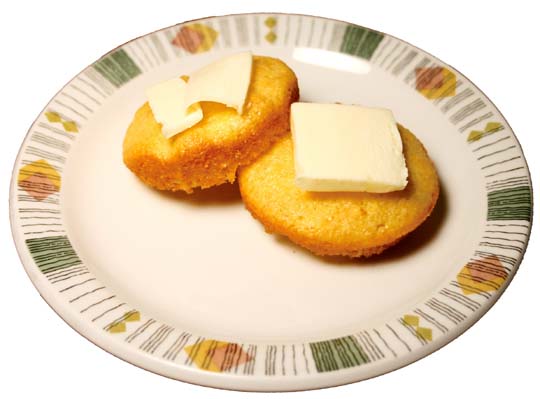
The counterman offered to warm the muffin for me, but I couldn’t wait. Before I could stop him he cut it in half—not from the top down, but sideways, creating two hockey-puck like wafers. He served it to me on a small round plate edged with a green stripe. Even allowing for having been split in two, in shape it was unlike today’s muffins. For starters it far more modest in size, three inches across at most and maybe two inches high, and lacking the bulbous, mushroom-like caps of current muffins. Instead, this muffin was nearly flat on top, with the subtlest rise at its center, and an even more subtle gradation forming a flange or brim at its circumference. From top to bottom it was a perfectly even, golden-brown, spongy in texture. Not wanting to mute its flavor with soda or chocolate milk, I ate it with a glass of water, ignoring the knife and fork the counterman had given me, choosing instead to tear it into bite-sized bits with my bare hands. Its grease coated my fingertips, so I was forced, forced to lick them following every bite. I ate with Zen slowness, wanting to savor every morsel, to prolong the experience, picking up crumbs and licking them one by one like flecks of gold off glossy, greasy fingers. At last my mother could no longer contain her impatience. She yanked me off the stool and dragged me—still licking my fingers—through the store’s automatic doors and into the parking lot where her boat-like black Mercury waited. All this time the Muffin Man’s song ran through my head.

Years later, when I was a struggling artist in New York City, muffins became my all-purpose food. I ate them for breakfast, lunch, and sometimes even for dinner. Corn muffins were my favorite. They were the perfect “starving artist” food: tasty, inexpensive, and filling—not terribly healthy, but not that unhealthy, either. And muffins offered something more than nutrition: the were a source of comfort, too. Their very shape suggests comfort: round and soft, like a mother’s breast. Add warmth and sweetness and you get the full package. Other foods might have done more for me by way of vitamins and other nutrients, but few offered more solace. On my worst days, days permeated with gloom and doom, I’d step into a coffee shop, sit at the counter, and order a corn muffin toasted lightly with butter and a cup of coffee. No sooner would it be placed before me than the gloom would dissipate, replaced by something warm and reassuring, the sense that somehow things would be okay after all. How doomed can a world be with corn muffins in it?

Eventually my source of comfort turned against me. Having spent the better part of a decade eating practically nothing but corn muffins, I developed an allergy to them that left me bloated, feverish, and with epic headaches. I spent the next decade avoiding all foods with corn or corn syrup in them, meaning just about everything from pickles to coffee creamer.

Just as I forwent my beloved muffins, the rest of the country developed a mania for them. Suddenly—like the mushrooms they so resemble in shape—muffins sprang up everywhere: not just in diners, but in cafes, health food stores, even in posh restaurants. And just as suddenly they went from being a humble, working-class food to being trendy, gaudy and huge, pumped up to grapefruit size on muffin steroids. And where once they’d been simple concoctions of whole grain augmented with a sprinkling of raisins or nuts, suddenly muffins were made of everything from zucchinis to sour cream, from peanut butter to avocados. Granola muffins, cappuccino muffins, strudel muffins, applesauce muffins—muffins whose entire purpose in life seemed to be nothing less than denying their muffinhood. And just what, I ask you, distinguishes a chocolate muffin from what we used to call a cupcake? Take away the whole grains, add a ton of sugar and some frosting, and what have you got if not a cake by some other name?

And though a good muffin may be many things, a cupcake isn’t one of them. The difference isn’t merely semantic. Muffins are—or were—less sweet, and never frosted; some were even savory. They were meant to exist somewhere in the continuum between cake and bread. Still, I’d bear no grudge against alternative muffins if within their swollen ranks one could still find a classic corn or bran muffin. In fact those are the two types of muffins one is least likely to encounter these days. Except in diners (themselves a vanishing species) one isn’t likely to find corn muffins at all. That the purveyors of postmodern muffins show such ignorance of—contempt for?—the prototype should annoy more people. It’s one thing to come up with variations on a classic; it’s another to do away with the original altogether. To those who like chocolate muffins, I say let them eat cupcakes. Only let me have my corn muffin, too.

Like most cries in the dark this one will go unanswered. Times change, and so must muffins, I guess. Soon my beloved corn muffin will have gone the way of ocean liners, locomotives, and other quaint relics of the past, resurrected every now and then as a museum piece or curiosity for the sake of a handful of nostalgic geezers. The future belongs to the young. And the future of muffins belongs, apparently, to cake eaters.

Meanwhile I still eat corn muffins wherever and whenever I can find them. And whenever I’m troubled by this changing world, I take solace in the lyrics of a song my babysitter taught me. Do I know the Muffin Man? Indeed I do.

Posted in Uncategorized | Leave a comment

Leaving This Place

Soon I will leave this place. No more house shaped like a big A. No more gentle walks over spiky pine cones down the gentle slope to the gray, lonesome dock. No more swimming across the lake and back. No more twenty minute drive to and from campus, stopping the car by the mailbox on the way home, leaving the engine and the radio on as I check the mail. No more turning on NPR at seven thirty in the morning while waiting for the espresso pot to bubble. No more waking up at 3:30 in the loft bed and searching the bookshelves as if by magic some new, unread book might have self-generated there. No more sleepover visits by the fat neighborhood stray calico cat with the stiff lump of fur on its back. No more climbing down the rusty dock ladder and avoiding its spider webs. No more glasses of wine on the rear deck with the sun setting red and blue over the lake. No more view of same lake from loft office where I spent too much time at the computer. I have graded my students. I have examined their portfolios. I have attended my last departmental meeting and thesis defense. I will miss my students. I will miss my colleagues. I will miss the little town where I’ve felt so welcomed. I will miss the student dives and the fancy restaurant (one) where I had my martinis at the bar. I will miss getting those peanut butter cup cookies at the Blackbird Cafe. I will miss having Pam make me double decaf espressos with just a little hot milk in the other cafe, the one in the library. I’ll miss my little office (that wasn’t mine, really, but only borrowed). I’ll miss the people I worked with here. I’ll really miss them. I won’t say their names. I’ll leave a piece of myself here, in Georgia. Such is the visiting professor’s life.

Posted in Dreaming on Paper | Leave a comment

Hewlett-Packard

Corvallis, Oregon, 1980. 4:30 a.m.

Too tired to go home and sleep, you wander with your guitar to the park, a square block of grass in the middle of the town. Under a full moon the grass glows. At the northern water fountain you bend to slurp, then sit on a bench serenading yourself. As you do a voice from nowhere says, “You play beautifully.”

You look up at a short, pudgy, dark-skinned boy with a droopy hangdog face. “Oh, please don’t stop. Please—go on.” As you start playing again he says, “Do you mind?” and sits down on the bench next to you.

He says he works the graveyard shift at the Hewlett-Packard factory, his voice soft and dripping with sadness. “I get home too early to sleep and too late to talk to anyone. Honestly,” he says, “I’m a little bit depressed. Sure you don’t mind me sitting here?” You shake your head and keep playing. He watches you with a hungry look. “You play beautifully,” he says again. Then: “Would you mind doing me a favor? Would you come back to my apartment and play your music for me there? I’ve got a color T.V. and some movies we can watch. You can sleep on my sofa if you get tired. It would be a lot nicer than staying in the park all night long, wouldn’t it?” You’re reminded of that Robert Frost poem, the one that begins, I have been one acquainted with the night.

You go to his apartment. By then, you see, you don’t give a shit. You have nothing to fear. And you understand, too, that, whatever intentions this person may have, his loneliness is real. When you lived in New York, when you were going to art school and trying your luck in show business, you got used to telling strange homosexual men to piss off, or just stepping over them, as you did with the actor who looked and sounded like Richard Basehart and who claimed he was with the Royal Shakespeare Company before inviting you to the studio apartment he had sublet and mixing you both screwdrivers. Soon he was stretched out on the floor reading aloud dirty passages from Henry Miller’s Opus Pistorum, his hand busy in his pants as you stepped over him on your way out the door. No: you had no qualms about telling such men to piss off. Sometimes you waited too long, but you had no qualms.

But this man is different. He’s younger than you, first of all, and he seems so sad, so thoroughly depressed and lonely. You resent the fact that life has left him and others like him so alone. You want revenge for his sake, for the sake of all lonesome people everywhere, yourself included. To the conditions that give rise to such extremes of loneliness you wish to convey one great Fuck You! So you go home with him.

His apartment is in a modern building, a single room with an attached kitchen modestly furnished, with white plush carpeting and no paintings or posters on the walls. While he fries up some Jiffy popcorn and mixes up a batch of cherry Kool-Aid you peruse his video collection, settling on Escape From Alcatraz, starring Clint Eastwood.

Halfway through the movie you doze off. The boy’s whispers wake you. “Hey, there,” he whispers. “Do you trust me enough to let me give you a back rub?” You nod. As he kneads your shoulders you drift into a dream. You dream yours lying in a field. In the dream, while lying there some farmers come with torches and set fire to the field. You wake up choking on smoke, groping for an escape, but it’s too late; you’re surrounded by flames. You see yourself from above at the center of a ring of fire.

When you wake up there’s a blanket covering you. The boy sleeps nearby on the floor. You massage his shoulders for a while. Then you cover him with the blanket and leave.

Posted in Dreaming on Paper | Leave a comment