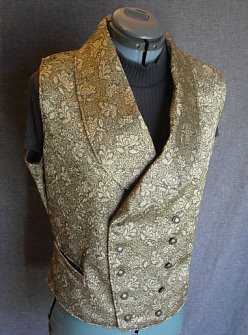
How the Vest was Won


“The king hath yesterday declared his revolution of setting a fashion for clothes which he will never alter. It will be a vest. I know not well how, but it is to teach nobility thrift and it will do good.”–Pepys in his diary

The king was Charles II, the year 1662. Thus what began life as a cassock in the mid 1400’s and evolved into a doublet by the first half of the 16th century underwent its final transformation to become a small, sleeveless jacket shorter in length and open in the front, providing ample opportunity for men of the period to show off their frilly shirts. The vest was born.

Others were less enthusiastic than Mr. Pepys. In his own diary of 1666 John Evelyn records how when the King “put himself solemnly into the Eastern fashion of the vest…divers courtiers and gentlemen gave his Majesty gold to wager that he would not persist in this revolution.”

They should have kept their purses shut. For though the history of men’s fashion is replete with styles that have come and gone (stove-pipe hats, spats, leisure suits), vests endure, and have for over four-hundred years, longer than neckties and collars.

A waistcoat, a “coat of the waist.” Who needs a coat for the waist? No arms, no legs, no collar. A square yard of fabric–hardly enough to keep warm in. You can’t tuck your pants or shirt into it. And those silly little pockets good only for pocket watches and snuff boxes, things no one uses anymore.

What good is a vest? You may as well ask what good are peacock feathers? Vests are made for showing off. Poor hairless and featherless man, his rubbery flesh available in but a few dull colors, his choice of suits even duller. And the necktie–that skinny, skimpy concession to individuality. A man needs more. Like the peacock he needs to strut his stuff, to show his true colors. Hence the vest!

It was another king, King George IV, who initiated the fashion of leaving the bottom button undone. He did so by accident, having forgotten to button it before attending a party in his honor. His friend, fashion arbiter Beau Brummel, quickly, so to speak, followed suit. The habit persisted.

As did vests, growing more functional in the 1800’s, made of lush fabrics depicting everything from hunting scenes to naval engagements, their mysterious myriad pockets hiding everything from love letters to pearl-handled derringers.

There followed the age of the fop, whose extraordinarily expensive vests featured buttons of perfumed wood or mother-of-pearl, and floral fabrics which, according to Constantin and his Almanac des Belles Maniers, could “be seen from one end of the street to the other.” Admired or loathed, the wearers of such vests were impossible to ignore.

Over time the brilliant expensive fabrics were replaced by plainer stuff, velvets and silks of rich but solid color, cypress greens and heady violets. In the late 1800’s they came in paisleys, plaids, and checks, and these in turn were followed by still more sober fabrics, until vests grew as plain as the clothes worn over them, giving rise to the three-piece suit.

Today vests once again trumpet their rich fabrics, and so they should. For unlike a suit, the best is no starched-down disciplinarian, no buttoned-down banker, no stiff-collared preacher, but a colorful orator whose locutions are as inspiring as they are manipulative: the Elmer Gantry of garments.

But a vest is more than a manipulator. It’s a seducer, a set of signals as subtle as whispers or as obvious as flashing ambulance lights.

Note the geometry of the vest, a series of V-shapes or chevrons aimed downward, indicating a man’s belly as the way not only to his heart but to his other desires, the focal point of his libidinal urges, his masculine center of gravity. Sexual attraction may start with the eyes, but from there it heads south. Indeed, the “humble” vest, with its trail of buttons and V-shapes pointing to the groin, may fill a more vital need than any other garment in the male closet, namely that of procreation.

As a boy I instinctively felt the power of vests, out of fashion when I came of age in the early 70’s and available in stores only as a dull component of duller suits. Inspired by a TV show called The Wild, Wild West whose James Bond-style hero wore tight ones of dazzling brocades, I had my mom sew me one. With a tight brocade vest, I, too, would beat up dozens of bad-guys at once, including Bobby Mullis, who went to St. Mary’s and used to persecute me at the bus stop.

Off we went, my mother and I, to the fabric store, where like prospectors sifting for gold we sifted through bins and racks of elaborate brocades to emerge with one yard of the most expensive fabric in the store, along with six buttons no less ornate and costly. An hour later I stood watching from behind as mom stooped over her Singer, making sure she curved the lapels just right.

Two days later, at the bus stop, wearing my vest, when Bobby Mullins shoved me I shoved back. We exchanged blows. His broken nose spattered its blood across my gold vest. I left the stains there. Blood and gold.

Years later, when I worked as a caricature artist at parties, I wore dazzling vests that I designed myself. I needed to keep my drawing arm free and unencumbered by any sleeve. But that was just an excuse. It was the peacock, not the artist, who needed his vest. I had my tailor make me a dozen, each more showy than the last. Two years later I outgrew them all, my chest broadened from swimming laps.

Today I seldom wear vests, mostly because I never see any that I like. The referees of fashion can’t seem to get it right. Vests shouldn’t be loose-fitting or boxy. They should slim the wearer by emphasizing the V-shape of his torso, and should never come down to the thigh lest they resemble the doublets of yore. The buttons should be small, and thus avoid looking like coals on a snowman. A vest should have lapels; without them they look flimsy. As for the fabric, if it doesn’t call any attention to itself what’s the point? Not a moose-call, or a peacock dance, but more than a stage-whisper. The same fabric should be used front and back, black satin backs being a concession to cheapskates aware that backs wear faster than fronts, but since vests these days are worn often without jackets, they should look good from all directions. Finally, vests should never be made of recycled neckties, washable paper, or canceled American Express cards.

And remember: leave the bottom button undone. Who are we to argue with kings?

Posted in Dreaming on Paper, Uncategorized | Leave a comment

The Great American Diner

Of the American diner Henry Miller wrote, “Everything is at its worst in this type of eating place.” We must allow Henry his verve, but need not accede to his accuracy. For if everything is at its worst at the diner, it is also at its best. Best, that is, in the American sense of the word.

Meaning not subtle or shy or in modest quantities. Whether a slice of apple pie or a t-bone steak or a bottomless cup of thick black coffee, it is robust, it is big, it will fill your belly and put hair on your chest and send you back on the road to wherever you’re going (or think you’re going) feeling like you never left home, or, for that matter, have been anywhere beyond than the huge, brawling, un-pin-downable network of greasy truck stops and gloomy gas stations snared in a harness of highways, biways, thruways, freeways, parkways, and superhighways that we who live here call America, as in the United States.

Not all Americans drive trucks, of course, but in our hearts we’re all truck-drivers, renegades, mavericks, cowboys. We get on those highways and start driving and next thing you know, we’re looking for a place to eat. Like the real cowboys they once served the chuck wagons are gone; so are most of the orange-gabled HoJos. Our only surviving hope is the diner.

I speak of those gleaming stainless-steel, streamlined wonders along the highway (even if they’re not alongside a highway, they ought to be), shining brightly as if fresh from silicon molds, trying (but not exactly succeeding) to look like Pullman cars; since that’s what they used to be, back in old days when two-bit entrepreneurs fashioned greasy spoons from discarded rolling stock. Rip out passenger seats, add a counter, stools and griddle, pour in a hundred gallons of liquefied lard and voila: Restaurantus Americanus.

You’ve been there. As a boy you spun on the stools, kicking the chin of the trucker next to you, who gave you your first bona fide dirty look. As a teenager you had your first slice of apple pie a la mode there, the one in the glass and chrome hat box? No mere apple pie, but a patriotic metaphor: Land of the Free; Home of the Brave. And though not exactly free, at fifty cents it was a bargain.

As for brave, you had be brave to order it, having no idea how long it had been sitting there, turning to rubber in its glass tomb.

But you had to be brave anyway, since America was a dangerous place back in those frontier duck-and-cover days when the Federal Highway System was born, a land of hungry refugess looking to stake a claim, willing to die and kill for one, and hungry, too. Dreaming of fallout shelters and ketchup (“catsup”) bottles lined up in rows.

A young man on lunch break from your very first job, you flirted with the waitress, Margie, Connie, Jan or Meg. For her time stood still: so long as she wore too much mascara and called you Dearest or Honeybuns or Sweetheart, chewed Juicy Fruit, and stowed an abbreviated pencil behind her ear–all was okiedokie with the world. She was your surrogate mom. She was everyone’s surrogate mom. And the country had an Edible Complex. Oh what longings, appropriate and otherwise, Meg could inspire while dishing out two over easy whiskey down and a burger with fries.

Now you’ve grown older, beyond those fine ketchup-slathered truckdriving days. You stand and wait for a booth, hang your coat neatly on a brass hook, search in vain for a seat neither split nor sticky with duct tape, and study the superlaminated menu as if you didn’t know everything on it by heart, order a tuna salad instead of a burger (opting for mercury poisoning versus cholesterol). Sit back, or slump forward, read the newspaper, follow the headlines. As she stoops over your wife the waitress dares still to call you honey: for it means nothing now, an appellation as hollow as God in the mouth of an atheist. Nor does the pencil behind her ear yet point quite so firmly heavenward.

But the counter still gleams, and the stools spin however wobbly with time on their axles, and the food is still exactly, miraculously, the same. There’s that same slice of apple pie you resisted ordering twenty-five years ago, with the same glutinous glob of jellified apple oozing outward. There’s that peach melba, and that lemon meringue, and that…what the hell is that, anyway? There’s the Coke dispenser, and the Hamilton Beach blender, and the stainless-steel cow full of milk, and the inverted Bromo bottle, bluer than blue, and goosenecked soda fountains, and black-knobbed syrup squeezers, and Sylex coffee orbs, and the sign over the chromium register:

If You Believe in Credit,
Loan me Five Bucks

And the sacred ubiquitous bottles of Heinz: precious frank fluid, elixir of burger, lubricant of liverwurst, myrrh of French fry, frankincense of hash and egg. What diners bleed when cut.

Whether it’s Detroit or Milwaukee, Biloxi or New York or the lonesome prairee; whether called diner, cafe, coffee shop, restaurant, or luncheonette, it’s the same, still the same, ever and always the same; whether the waitress is Greek or Polish or Hungarian or as midwestern as the Kellogg’s rooster; whether the blue-plate special is pierogi or goulash or moussaka or barbequed pulled beef w/ sauteed collard greens, it’s still the same, always the same. Because the menus are as overstuffed as the filet of flounder and the coffee refills are on the house; because the tuna platter comes with a mound each of coleslaw and potato salad; because, however mightily they try, they owners can never quite spell soup du jour right, and offer pie a la mode with ice cream.

Because the diner is there when you need it, and you need it more than you know, though you may not appreciate it. For the diner will always be nothing more than a means to an end: the end being a full and slightly queasy belly.

And that’s what counts, for whatever diners lack in sophistication they make up for in consistency. Just over the hill, around the bend, at the next exit, the next corner, the next intersection: radiant with wasted light, lodged in the dark underbelly of the American dream. Through times good and bad, the diner will always be there (we hope): a beacon of comfort and familiarity in the limitless, highway-crossed, desolate American night. To warm and feed you; to fill your stomach and empty our bladder. But mainly to make you feel like you know where you are, wherever you happen to be, despite never having been there ever before: a place where you feel as if you’ve come back where you belong.

The Diner: America’s home away from home.

Posted in Dreaming on Paper, Uncategorized | Leave a comment

Cheever’s Basement

I heard or was told by someone not long ago that John Cheever wrote the bulk of his short stories in the boiler room of a midtown office building, where he had contrived to set up a little office for himself, presumably with a desk, lamp, and a bottle of whatever liquor he preferred. Since then it has become almost impossible for me to read his work without being distracted by an image of Cheever in tie and shirtsleeves bent over his dark, gloomy desk, composing in longhand on a legal pad with a big, burly black fellow (straight out of an early Eugene O’Neill play) stoking a furnace somewhere in the stygian darkness surrounding him.

The image is especially distracting given Cheever’s subject matter, those tame Westchester suburbs and cool Cape Cod seascapes, not to speak of the cool characters inhabiting them, people whose concept of Dionysian ecstasy is a game of charades in the living room or Scrabble on the sun deck (augmented, to be sure, by another round of cocktails). At first it’s impossible to reconcile these two images—Cheever’s boiler-room Inferno and the sunny world populated by pale faces and witty cocktail shakers. Furthermore, there is that devilish look on Cheever’s perspiring, concentrated face (which he mops every so often with a monogrammed handkerchief) as he leans over his writing tablet, the look of someone sadistically clairvoyant when it comes to human failings and shortcomings, a man who knows the people he writes about so well that he can predict the exact time and circumstances of each of their sad deaths, not to mention when they will pour themselves their next drink. He’s a frightening entity, this devil-author in his brimstone-stinking cave, scribbling away while the civilized world tears itself to bits above him.

Don’t get me wrong. I love these stories, and love the way Cheever writes. There’s beauty in just about every one of his sentences, which seem less written sometimes than pulled from the sky. E.M. Forester talks about the need for both flat and round characters in fiction, but none of Cheever’s characters are flat. Even the maid who answers the door and waters her boss’s gin is given her fully dimensional due. One gets the feeling that, whatever original impulses may have given rise to his stories, Cheever cannot resist applying the full force of his satanically clairvoyant powers to every single character his pencil touches in its careening subterranean journey.

Indeed, there are moments in “The Sorrows of Gin” where he seems to forget, or at least not to give that much of a damn, whose story he’s telling. Cheever’s omniscience is omnivorous: it consumes anything it touches: children, household servants, even pets—in his hands even the landscape itself, his “verd stone” colored seas and glinting swimming pools, are not exempt from empathy, or its evil twin cousins: complicity and condescension. One feels these people doomed by their affluent trappings, by the sunny porches and brine-pickled summer homes poised to plop into the sea. Oh these poor doomed sunny families and their gin-soaked sorrows. Oh what can we do for them, when the sun has gone down, after the last drink has been poured? And why, when he gets near the end of a story, does Cheever almost always swoon, his sentences mounting into a feverish Whitmanesque rhapsody heralded more often than not by the obtrusive entrance of the anachronistic “Oh”? And when he does swoon, when he opens his mouth to catch a last, dizzy breath before the brain-cells start their gasp, shaping it into that wide, oxygenated “Oh”, we can be pretty sure then that the plot will be the first thing that all that excess oxygen burns, that Cheever, in his swoon, will forget whatever particular story he has set out to tell, to wax generally about “men such as this” and “women such as that” and the “obdurate truths before which fear and horror are powerless”—true, true, oh so true, and so generic you could end any story on such grace notes.

Some writers abandon their stories, pull the red emergency handle and bail. Some drive a stake through their stories’ hearts. Not Cheever. He gets so moved by his own characters he has something along the lines of a literary orgasm, gives a last resounding howl and dead faints.

That’s not a complaint; I’m not even sure it’s a criticism. I love these stories. And even as they disappoint me their endings thrill.

One more thing. As hard as it is for me to read these stories now without the double vision of Cheever in his underground man’s bunker, it’s just as hard not to see the ghost of Frederick March hounding his suburban husband characters, accosting the maid for sacking his gin, or Colleen Dewhurst as the backgammon playing, brandy-nipping WASP matriarch. Not Cheever’s fault, I’m sure, but the fault of life (and movies) imitating art. But even if some of his characters have become archetypes, and his stories are less devilish for it, still, who won’t forgive anything of an author who has the sea say, “Vale, vale.”

Posted in Dreaming on Paper, Uncategorized | Leave a comment

Count on a Murderer for a Fancy Prose Style

The plot of Lolita, to the extent that one exists, is about the contest between poetry and prose, between style and substance. Hear me out on this. I’ll focus first on the book’s style, specifically those moments where author Nabokov, through his narrator Humbert Humbert, calls attention to his own use of language, whether directly through parenthetical asides, or through the use of elaborate puns, gestures, and/or invented words and phrases.

To point out stylistic flourishes in Lolita is (to warp a cliché, as H.H. is so very fond of doing) like shooting schools of bright purple fish in a barrel. Just about every line of Lolita holds some stylistic flourish, and with its profusion of subordinate clauses, its raised-eyebrow semicolons, its profusion of parenthetical asides and italicized French (mon dieux!) the book is often more pleasing to the ears than to the eyes, which grow weary under the weight of such prosaic richness. This sort of writing demands to be heard, specifically in the voice of an “aging” European intellectual with a posh mid-Atlantic accent and mobile features who happens, incidentally, to be a pederast.

I begin my annotation on page 43 of my text (Vintage International Paperback) with the 2nd paragraph, the one that begins, “Monday—Delectatio morosa. I spend my doleful days in dumps and dolors.” That last line, so encrusted with puns, alliteration and double entendres, could easily be borrowed from the allusive rag and bone shop of Finnegan’s Wake. I ask myself: what’s Humbert/Nabokov up to, what’s his game? Is this meant to charm, disarm? How does the use of such self-conscious stylistic language achieve, or subvert, his end, which, I take it, is to get the reader to ingest the 300 some-odd page confession of a child molester? Nabokov says it himself: “You can always count on a murderer for a fancy prose style.” Yes, but why? Does the fancy style make Humbert easier to swallow? Or is it a decoy designed to call the reader’s attention away from the disgusting facts? Am I being seduced?

Page 58: “The magazine escaped to the floor like a flustered fowl.” It’s a good description; a great description. But not the kind that goes down like clear water, leaving the reader only with the intended image: a magazine splayed across a carpet, and not—as here—a flurry of winged words flapping their feathers, so the dazzled reader must stop for a moment and rub his eyes before seeing a magazine again, and not a duck or a chicken. This is description not as depiction but as a form of distraction, not meant to help the reader see but to dazzle and deflect the reader’s sight. This is showing off.

Humbert makes a good case for his own decency, this man who (pg. 62) steals “the honey of a spasm without spoiling the morals of a minor” and later (pg. 63), “I intended, with the most fervent force and foresight, to protect the purity of that twelve-year-old child.” He doesn’t tell us, of course, to what end he intends to protect it. But he tells us in language as sweet with its own honey, language that Humbert fondles and caresses and holds out to the reader for his or her own delectation just as he holds Lolita (the book, not the nymphette) out to us, for us to slobber over, to make us complicit in his crime. If we hold Humbert guilty of child abuse, then we must as surely hold him guilty of a mannered style. But if, on the other hand, we not only forgive his mannerisms but allow ourselves to be seduced and to even gain pleasure from them, then we must also forgive him his other crime. This, I think, is the method of Humbert’s madness, also a possibly key to the style of Lolita. His two wrongs (snobbishness and pederasty) may make a right, if only by nullifying each other.

Later (page 71) “. . .I might blackmail—no, that is too strong a word— mauvemail big Haze into letting me. . .” Here Humbert goes to extremes to demonstrate his passion for accuracy, le mot juste, even to coining his own terms when existing ones won’t do. But Humbert also knows he’s making us laugh, and that, I suspect, is his true aim, to get us to see what a (to borrow a phrase) “charming bugger” he is. Here, let me freshen your snifter—just a dram. It goes without saying that a man so playfully exacting with language wouldn’t harm a little girl, would he? Here, let me kiss your skinned knee.

Further down the same page; “the artist in me has been given the upper hand over the gentleman. It is with great effort of will that in this memoir I have managed to tune my style to the tone of the journal that I kept when Mrs. Haze was to me but an obstacle.” And later, ending the same paragraph, “But I am no poet. I am only a very conscientious recorder.” The point is arguable, since only a very fine line divides the skillful stylist and the poet, and often they’re indistinguishable. And anyway our narrator is being coy, since he’s nothing if not a poet. “Poets never kill,” we’re told later, on page 88, in the same passage where Humbert throws his hands in the air and declares on behalf of all pederasts, “We are not sex fiends!” In either case he dost protest too much. No wonder poets are distrusted. To be sure Humbert is a fiend, a fiend for the English language.

Of course the poet’s main aim is to tell the truth, while the stylist may —inadvertently or not—deceive. But Humbert does tell the truth, factually, but in words that are so beguiling we hardly notice, at times, the truth that we’re being told. When it comes to language, even more than when it comes to nymphets, Humbert is a voracious seducer, a man with little self-control or restraint: he cannot help himself.

But with respect to style this may be in his favor. Were Humbert any more humble, any less determined to arouse through the snobbishness of his prose an antipathy so thorough it would survive a “not guilty” verdict by any number of juries, then his readers (the real jurors) would really hate him. As it is, we must choose between our strongest antipathies. Indeed, Humbert is as defensive of his literary style as of his sexual predilections.

Pg. 77: “(to prolong these Proustian intonations)”. Humbert’s style is riddled with parenthetical asides like this, often embodying some form of internal literary self-policing, to remind his reader that, if he’s behaving badly, that is, if he’s going too far, he knows it. Not only does he know it, he’ll be the first to tell us he’s doing so. I know I’m pompous; I’m so pompous I can apologize pompously for being pompous. Often parenthetical asides are used to tell us exactly how to read a line, even how to punctuate or typeset “(underlined twice)” it. These days most authors consider parenthesis eyesores, to be avoided. But like so many aspects of Nabokov’s style, I think he wants to poke you in the eye with his parenthesis, to interrupt the narrative flow, to call attention to the scrim, the artifice of words.

Literary slumming. Often Humbert bursts into “common folk talk,” as on Page 87 where he writes, “But what d’ye know, folks. . .” This refined European sensibility dipping his toe now and then into the reeking muck of the vurnacular, just as he dips other parts of himself into pedestrian little girls. The whole book, after all, is about a refined gentleman’s slumming, literally and sexually, in America, wallowing in its neon-tinged highway gutters, fascinated by its homely giddiness and grit. Often, reading this book, I’m aware that America is Humbert’s real nymphet, only he’s the one losing his virginity to it, having his cherry popped (so to speak). He’s certainly as in love with the landscape that floats past the windows of his car as with the girl in the passenger seat beside him (a passing truck’s break lights: “backside carbuncles pulsating”). . .The more I read, the more clearly a triumvirate of obsessions comes into focus: a certain type of pubescent girl, America, the English (American) language: each tempting in its own way; each in its own way dangerous; each in its own way potentially damning. In the end, Humbert’s love for the English language will seduce, trap, and betray him as surely as Lolita; he will make his own bed out of words and lie in it, this fancy talking sexual deviant, this stilted orally-fixated predator, this intellectual European snob come to our shores to rape our little girls. Inarticulate American brutes and blockheads, feel vindicated! This guy with all his fancy talk makes y’all look good!

But it’s the English language which we think of as our own—as our innocent child—that’s been ravaged. Left alone in a room with her, Humbert’s fingers fondle and probe mercilessly. What’s that lump there? An adverb. Supposing we stick it here. And that adjective, let’s stick that there, thus.

The real object of these pages is no pubescent girl, but the American language and landscape, still virginal to Nabokov, as fresh, as untouched and untainted as any brown-skinned nymphet.

To return (“by a commodius vicus of recirculation”) to my original premise: Humbert, the poet-seducer, in love with his new language, must seduce her away from Plot, spelled with a Q, as in Quilty, the Dramatist. A tug of war ensues, a cross-country battle, an interstate chess match (quilt = chess board = patches of cultivated terrain as seen from the sky) of wits and wills with Quilty in pursuit of Humbert, insisting that he release his drunken grip on Lolita (language: trippingly off the tongue) and deliver to us, the readers, a book with a shapely, eventful narrative: a plot. Humbert will have none of it. He wants to be free to take the language where he wishes and do with it what he wants to do; by no means does he wish to ploddingly plot his way through 300 some-odd pages, but to soar away free, stopping occasionally at a seedy motel for a bout of pure linguistic cunnilingus. But Quilty keeps interfering with Humbert’s plan (to write a book with no plot), and so the contest. In the end, Plot is riddled (almost to his satisfaction, one senses) with bullets (made not of lead, but of words) and murdered. Loyal to the end, Quilty staggers through a dozen pages. Dramatist dead. Contest over. End of Plot.

Posted in Dreaming on Paper, Uncategorized | Leave a comment