That First Glimpse

If plot is the backbone of fiction, that which gives fiction its structure and movement, then scenes are plot’s vertebrae. A concatenation of causally related scenes add up to a plot. But beyond their technical function, scenes are what we’re most likely to remember about a work of fiction; at the very least, they are what we’re most likely to discuss with others. Remember that scene in (fill in title) where (fill in event) happens?

Think of a particular novel or story and what you remember most about it, and odds are you’ll remember a scene. I’m thinking of Catch-22, of the scene where Yossarian rips open wounded Snowden’s flak vest and the “secret” he’s been keeping spills out of him in the form of a heap of shredded intestines. Or the scene in Ken Kesey’s Sometimes a Great Notion where Hank Stamper tries to save his lumberjack brother from drowning by breathing air into his mouth under water. Or the scene in Anna Karenina where Vronsky rips his shirt open.

Of all the scenes in fiction, none play a more crucial role than “First Glimpse” scenes—scenes were key characters see each other for the very first time. Here, too, examples spring to mind, like this one of Ishmael’s first glimpse of Ahab:

He looked like a man cut away from the stake, when the fire has over-runningly wasted all of the limbs without consuming them, or taking away one particle from their compacted aged robustness . . . His bone-leg steadied in that hole; one arm elevated, and holding by a shroud; Captain Ahab stood erect, looking straight out beyond the ship’s ever pitching prow.

Another first glimpse, this one from Zorba the Greek:

. . . the stranger opened the door [of the cafe] with a determined thrust of his arm. He passed between the tables with a rapid, springy step, and stopped in front of me.

“Traveling?” he asked. “Where to? Trusting to providence?”

“I’m making for Crete. Why do you ask?”

“Taking me with you?”

I looked at him carefully. He had hollow cheeks, a strong jaw, prominent cheekbones, curly gray hair, bright, piercing eyes.

“Why? What should I do with you?

He shrugged his shoulders. “Why! Why!” he exclaimed with disdain.”Can’t a man do anything without a why? Just like that, because he wants to? Well, take me, shall we say, as a cook. I can make soups you’ve never heard or thought of. . .”

And another—from Elizabeth Smart’s novel (extended prose poem?) By Grand Central Station I Sat Down and Wept, where the first glimpse is of the wife of the man with whom the narrator is hopelessly in love as she de-boards a bus:

But then it is her eyes that come forward out of the vulgar disembarkers to reassure me that the bus has not disgorged disaster: her madonna eyes, soft as the newly-born, trusted as the untempted.

The first glimpse scene offered by this author’s first page presents us with Ewan, a fellow student at the narrator’s university “in a small town in Illinois.” About Ewan by the end of this first page we know very little; that he is a fellow student we can only assume, since we’re not told as much; in fact we’re hardly told anything. We don’t know what he looks like, or how he walks, or—when he speaks—how he speaks. We’re told that he’s a “guy”—something we can surmise from his name, and that at some point he will “latch on” to the narrator: but that point exists in the future, and has no bearing here.

If Ewan emerges as a character it’s through his dialogue. “Are you for or against Pro-Choice, Lilli?” he asks the narrator one afternoon as she sits at the counter of her favorite coffee shop. If these aren’t Ewan’s first words to her, they’re close to being so; anyway they successfully evoke a man who, to put it nicely, has little patience for decorum. Those less generous would call him tactless.

If only we could see Ewan as clearly as we hear him, the way we see Zorba strut into that cafe. Since Ewan’s words are what characterize him, my inclination would be to lead off with his in your face inquiry, and take it from there.

As for the first paragraph, I’d cut it. It indulges the author with a gratuitous wish that her novel were a movie—and not just any movie, but one directed by Gus van Sant. But this fantasy gives nothing to readers: in fact it discourages them. Not only is the wish doomed; it’s the wrong wish to hold out to lovers of fiction. If the novelist is really so intent on Gus van Sant and Matt Dillon, she should be writing a screenplay.
Posted in Uncategorized, Your First Page | 3 Comments

How to Buy Hat Factory Painting

Bare walls give me the creeps. I’m always distressed and frankly a bit amazed especially in the homes of well-off people, homes equipped with the best appliances, expensive furniture, and two-hundred dollar faucets, when people either have nothing at all on the walls, or some very expensive signed stupid lithograph by a famous artist for which you know they paid way too much money at some gallery. These are the same people whose book shelves, if they have any at all, are lined with first edition hardcovers of worthless airport novels, still in their pristine dust jackets as if barely read or not read at all: in fact, one gets the sneaky feeling they bought them simply to adorn the shelves (in which case one wonders at the mentality that would do so, say, with novels by James Patterson and Jackie Collins rather than by Tolstoy or Proust).

But never mind; this post is about paintings, not books, and about the bare walls that should be under them. Bare walls disgust me. Every naked space on a wall is space that could be taken up by a piece of art, and not just some prefab kitsch like those horrible wide-angle framed photos of island beaches at sunset with corporate bromides typeset an small-caps with very wide kerning, a sure sign that whoever inhabits the place is a dyed-in-the-wool, card-carrying philistine. Nor do I mean commercial posters whose frame jobs cost twenty times more than the artwork they contain. Nor do I mean signed lithographs, silk-screens, or other expensive reproductions of Calders or Picassos or Dalis or any of the dead fat-cat artists on whose corpses the commercial fine art world continues to gorge itself, or try.

I mean the works of living and struggling artists who are not famous yet but trying mightily to be, or maybe they aren’t trying at all, maybe they simply paint for the joy of painting. There are many of them, and their paintings belong on people’s walls.

Why, when it comes to fine art, are so many otherwise intelligent people so willfully ignorant? It’s not merely that they don’t appreciate good art, it’s that they don’t even try, ever. They know less, most of them, about art than they do about the engines under the hoods of their cars. They think it’s too complicated, elitist, an enterprise for snobs. They don’t seem to get that a piece of art, a painting, a good painting, it very simply something done by an artist. Among all the living artists they are entirely free to choose those works that appeal to them: nothing wrong with that. They need not fear the scorn of critics who may not approve their choices. However, they deserve to be scorned when, rather than make any effort to live with genuine art, they put overpriced insincere bragging-point crap selected by experts on their walls, or worse, nothing at all.

How do you go about buying real art, then? Genuine art that isn’t overpriced or otherwise out of reach? Let me show you how simple it can be.

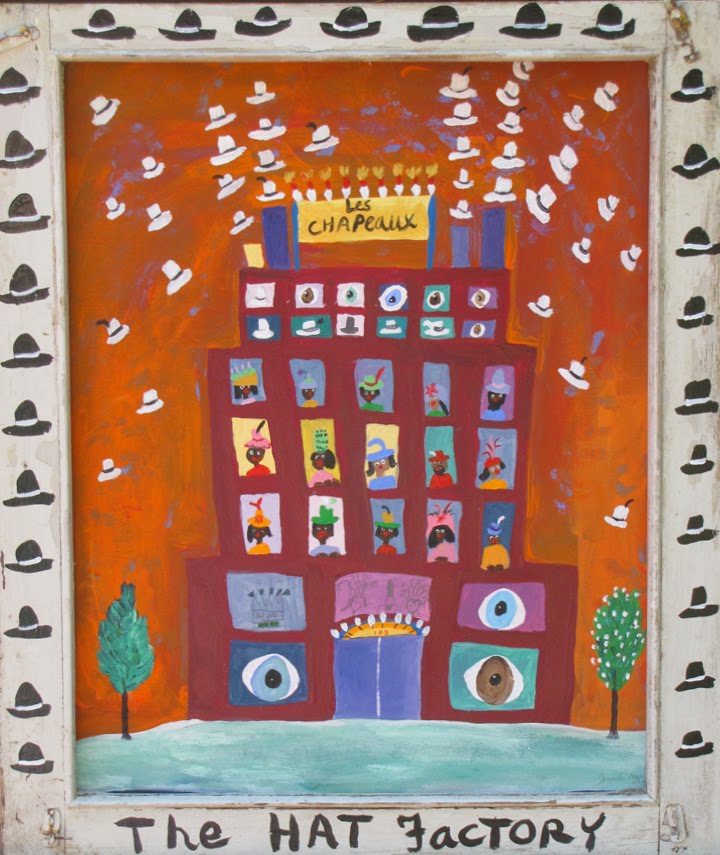
A few weeks ago I happened to read in a back issue of a literary journal that had been left behind on a shelf in the office I’ve inherited with my new job a short story by a woman named Jennifer Moses. I enjoyed the story very much, though it is not the point here. In the back of the journal were biographical note on the authors, each of them accompanied by a small, personal photograph. In place a a photograph of Jennifer or her family, I found one of a painting. For Jennifer, it turned out, is a writer and painter.

Now, two things struck me about this painting. First, it was done in a naive style. Naive art, for those who may not know, is art that either purposefully or by accident dispenses with the “rules” of perspective, light, proportion, composition, scale, and so on. Rousseau was a naive artist, but there have been many. I myself am a naive, and proud of it. In fact I felt as if this painting could have been done by me, which, I guess, is a rather narcissistic reason for my liking it, but then why would I paint my paintings not to like them?

The second extraordinary thing about this painting is that it was a painting of a hat factory. And hat factories, as you may know, are central to the novel I have been working on.

So I checked the artist’s website, and sure enough she had done many lovely paintings, but only this one of a hat factory. So I emailed her and asked: is it for sale? Mind you, I really can’t afford to be buying painting these days, but I had to ask. She wrote me back very quickly saying a)that the painting had already been sold and b) but she would be glad to do another for me. The price: $200, framed. And (she added) if I was not pleased with the result I needn’t buy it.

Well, I guess I don’t have to tell you my response. The painting hangs in a place of honor in the university home where I am living, whose walls, when I moved in, were bare. And that’s how you buy a painting.

Posted in Dreaming on Paper | Leave a comment

From a Novel-in-Progress

I’ve been working hard on a new novel, and also on my “Your First Page” blog, and hence I have been neglectful of this blog. When that will change I don’t know, but here at least I can offer my few intrepid followers a sample of my work-in-progress, from a novel I’m calling HATTERTOWN (the capital letters are important: they are meant to mimic the names of the towns extinct hat factories as they appear in block letters down the shafts of the equally extinct smokestacks that shoot up from the landscape like ruddy brick fingers.

The sample paragraph is from a scene fairly early in the book in which the narrator imagined his mother’s reasons and regrets with respect to marrying his stepfather, the owner and operator of the town’s last dying retail hat store. You’ll read it and tell me if you think it’s any good.

“From where I half-crouched behind the beaded curtain I couldn’t see my mother, but I could picture her lying there, spread out on the parlor sofa, her long former dancer’s legs hidden under a plaid throw, cigarette in one hand, sherry glass in the other, for to go with her smoking she had taken up this other habit, a glass of creamy sherry every evening before bed—and sometimes, lately, more than one. She drank, I suppose, for the same reason she’d started smoking again, to take the edge off her disappointment, the disappointment of a woman who, having married a second time not out of love but for money, discovers that in fact she has done so for neither. Had my mother, when she married him, the vaguest inkling that Walter J. Waple was in financial straights? Certainly not. Had she had any such inkling would she have married him? Again, no. But she’d had no such inkling. About Walter J. Waple she had known very little, as a matter of fact. She knew only that he was a widower who lived in a grand stone house on Crown Heights Boulevard with a wraparound porch and stained glass windows and a turret with a witch’s hat roof and a circular driveway edged with day lilies—or were they daffodils? He had a retarded son, poor man, and perhaps for this reason he was alone, though it seemed not a very good reason, not to my mother. He owned the town’s only retail hat store, and so he must have been rich; at any rate, he was not poor, and he did not work in a hat factory. He did not smell of fusty damp wool and harsh chemicals and sweat, but of sweet pipe tobacco and cologne. His fingernails were polished and trimmed square with no a trace of factory grime under them. He didn’t swill bourbon or try to drown or disfigure his children. He was courteous and well mannered and never once presented himself to her without a bouquet of roses. Perhaps he was not rich. Perhaps he was not worth a fortune but only earned a considerable income. Still, it would be enough. With said considerable income he would buy her gowns and in his shiny blue Buick would take her out to dine (not to eat, mind you, but to dine) at gentile New England establishments with names like The Cobbs Mill Inn, The Wild Turkey, The Old Oak, The Spinning Wheel, or to that Swedish place on the lake, what was it called, the Viking’s Table, the one with the smorgasbord, where the chef always came out to greet the patrons in his puffy hat. He’d order a martini, extra dry with a droll olive, and she a Brandy Alexander. At the long banquet table buckling under steaming vats of half-drowned meatballs, golden one-eyed fish, gleaming amber turkeys, diamond-scored, clove-studded hams, and pantied racks of lamb, Mr. and Mrs. Walter J. Waple would fill their plates and life would be good.”

Posted in Uncategorized | Leave a comment

The Curfew

There’s a reason why few stories—and even fewer novels—are written using the second person point of view. It tires readers out. It says to them, in effect: here, you step into the protagonist’s shoes; you play the role; you do what he/she does. Depending on who the character is, and what befalls them, readers may or may not want to play along. Even assuming that they’re game, they may not be willing to play for hundreds of pages.

Which isn’t to say that second person doesn’t have its place. It’s been used to great effect, more often in short stories, most notoriously by Loorie Moore in what may still be her most famous collection, Self-Help, wherein many stories take the form of how-to guides, to wit (from “How to Be a Writer”):

First, try to be something, anything, else. A movie star/astronaut. A movie star/missionary. A movie star/kindergarten teacher. President of the World. Fail miserably. It is best if you fail at an early age–say, fourteen. Early, critical disillusionment is necessary so that at fifteen you can write long haiku sequences about thwarted desire. It is a pond, a cherry blossom, a wind brushing against sparrow wing leaving for mountain. Count the syllables. Show it to your mom. She is tough and practical. She has a son in Vietnam and a husband who may be having an affair. She believes in wearing brown because it hides spots. She’ll look briefly at your writing, then back up at you with a face blank as a doughnut. She’ll say: ‘How about emptying the dishwasher?’.

Note how easily the second person viewpoint lends itself to comedy—far more easily an willingly than it lends itself to tragedy, since though we balk at being forced to endure, say, a heroin addict’s withdrawal symptoms or gang rape, we don’t seem to mind being the butt of a joke or a buffoon.

At any rate, we don’t mind for short intervals—say, the length of a short story. That said, the second person technique has proven extremely successful with longer forms—or anyway with one longer form, namely Jay McInerney’s 1984 love letter to Yuppiedom, Bright Lights, Big City, which opens:

You are not the kind of guy who would be at a place like this at this time of the morning. But here you are, and you cannot say that the terrain is entirely unfamiliar, although the details are fuzzy. You are at a nightclub talking to a girl with a shaved head. The club is either Heartbreak or the Lizard Lounge. All might come clear if you could just slip into the bathroom and do a little more Bolivian marching powder.

In fact throughout the course of McInerney’s book “you” go on to do a lot more Bolivian marching powder. Here, too, the overall effect is comic—though by the book’s end the comedy has turned to pathos and arguably to self-pity (but then the self being pitied is, well, you).

Owing to the tortured metaphysical logic of second person narrations, we have, in a sense, ourselves to blame for whatever weaknesses endow their characters. We bear their burdens and their faults—and, to some extent at least, the faults of their authors. Call it guilt by association.

Then again many readers will cross their arms and say, “As a matter of fact, no, I am not in a nightclub talking to a girl with a bald head.” And that will be that. In using the second person you throw a gauntlet to the reader. Supposing the reader doesn’t pick it up?

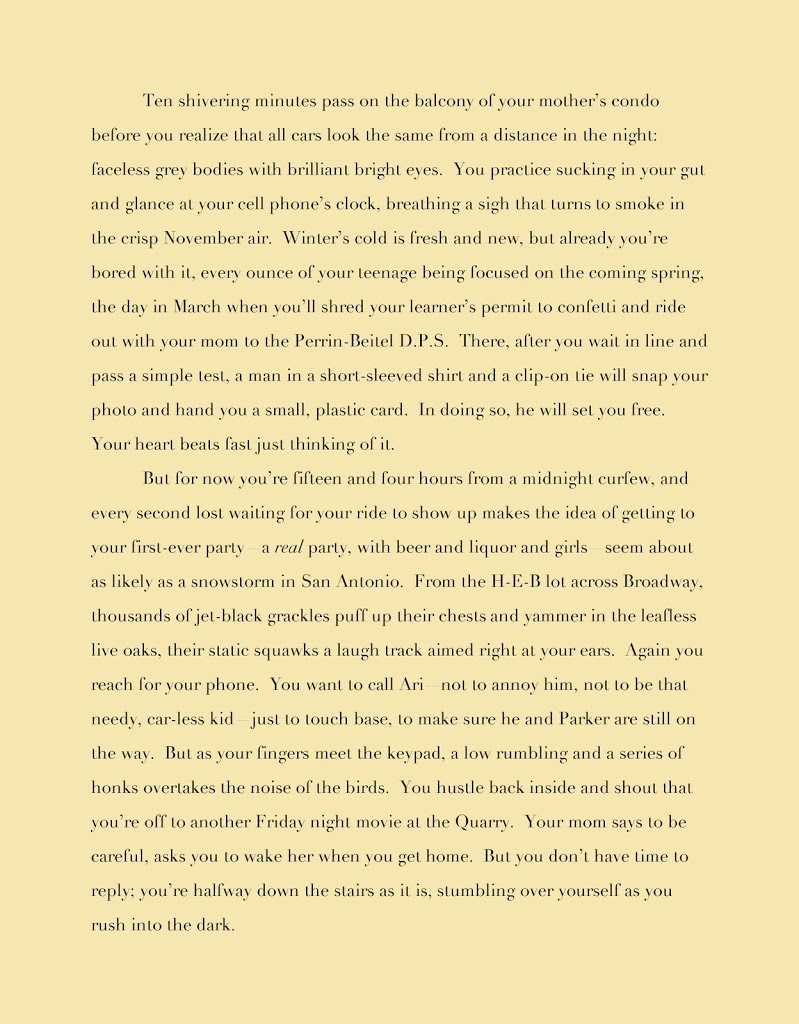
In the given example “you” (a teenage boy) wait on the balcony of your parents’ home to be picked-up by some friends for your “first-ever party.” Just thinking of it “your heart beats fast,” for you know it’s not just a party that awaits you at the far end of that ride: it’s a right of passage, an initiation. There will be “beer and liquor and girls.” You almost can’t believe it. It even seems to you, as you stand there waiting, that the likelihood of your actually achieving this milestone is about as great as that of “a snowstorm in San Antonio.”

All this is well done; the author does indeed put us (or rather forces us into, for the second person is never quite voluntary) the psyche of an adolescent boy, a psyche beside itself with nervous erotic energy and anticipation. The details are convincingly precise, down to the grackles whose cries make a laugh track of the night—fittingly, for here, too, though there’s drama, it’s underscored by comedy. It makes for a strong opening to a story whose theme is the heady anxiety of adolescence—a story I, for one, wouldn’t mind reading. Or playing the lead in.

Posted in Your First Page | Leave a comment