The Elephant in Marshall Field’s Window: My Glimpse of Saul Bellow

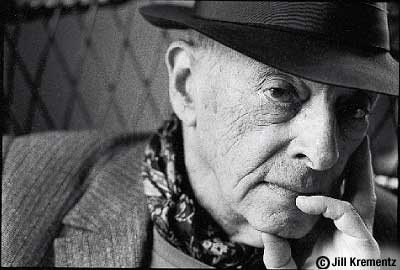
As we pulled up the driveway there he was, an old man with white hair sitting in a rocking chair on the front porch of his Vermont farmhouse, reading the newspaper. I was with my friend Oliver. We’d been invited to the Bellows for dinner that night. For a while we sat drinking beers in our own rocking chairs to either side of Saul as the sun started down and he turned the pages of his paper—the Sunday Times—though he wasn’t reading it. He was eighty-five years old then, still pretty much there, though he had stopped writing, and he tended to repeat himself. Otherwise, though, he seemed content in that way that only great men seem able to achieve, and only when they arrive at grand old age after long lives filled with struggle and success, the contentment born of finally laying down the sword and shield. As a writer Saul Bellow was finished and he knew it, but he had nothing to regret or apologize for, having done all anyone could have asked him to do and more.

And now he sat there in his rocking chair on the front porch of his Vermont farmhouse turning the pages of his paper with the sun about to go down, telling a story about Trotsky, probably his favorite story of all, how when he was an undergraduate studying anthropology at the University of Chicago he and a fellow student decided to hitchhike to Mexico and gain an audience with the expelled Bolshevik revolutionary.

“We got there a day too late,” Bellow said. Trotsky had been killed the day before. “But,” Bellow went on, “we were allowed to see the body.”

He and his friend were escorted to a room. There lay Trotsky, under a starched white sheet in a hospital gurney, his beard brown with iodine or blood—either he couldn’t recall or had never been sure. Both what he remembered he saw with perfect clarity, as if it hadhappened the day before. “It was the sort of thing you never forget,” he said.

Before the sun went down completely Oliver and I went for a swim in the Bellow pond, a Huck Finn style pond with a small sagging dock and bullrushes all around. The water was murky but cool. Some of the Bellow girls swam with us. Except for Saul and his three-and-a-half year old daughter, the rest of his family consisted of brunettes of all ages, all of them beautiful. We finished our swim and walked in wet bathing suits back to the house for dinner.

I forget what we ate. Something warm and good—stew with salad and warm beets, something like that, or a vegetarian dish, served with a red wine. Oliver, Saul, and I sat together at one end of the long rustic table (everything about the place was rustic). As Oliver tends to when we’re with others, he let Saul and I do all the talking while he listened and laughed and smiled. Saul, on learning that I had written a children’s book, said he once had an idea for one himself.

“Really?” I said, taking a more than polite interest. “What was the idea?”

“It’s called ‘The Elephant in Marshall Field’s Window.’”

“Sounds great. What’s it about?”

“I don’t know,” Saul leaned in close to me and whispered conspiratorially. “All I know is it’s called ‘The Elephant in Marshall Field’s Window.’ I haven’t worked out any of the rest.”

From there somehow he drifted back to seeing Trotsky when he was eighteen years old. This sensational episode of his young manhood, it occurred to me—an event that may or may not have played a role in his becoming an author—had become for him a sort of reference point, a lighthouse at sea, shining a beacon that lit up his past—but fitfully, as beacons will.

After dessert, and after watching Saul’s three-and-a-half year old daughter dance for us, Saul, who’d had a long day, said goodnight, and Oliver and I in turn bid our farewells to the rest of the Bellow clan. Saul died three years later. He was eighty-seven.

Among today’s young writers and readers Bellow has since fallen into something like neglect, a shame, since his books remain worth reading. I still think of him as a literary Titan, our most legitimate heir to Melville. Those who wish to disparage his works point out that when writing fiction the man had trouble checking his intellect at the door—and that starting with Augie March he stopped trying. True, true. But then who among us wouldn’t have trouble keeping Saul Bellow’s intellect at bay? Among all his books you’d be hard pressed to find a single uninspired line. The texture of his prose alone is worth the substance of most others’.

As for me, from now on I’ll think of Saul Bellow as a neat old man who once glimpsed Trotsky’s bloody beard and imagined an elephant in Marshall Field’s window. Oh, yes, and who wrote a few masterpieces and won the Nobel Prize.

Photo by Jill Krementz
Posted in Dreaming on Paper | 1 Comment

Living With Lyle

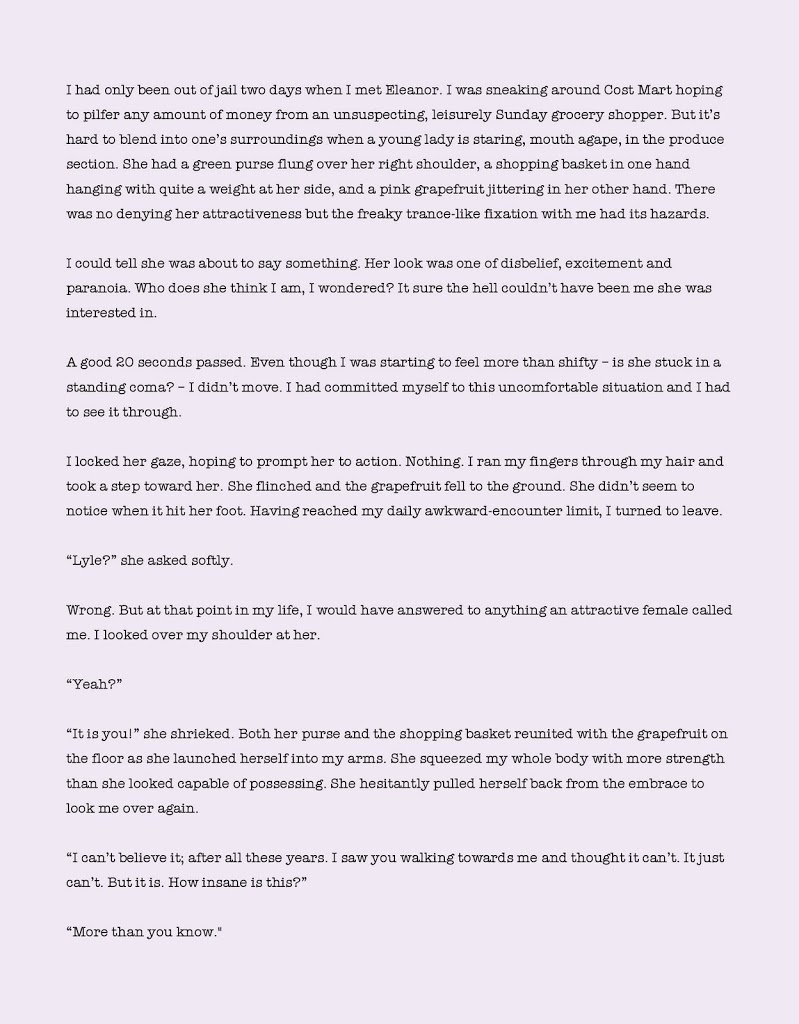
A young woman runs into an old friend in a grocery store—at least she thinks he’s an old friend. In fact the man Eleanor mistakes for “Lyle” is fresh out of prison, sent there for what crime we don’t know. But rather than correct her, “Lyle” let’s the mistake stand.

“I don’t believe it,” Eleanor responds. “After all these years . . . How insane is that?”

“More insane than you know,” the narrator answers—and he means it.

This opening has a lot going for it, in fact it’s hard to find fault with it. The first line thrusts us into the heart of the story, with the paragraph that follows setting the scene for the inciting incident—the unique event that wrests the character or characters out of their status quo and into something worthy of being called a story. Here, that unprecedented event is the meeting of not-Lyle and Eleanor, an encounter that turns on a case of mistaken identity. Not one but two lives are about to be derailed from their routines—or, in not-Lyle’s case, from whatever passes for routine in the life of an ex-con fresh out of the slammer. The question now is what’s going to happen with these two? It’s the right question, the very question that will propel us through this narrative. Will he take advantage of her? Will she fall in love? Will she uncover his criminal past along with his deception? Is he a petty-thief, or a murderer? Will he love her in turn, or will he rob, beat, or kill her? Or combination of these things? The possibilities are, if not limitless, rich.

How would this story read from Eleanor’s point of view? As a point-of-view character, pseudo-Lyle has his charms. But then he also knows he’s an ex-con, just as he knows what sent him up the river in the first place. It will be much harder, and may require manipulation on the part of the author, to withhold his knowledge from the reader so as not to give a big part of the game away. If she manipulates too much, the author exposes herself to the charge of creating false suspense—suspense achieved artificially by withholding information from the reader that the character (or characters) are fully aware of. In that case it may be better to experience this relationship from the point-of-view of the character who’s totally in the dark: Eleanor.

But in that case the author faces another challenge: namely, how to plausibly render a case of mistaken identity from the viewpoint of the person making the mistake. Will we be treated to Eleanore’s perspective after she has already survived her experience—such that, as she begins the tale, she knows it is one of mistaken identity? If made such a choice would result in a great loss of tension and suspense. For a start we’ll know she survives to tell the tale.

Hmm, maybe our author had the right idea: maybe it’s better to stick to his viewpoint.

You see the sort of decisions writers wrestle with. There are no absolute or easy solutions. In the end, it may be best to rely on gut instincts. Here, so far at least, those instincts seem to be paying off.

Posted in Uncategorized, Your First Page | 4 Comments

Flying With Father

In Latin there’s a phrase for it: in media res. It means “in the middle of things,” and it’s where many authors like to begin their books. By starting “in the middle of things,” authors avoid the long and potentially tedious expositional climb to exciting scenes and dramatic events, while at the same time plunging readers headlong into a story’s central issues, themes, and conflicts. By starting in medias res, they front-load their tales with action and suspense.

But when starting in medias res, it’s important to choose a moment or scene that not only gains a reader’s attention, but is relevant to the work as a whole, providing a tantalizing glimpse of what’s to come, while also raising the right questions—namely, those questions which the book as a whole exists to answer. An opening that’s sensational but with only a tangential or tenuous relationship to the book’s overall theme may pull in readers, but it may also lead them to disappointment and, possibly, frustration and resentment.

The Duke of Deception, Geoffrey Wolff’s brilliant memoir about his con-artist father, opens not in the middle but toward the end, with Wolff learning of his father’s death. While Wolff and his family are summering in Narragansett, a telephone rings. The telephone belongs to a friend on whose “shaded terrace” Wolff is relaxing, “sitting in an overstuffed wicker chair . . . glancing at sailboats beating out to Block Island . . . smelling roses and fresh cut grass” and drinking rum “with tonic and lime.” His soon-to-be four year old son Nicholas is with his mother-in-law, out for a ride in her black Ford sedan. Nicholas’ little brother Justin is with his mother at the beach. “It was almost possible to disbelieve in death that day,” Wolff writes, “to put out of mind a son’s unbuckled seat belt and the power of surf at the water’s edge.” The opening continues:

In my memory now, as in some melodrama, I hear the phone ring, but I didn’t hear it then. The phone in that house seemed always to be ringing. My wife’s brother-in-law John was called to the telephone . . . John returned . . . As I stared down the terrace at him, Kay and her children quit talking, and John’s cheeks began to dance. I looked at the widow Kay, she looked away, and I knew what I knew. I walked down that terrace to learn which of my boys was dead.

In fact neither of Wolff’s sons has died. The bad news has to do with his father. “Your father is dead,” John tells him. To which Wolff replies, “Thank God.” That “Thank God” is what Wolff’s book exists to explain. That “Thank God” frames the tale that follows, puts it into context, while at the same time raising a pertinent question: why, on learning of his father’s death, would a man say “Thank God?” Had one of Wolff’s sons indeed died, it would still have made for a powerful prologue, but one for a different memoir.

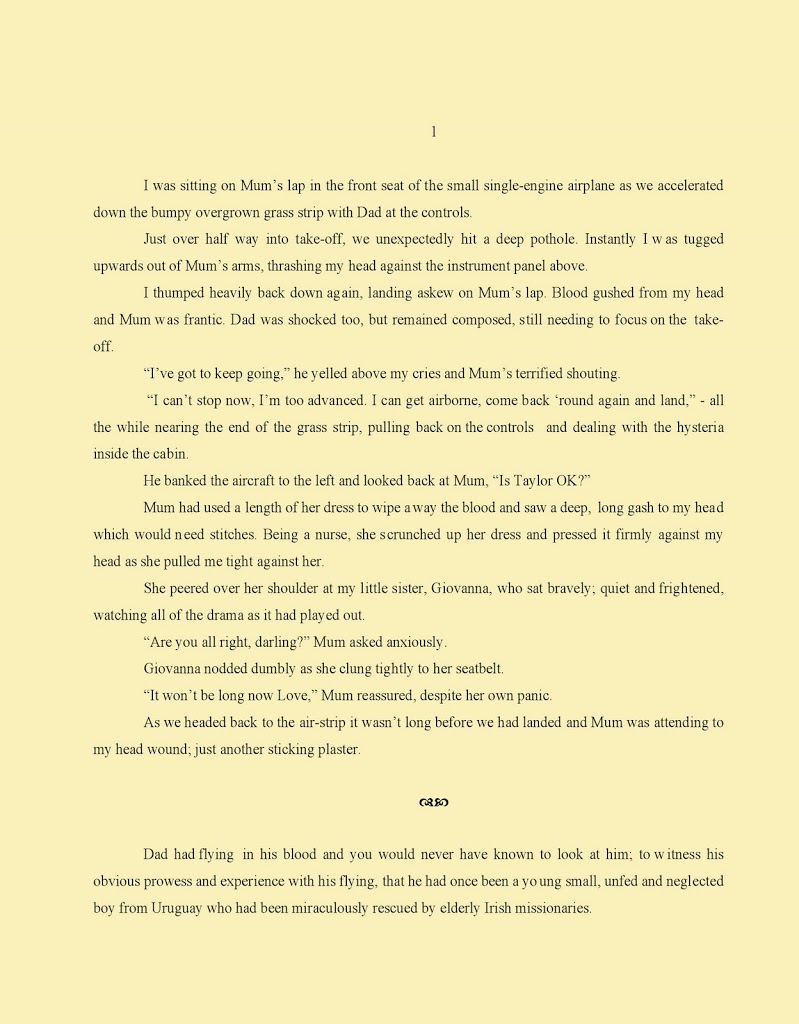
Here, in this memoir of a woman whose father was a pilot, we open with her in her father’s plane as it accelerates down a grassy runway. The airplane’s wheels strike a pothole, and the narrator’s skull is bashed against an instrument panel. Too late to abort takeoff, the father lofts his injured daughter into the sky while her mother “wipe[s] away the blood” from the “long, deep gash to [her] head which would need six stitches.” Since Mom is a nurse, she tends her child’s wound with expert calm,”scrunching up her dress and press[ing] it firmly” into the gash.

All of this is described well, and it is certainly dramatic. Yet the scene is at best gratuitous, and at worst misleading, since it conveys nothing essential about the father or his relationship to his daughter (nor does it illustrate his piloting skills, since anyone can hit a pothole). What’s best demonstrated here is the mother’s nursing skills, yet my sense is that these are not central to the memoir. Ultimately, because it fails to point to the crux of the story, this opening scene feels anecdotal—a curious event, but not an exemplary one.

The second part of the opening crash-lands us into pure summary exposition about the father’s impoverished Ugandan past. Might it not be better to choose an opening scene wherein somehow that past intrudes on the present: where, for instance, the father flies his daughter over the land of his birth? By such means one can have action, drama, exposition, and relevance all at once.

Posted in Uncategorized, Your First Page | 1 Comment

Suspense: False & Real

In works by inexperienced authors suspense tends take one of two forms. The first kind of suspense, the good kind, raises questions like the following:

  1. What will happen to X when Y happens?
  2. How will Character X solve Problem Y?
  3. How will X respond to Y?
  4. and so on.

With the second type of suspense, what I call “False Suspense,” the questions raised in the reader tend to fall along the following lines:

  1. Who is X?
  2. What is Y?
  3. Where is this?
  4. What’s going on?
  5. What in blazes am I reading, and
  6. Why am I reading it?

Both kinds of suspense create tension in the reader, but in the first case the tension created in desirable. Though eager to arrive at answers to the questions raised, the reader of a narrative that generates true suspense is willing to be teased, knowing that the answers will come in due time, and confident that when they do come they’ll be satisfying and worth the wait. And while waiting for answers to genuine suspense questions, readers are provided with enough answers to inhabit the world of the story, to fully appreciate and experience its characters, settings, events, moods and themes.

With false suspense many if not all of the virtues of true suspense are sacrificed. Instead readers are treated to the extremely circumscribed and dubious thrill of wondering, for instance, in what part of the world a scene is taking place, and in what year, and who are the characters involved, what are their names, how old are they, how are they related to each other? Such questions are rotten fruits of the practice of withholding information: denying readers access to basic facts perfectly well known both to the writer and his or her characters.

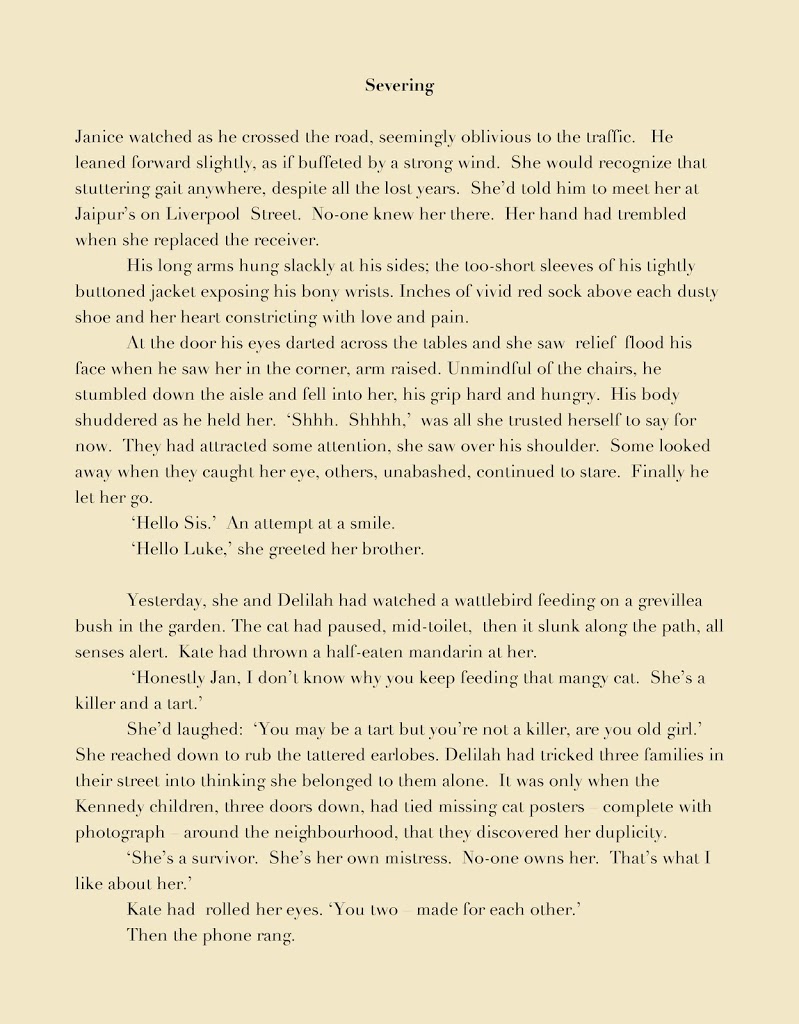
That practice is hard at work in the opening scene of this novel, in which a woman named Janice watches a man cross a street toward her. From his “stuttering gait” to “the too-short sleeves of his tightly buttoned jacket exposing his bony wrists” to the “inches of vivid red sock above each dusty shoe” the man is carefully and vividly rendered. Though syntactically awkward in places (“she saw relief flood his face when he saw her in the corner”), on the whole the prose is solid, the actions—albeit laced with melodrama—duly observed.

And yet because the scene raises and answers the wrong questions, because its author is bent on false rather than real suspense, it falls flat. Instead of asking, “Who is this strange, raggedy man walking toward the protagonist?” (a false suspense question, since the protagonist knows perfectly well who it is) we should be asking, “Why has this woman not seen her brother for so long? Why does he look like a bum? Why is he shuddering? And what brings them together now, after so many years?” These genuine questions—questions the answers to which may justify the rest of the novel—are undermined by that one question, “Who is he?”—a question with no relevance to the situation at hand: and one no sooner answered than the scene ends, as if it had nothing better to accomplish.

Why do writers generate false suspense? For several reasons. First, because in reading works by other authors they confuse real suspense with a general state of confusion, or because in reading such works, even by celebrated authors, they encounter the same false suspense: i.e. Steven King does it, so why can’t I? But a third explanation is the most likely: they lack sufficient confidence in the ability of their material to generate its own, authentic suspense, so they give it a leg up by capriciously withholding something here and there—in this case, the fact that the man crossing the street toward the woman is her brother.

Unfortunately, often this third explanation points to a deeper problem, namely the reason why authors lack confidence in a story’s ability to generate authentic suspense: they don’t yet know, or aren’t sure, where their stories are going, or if they have a story to tell.

In this case I’m willing to give the author the benefit of any doubt. In fact I’m sure that Janice and Luke have had an intriguing past, and are headed for an even more intriguing future. I just wish their creator were as confident as I am.

Posted in Uncategorized, Your First Page | Leave a comment