The Charmed Life

Home with Audrey now for two days. She’s very fussy when awake, and (much like her Papa) seems to find the waking world unsatisfactory in almost every way. Unlike him, she hasn’t yet learned to express her dissatisfaction in words and pictures, so she resorts to a cruder if no less effective medium: screaming. For hours on end Jung and I find ourselves trapped within the stretcher bars of Munch’s most famous painting. But as soon as she feeds or sleeps “The Scream” turns into “Lullaby for Strings” and her parents fall in love all over again.

Hopefully, as time goes on, Audrey will find the world more to her liking, or at least develop more subtle ways of expressing her discontent!

Meanwhile it’s snowing here in Carbondale; forecasters predict six inches by mid-afternoon. Already I’ve been out shoveling, feeling like the father in Robery Hayden’s “Those Winter Sundays,” whose love for his family is best expressed by tending the fire. I’ll say this: it is better to clean the snow off the car with a baby in the house than without.

A year ago if someone had told me I’d be a daddy, I’d have laughed in his or her face. For me, then, the charmed life consisted of tidy quiet rooms equipped with drawing supplies, writing implements, books, and cozy corners to read in. The phrase “charmed life” conjured a sunny cafe fronting the Mediterranean. A pied-a-terre in Paris, maybe another in Rome. Two swims a day, one in a lake, one in the sea. An aperitif at four in the afternoon giving way to quiet meals eaten under grape arbors with good friends–all of them childless.

And here I am in Carbondale, Illinois, in an apartment crammed and cluttered with baby implements—swing, stroller, bassinet, car seat, diaper bags, baby tub, crib, breast pump, swaddling blankets … what Zorba would have called “the whole catastrophe.” In four days Jung and I have slept maybe eight hours. Clothes and shoes scattered everywhere, dirty dishes piled in the sink. Last night we were so exhausted we left a pan of re-heated takeout egg foo yung on the stove. No time for tidying up. I remember in my younger days walking into homes like this one–homes of fresh parents–hearing the baby’s screams and saying to myself, “There but for the grace of God.” For me having children was something other people did out of some perverse masochistic instinct, a form of self-sacrifice that made about as much sense as setting yourself on fire.

Now, fresh from brushing the snow off the car, I crack open the bedroom door and bear witness to my child sound asleep in her mother’s arms, and the words “charmed life” take on a whole new meaning.

Posted in Dreaming on Paper, Uncategorized | 4 Comments

David Levine

(Note: I first write and posted this at the beginning of this year, but removed the post, since I felt it violated the artist’s privacy. David Levine died on Tuesday. He was 83.)

I met him at the Museum of the City of New York. We sat next to each other in the small theater, where we had come to listen to Oliver in conversation with Jonathan Miller, a fundraising event for Glimmerglass Opera, where Jonathan has directed productions of La Traviata and Janácek’s Jenufa. The man’s daughter-in-law, Nancy, whom I’d spoken with at the cocktail reception, introduced us.

“And this is my father-in-law, David Levine.”

“Not David Levine the caricaturist?” I said.
Indeed, the man whose pen and ink likenesses of famous authors and political figures have graced the pages of the New York Review of Books for the past thirty-five years. But the word “likeness” hardly does justice to Mr. Levine’s work, since his caricatures (another word which, applied to his work, seems too limiting) do more than capture their subjects’ looks; they snare them in a spider’s web of crosshatchings, pin them to paper with crow quills, lash them to the white page like Ahab battened to his pale whale.
I was still in high school when I first came upon Levine’s drawings. Aware of my own bent for caricature, a friend of my parents’ gave me a book of his literary caricatures titled “Pens and Needles.” For the next week I carried the book around with me, and copied Levine’s portraits of Beckett, Joyce, Hemingway, and Poe. I tried all different kinds of pens, paper and ink; still, for the life of me, I couldn’t duplicate his line, those cunning crosshatchings. They looked easy enough; scratch, scratch, scratch . . . ah, but they weren’t so simple! Levine used his pen like a sculpture uses his chisel, an ink-stained Michaelangelo carving away at the stone to release not just the face or even the expression, but the personality entombed inside it.
Now here was the man, eighty-two years old. He looked, I thought, like one of his subjects; the hook nose, the chin melting seamlessly into what might have been a neck, the small worried mouth tucked into the shadow of the nose, the eyes small, wet and sad. I explained that I’d been a longtime fan of his work; that I had seen not just his caricatures, but his watercolors of Coney Island. “Such beautiful watercolors,” I said. This, I could see, made him glad. Afterwards, when the event was over, I asked if I could send him something, an essay I’d written about my days as a caricaturist. He gave me his address. As he wrote it on the back of a card, his hand trembled; the writing was barely legible. I had to confirm it, later, through his stepdaughter.
* * *
A week later I got a call from Oliver. “David Levine has invited us to lunch at his place on New Years’ Eve. Would you like to go?”
David lives in Brooklyn Heights. He’s been living there for thirty-five years.A freezing day;the forecast called for snow. When we arrived in Oliver’s hybrid the snow had already started. It took a half hour to find a parking space. We plunged into the icy headwind that greeted us on Montague Street. It was only a four block walk, but with the wind it felt like fifteen.
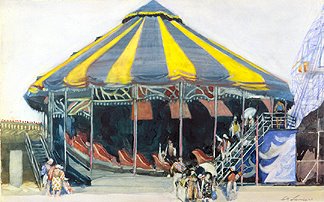
David lives in a grand, sprawling pre-war buildings, with his apartment every bit as grand and sprawling. We walked from room to room, with every parcel of wall space taken up by David’s paintings—mostly small watercolors and oils in antique frames. “I’m a small-scale painter,” he said while giving us the tour. His second wife, Kathy, took us aside one by one to give her own little tour. She showed me the paintings in their bedroom, portraits, mostly, and a painting of David’s father in the tailor shop where he worked—a study in dusty browns and umbers raw and burnt. David’s paintings, I noted, have an antique, anachronistic quality that makes them more than a match for the old frames he hangs them in. Someone unfamiliar with him and his work would have been hard pressed to guess that the works had been done in the late twentieth century, let alone the twenty-first.
David’s apartment holds three studios, one for painting, one for watercolors, and one for the pen-and-ink caricatures for which he is famous. The painting studio is largest, with windows to the north and west. A large in-progress canvas—the biggest I would see that day—sat on an easel, a seascape with heroically posed figures jumbled together among breaking waves: a sort of Raft of the Medusa without the raft. Jittery black lines filigreed the paintings otherwise pale, ghostly surface. The lines—in charcoal—seemed to have been added lately, as an afterthought, by someone whose touch was far less sure than that of the man who had done the underlying brushwork. There was something desperate, something last-gasp like, about those black lines.
Leaning against one wall were dozens of old canvases—old enough so that the linen had been stretched using nails, not staples. These were traditional portraits in the style of the Robert Henri or the Barbizon school, with muddy backgrounds. I didn’t think much of them; but as David himself explained they were apprentice works. Against another wall we found stacked portfolios filled with watercolors on paper, and these were much more exciting, more beach and Coney Island scenes, symmetrical compositions holding more amalgamated bathers in bright swimsuits, with striped umbrellas and chairs poking through here and there, paintings both somber and cheerful, filled with raucous life but also strangely static, the static quality reinforced by a low-key palette that imparted to a wide range of hues the dull yellow sheen of old varnish. All of David’s paintings and watercolors have this aged look; as if the classicism of their subject matter and style weren’t enough to render them anachronistic. I couldn’t help thinking, “This man wants nothing to do with his time.”
And yet David wants very much to be remembered as an artist of his time. As we passed into his caricature studio, where we perused one of several thick document boxes holding hundreds of numbered ink drawings, he posed the question. Without thinking I invoked Daumier, who like Levine was both a great caricaturist and a great painter, with one art form informing the other. This did not seem to please David, whose already drooping face dropped even further. “What’s wrong with Daumier?” I said.
“You shouldn’t wish me so well,” said Levine.
At last we finished our tour. We spent an hour—I could have spent much longer, but unlike me Oliver’s interest in two-dimensional art is limited; whereas I could have gone on forever asking David about pen nibs and kid-finish bristol vellum . . . By now the snow had laid a sheer white blanket over the rooftops of Brooklyn Heights, and Oliver was worried about getting home. We put on our coats and made our way against the icy wind to Montague Street, where, at a place called Teresa’s, everyone ordered bowls of chicken soup.
While waiting for the soups I asked David to sign a small facsimile of one of his sketchbooks that he’d given me, which he did using one of Oliver’s magic markers—a purple one. David’s hand trembled as he signed, his face inches away from the notebook.
David has macular degeneration and is going blind. The man who drew a thousand caricatures for The New York Review of Books won’t draw much longer.

Posted in Dreaming on Paper, Uncategorized | Leave a comment

The Train

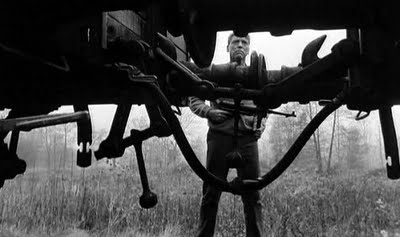
I remember one locomotive, in black and white, smashing into another.At seven years old not something you forget. The moving image of those two trains colliding, the accelerated chuffings of one locomotive bearing down on another splayed across the tracks, a collision inevitable, imminent, and yet impossible: they’re not really going to crash into each other, those two trains. And they do.

The first time I saw John Frankenheimer’s “The Train” I must have been around seven years old. The screen I saw it on was that of a wooden, boxy Magnavox in the living room. Back then you saw movies in one of two places, in the theater when first released, or on television when and if one of the three or four networks broadcast them. If memory serves me, I saw it on Channel 9, WPIX, on The Million Dollar Movie (please don’t check facts).

The title alone would have drawn me. What boy of seven (or six or eight…) isn’t drawn to trains? By then I already had a Lionel train, the one my parents got me for Christmas, set up in the playroom downstairs: one locomotive and a circle of track set up on a table made from a large sheet of thick plywood laid across two saw horses. No houses, trees, buildings, nothing but the bare tracks and a transformer than hummed, grew warm, and gave off a dull, metallic odor when in use. It was enough. Down there, with my Lionel set, I could do with my train what I liked. I could make it go backwards. I could make it jump the tracks (all too easy to do); I could put things on the track for my train to crash into: a wooden box, a shoe, a Matchbox car.

The movie, starring Burt Lancaster, has a simple but stirring plot: at the close of World War II, an obsessed Nazi general, played to perfection by Paul Schofield, contrives to deliver a trainload of so-called “degenerate art”–contemporary masterpieces by Braque, Cezanne, Picasso, Renoir, ransacked from the Jeu de Paume–into Germany before the Allies close in. To achieve his goal Colonel von Waldheim commandeers a train and the services of LaBiche (Burt Lancaster), a railroad man who happens also to be a member of the French resistance with his own orders: to see to it that the train never arrives in Germany while also protecting it from allied bombers.

Adding great dimension to this simple premise is von Waldheim’s passion for the paintings he has plundered. However “degenerate,” he realizes their value not only in Reichmarks, but as art. He is in love with the paintings–so much so that he is willing to sacrifice many lives, including his own, to “own” them however vicariously and briefly. This equation pitting the value of art against that of humanity runs as deeply and thoroughly through the film as the chuffing refrain of locomotive engines, the staccato Maurice Jarré score, and the deep, depth-of-field black and white photography that gives each frame the quality of a Cartier-Bresson photograph.

“The Train” may be the first noir-action-war picture, one whose starkness is complemented by a plot of nearly pure action (man must stop train) such that the very minimal dialogue–much of it dubbed over the voices of French actors–is scarcely necessary. One thinks of Buster Keaton’s “The General,” with its similar plot and theme. “The Train” is the direct descendant of that 1927 silent comedy classic, harbinger of countless “chase scenes” and “action movies” to follow.

But when it was made in 1964, “The Train” did something that practically all action films made since have failed to do: it took its time. Instead of a lot of jump-shots and quick-cuts, we watch sensible action sequences played out in real-time. When Burt Lancaster rigs an explosion, we watch him prepare the detonation fuse, stripping the wires, twirling them into each other, and sinking them into the plastique, covering the fuse and explosive with ballast, then unspooling the wires to where he attaches them to the plunger contacts. The sequence takes minutes. The whole movie is filled with such painstaking processes. Blowing things up takes time (from today’s films you wouldn’t think so). There are no special effects. A rail yard is blown to bits–for real (in fact it was due to be demolished; Frankenheimer and his crew obliged.) A single short sequence where the train is strafed by a fighter plane cost as much to film in itself as the rest of the movie.

But the real beauty of “The Train” goes deeper than explosions and crashes. Through watching it, I got my first dose of culture. Art was no longer an abstraction. Something of great value was packed inside those wooden crates. All those locomotives chuffing and crashing, they served a high moral purpose. Spoiler alert: When it’s all over, amid a sea of crated paintings and human carnage, the defeated General confronts his nemesis, LaBiche/Lancaster, who faces him with a loaded machine gun. “The paintings are mine,” he claims. “They always will be; beauty belongs to the man who can appreciate it! They will always belong to me or to a man like me. Now, this minute, you couldn’t tell me why you did what you did.” Lancaster looks at the paintings, then at the bodies, and then at the General. His machine gun answers for him. To my knowledge, the first act of verbal suicide on film.

Posted in Dreaming on Paper, Uncategorized | Leave a comment

Wild, Wild West

Like most if not all boys I wanted to be a hero, and tuned in to the TV to see what latest models were available. There was one program, black and white at first, called The Wild, Wild West. Maybe you remember it?

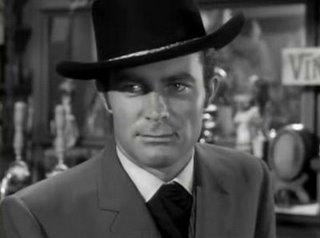
Onto a western format, the series grafted a James Bond spy motif with science-fiction plots straight out of H.G. Wells and Jules Verne, with a dash of rococo thrown in for good measure. The James Bond secret service hero, named—appropriately—James West, answered directly to President Grant while touring the nation in a glammed-up private railroad train with his sidekick, Artemus Gordon, man of a thousand disguises.

But James West—or Jim, as Arty and others called him—got the fights and the girls. With a combination of martial arts that included lots of kicking, double-hammers, and karate-chops, he could dispatch ten bad-guys at once, flinging them over balconies and out of windows like so many sacks of potatoes. As for the girls, he no sooner flashed them his devastating dimples than they swooned into his arms—often with a dagger or a derringer behind their backs, but that they never got to use: with nothing more than kiss Jim disarmed them.

How I wanted to be that guy. He wore tight gold vests that emphasized the V-shape of his fighter physique, and an equally tight bolero-style jacket and pants that looked painted on (and must have split dozens of times during those fight sequences). I wanted to wear tight clothes like that, and vests made of gold brocade with exploding buttons and knives concealed in secret pockets. I wanted a pair of black boots with triangular heels that opened up to hide exploding balls. I wanted a spring-loaded derringer up my sleeve and ten bad guys to beat up at once, starting with Bobby Mullin, the Catholic school bully who used to beat me up regularly at the bus stop for not believing in God.

But mostly I wanted girls to swoon into my arms, to be rendered paralytic by my dashing good looks—though I had no dimples, devastating or otherwise, and my hair was too curly, and my Italian eyes were too big and too brown, when they should have been squinted and blue. One makes allowances. I bought a pair of black cowboy boots, and had my mom sew me a chest-constricting brocade vest, and wore the tightest jeans I could squeeze into.

Jim West was played by actor Robert Conrad, a short, cocky, chisel-jawed jock, five-foot-eight if that. And that was one of his great appeals to us boys: he was like us, short; we could measure up to him. If he could stand up to a dozen bullies, we could stand a chance with the two or three assholes we had to contend with. He gave us all hope, Conrad/West did. When the series ended after four short years, Conrad went on to do a series of increasingly poor shows; his looks faded and with them his appeal: he was no great actor, never was. But the role of Jim West was his and none could have done it better. He countered Ross Martin (Artemus)’s hammy caricatures with a deadpan delivery that made him salt to Martin’s pepper. Conrad did his own stunts, too.

Forty years later, Jim West still represents for me the definition of masculine beauty, strength, and style—an obsolete standard, to be sure, better suited to the black and white world, the world of Playboy clubs and cold wars, than to that of fundamentalist zealots and hardcore: a world that still believed, however ludicrously, in heroes, villains, and damsels in distress. And that by rights I (along with everyone else) should have long ago outgrown.

Posted in Dreaming on Paper, Uncategorized | Leave a comment