The Spider’s Web

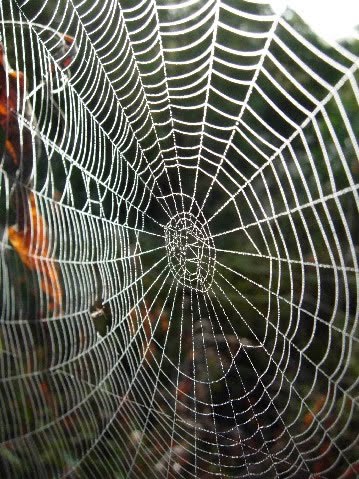
Sometimes the mind goes as blank as the white page, as an empty glass, as a cloudless sky, as a spider’s empty web.

I get up from my desk. I would pace, but there’s no room for pacing up here in my loft. So I walk down the stairs to the living room and wear out the strip of carpet behind the sofa. Since the house is small the kitchen is only a few steps from the sofa. I pace to the refrigerator, where I search inside for—what? Milk? Juice? Yesterday’s sauteed fillet of flounder? Salvation?

I take the orange juice out, pour and drink a splash, put it back. I don’t feel saved.

I linger awhile in the cold breath of the opened refrigerator, then close the door.

I turn to the windows, look at the lake. When in doubt there’s always the lake. I put on my sandals (to keep the pinecones and needles from stabbing my feet) and head out the door. On second thought I should get my Speedo and towel. No, just go to the dock, I tell myself. Go stand there and think how lucky you are to be so completely empty in such a lovely place.

I walk down the sloping lawn over the pine needles. My sandals thump down the gray wooden boards. I check to see what latest webs my spider neighbors have spun. There’s a fresh one on the ladder. I tried to save the last one, but in climbing out of the water after a swim I forgot and ruined it, and felt terrible, until I reminded myself that spiders have nothing else to do but make webs. By ruining one I was keeping a spider employed. Is it the same spider, I wonder, that week after week keeps on building the same web across my dock ladder, the one I destroy each time I go for a swim?

It’s that guy again, the spider must say to himself, surveying the damage each time. That writer who lives in the A-frame. He can’t write so and so he comes down here and destroys my work. His mind is blank, and he takes it out on my webs. Those who can’t create destroy, the spider thinks, and goes on weaving his latest web.

Today I won’t destroy your web, spider friend. Jealous though I am of your talent, of the perfection you achieve time and again in your designs, and also of your industry, your tenacity, your perseverance … you who never run out of webs to weave, who spin the most delicate and intricate yarns … while I sit at my desk spinning nothing but loose thoughts, weaving an empty web of words … You have nothing to fear from me. I won’t ruin your creation. I’ll climb around the ladder and take some comfort in knowing that, though I made nothing today, I didn’t destroy anything, either.

Posted in Dreaming on Paper, Uncategorized | Leave a comment

The First Sip of Coffee

There are little things one lives for, and for me the first sip of coffee in the morning is one of them. Without my morning coffee to look forward to, I would still live, but it would be a muted, sorry, flavorless life.

I say “coffee” but to most people what I drink is espresso. In fact espresso is coffee, but in a form so vastly superior to what commonly goes by that name here and in the United Kingdom and in certain other deprived corners of the world, these places don’t dare use that other name.

I once met a coffee expert, a man who traveled the globe sampling coffee in different countries, who did tastings and rated coffee for several coffee trade magazines, an interesting and articulate man. He kindly brewed me a cup of what he claimed was the world’s finest coffee—no milk, no sugar—and had me taste it. It tasted good, but it didn’t taste like coffee, not to me. And it was frankly less satisfying than the very simple espresso I brew in my cheap little aluminum Bialetti moka pot (by the way, aluminum does not cause brain damage; that’s a tired old myth). When, as politely as possible, I said so to the coffee expert, the coffee expert replied, “Well, espresso is something else altogether.” I agreed.

As for what they serve in Starbucks, don’t get me started. Somehow—as difficult as it is to do so—they manage to make a bad espresso. Their American coffee is even worse. Just the smell is enough to depress me. Back in New York, if when walking down the sidewalk I came across a Starbucks, I’d cross the street just to get away from the smell.

I get up between six and seven. I’m a morning person. I dislike and even resent the hours between ten and dawn; they don’t like me much, either. As far as I’m concerned those hours are good for insomnia and sleep. Usually, I get some of both.

Even when I sleep, I don’t like it that much. In a movie, “Journey to the Center of the Earth,” I think it was, once I heard a character describe sleep as “those little slices of death.” What might be worse than death, though, is insomnia, which I suspect is more like being buried alive. It’s enough to make you hate going to bed. When I do sleep I don’t dream; anyway I don’t remember my dreams. A few times a year sleep presents me with a dream fragment, which by the powers of my imagination I convert into a whole and satisfying dream. Otherwise sleep gives me nothing but oblivion, and not enough of that.

The only thing I get from sleep is my love of and gratitude for morning. Unlike most people, when morning comes I don’t feel perturbed, resentful, annoyed, half-dead, or even groggy. I feel relief, like I’ve been rescued from an unpleasant chore or a form of passive torture.

I celebrate with a bowl of espresso and hot milk.

The moka pot comes in two parts. I unscrew them and fill the lower section with water up to its little nipple. Then I fill (but don’t pack: loosely) the aluminum filter with fine-ground espresso coffee— it makes very little difference which brand, as far as I’m concerned. Then screw the halves together, put the pot on the stove with the heat high, and wait about five minutes—first it will gurgle, and then it will gurgle and hiss and splutter. Then it’s done. So simple.

Add to piping hot milk, drink.

The Italians, who guzzle the stuff, call it by one word: caffelatte.

Translation: Good Morning!

Posted in Dreaming on Paper, Uncategorized | 3 Comments

Town of My Dreams

Sometimes at night, as I drift off to sleep, or when I can’t sleep, I play a game with myself. I imagine that I’m in Bethel, Connecticut, my home town, circa 1965, when I was seven years old. I imagine myself walking down Greenwood Avenue, the town’s main street, and into its stores as they were back then.

The object of the game is simple and it is this: to recall, as vividly as possible, the town I grew up in, as it exists in my earliest memories.

Bit by bit, store by store, I put together the town of my childhood, now of my dreams. I start with Tony’s food market, at the north end of town where the main street climbs up a hill. I see the meat section there, and the mounds of ground beef that looked, to me as a child, like spaghetti. Tony Junior stands in his bloody white smock behind the meat counter, while his father, Tony Senior, works one of three cash registers, the one nearest the door. Tony Senior’s hair has gone gray, but he’s younger than Tony Junior today; younger than the man dreaming this now (Tony Senior has passed away).

From the meat department I go down the aisles one by one, seeing the cereal and oatmeal boxes, the stacked cans of soup, vegetables, and fruits, the frozen peas and lima beans and ice cream boxes in their freezers, the racks of spices and baby food, the bins holding oranges and peaches and other fresh produce, the pyramid-like stacks of tomatoes.

And it all makes me happy. Why?

From Tony’s I head down to Noe’s clothes store, where for years my mother outfitted my twin brother and me. As I step in the door I smell the blue jeans piled up on shelves, a deep, rich, cottony smell. I see Mr. Noe with his yellow tape measure behind the counter, and next to him a white-haired woman, I forget her name—but she’s always there, with red lipstick and pinched face.

In the dream I see and even recognize some of these people, but they can’t see me; I’m invisible. It makes me wonder. The ghosts whose presences we feel every so often, are they people like me lying in bed and dreaming in some future that I will never live to see? Will somebody somewhere someday dream up me?

I could name all the stores going all the way down the street: the hobby shop, with its glass cases and golden trains, Jerome’s Five-and-Ten-Cent store, with its candy racks of Life Savers and Pez (and Mr. Jerome on crutches with white shirt), Nelson’s hardware, Norton Jewelers, Elsa-Edna, the Booklet: the little white house where books were sold, and where I first fell in love with a book (called The Ship, packed with beautiful, full-color illustrations)….

When I dream my town this way, I always feel a sense of wonder and warmth: for the boy I was back then, and for the town that was so much a part of me it seems to have been one with my substance, and vice-versa.

Later, as I grew older and sophisticated, I would find things to complain about, how my town was boring, how small its minds were, how little it had to do with the world, how small, how drab, how provincial, how dreary—how the only hope it offered was that of escape.

Later still, my attitude would soften. As life in the big city dealt me blow after blow after blow, I would think back on my small-town past with a nostalgia as sweet and brown as honey, but that my occasional visits back home failed to support. In this alone I may have something in common with Samuel Johnson, who, in middle age, found the experience of returning to his childhood Litchfield less than satisfactory:

I found the streets much narrower and shorter than I thought I had left them, inhabited by a new race of people, to whom I was very little known. My play-fellows were grown old, and forced me to suspect that I was no longer young. My only remaining friend had changed his principles, and was become the tool of the predominant faction . . . I wandered about for five days, and took the first convenient opportunity of returning to a place, where, if there is not much happiness, there is at least such a diversity of good and evil, that slight vexations do not fix upon the heart.

If I were to return bodily to Bethel now, I too would find the town that I knew as a child gone, replaced by one vastly less charming. Now the only way back there is through my dreams.

Tonight, I’ll go there again.

I never get tired of going.

Posted in Dreaming on Paper, Uncategorized | Leave a comment

And Baby Makes Me

Congratulate me.

In less than five months and for the first time I will be a father.

What does it mean? I don’t know, really. My sense is one of impending delight and doom. Before it was more doom, now it is mostly delight.

I did not plan to be a father; in fact for the first half-century of my life I successfully avoided it. My papa had me when he was forty-seven, and there were many times growing up when I felt he was too old, much too old. Papa was a lovely man, and even a great papa, but Papa was old. He wouldn’t throw a baseball. He wouldn’t throw a football. He wouldn’t throw any kind of ball. He wouldn’t jump in the water like all the other fathers. “Jump, Papa, jump!” I’d scream at him, to no avail. “I can’t; I’m too old,” he’d say as he entered slowly, wincingly, massaging palmfuls of water over his pale, sagging chest. Too old: those two words rang in my young boy’s head like the tolling of a doomed, cracked bell. I would never inflict my old age on a child. Never.

I am fifty-two, five years older than my papa when he had me.

I have passed through all the initial stages: shock, horror, denial, anger, grief, resignation. I am somewhere now (I believe) between acceptance and joy, much closer to happiness than to its opposite, but having yet to arrive there—not quite. I am told that, until the moment comes, it’s impossible to second-guess or even to imagine how I’ll feel. That’s the thing that frightens and worries me most: what if I don’t feel what I should? What if I’m not overwhelmed with paternal joy? What if I don’t fall in love with being a father?

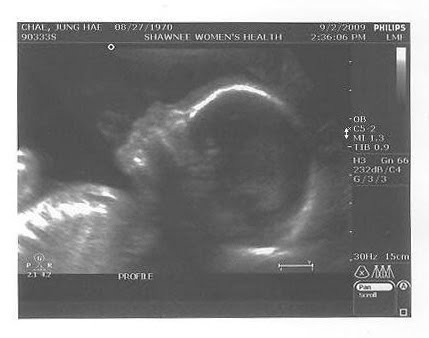
Yesterday Jung, the mother of our child-to-be, sent me by email two sonogram images from her most recent visit to the Shawnee Women’s Health Center in Carbondale, Illinois, where she has gone to obtain her master’s degree in poetry. Two small, grainy, blurry, black and white images, one showing a pair of tiny arms with even tinier hands, the other a very round head with distinct features—a nose, mouth, eyes, ear, the works (we both concur that these features are patently Italian, and that pasta dishes will be the order for the day for years to come).

My daughter, I say to myself, looking at it. This is my daughter. Audrey (the name we’ve chosen). This is my daughter Audrey. My daughter, my daughter, my daughter. No matter how many times I say them to myself, the words don’t seem any more real to me than the picture. It must be a mistake; it must be someone else’s fetus I’m looking at. For me to be a father is impossible.

That last thought, of course, is a carryover from the last few decades. For all those years it really was impossible for me to be a father, otherwise I would probably have become one. It was impossible because I was too immature, too selfish, too frightened, and too hungry and even desperate to establish my own presence in the world—through words, through song, through novels and stories, by any means available to me (and some not so available), to even consider being responsible for a presence other than my own. Instead I gave birth to works on paper, I scattered my seed in the forms of words and sentences, I spread it over surfaces in acrylics and oils and watercolors. I did my best in my own way to procreate. And I was prolific.

Where are the fruits of all those scattered seeds? Filing file cabinet drawers and flat files, mostly. No, that isn’t fair; my works have been read and appreciated. But still, something was missing, or I was missing something.

I remember, back when I had just graduated from Bethel High School, a classmate of mine also named Peter, Peter Smith, a very bright, very athletic guy, and the first of any of my friends to marry and have a child, which he did that year … I remember him saying to me, apropos my art and his fresh fatherhood, “Pete,” he said, “I know you’ve written lots of stories and made lots of great pictures, but I gotta tell you, man, until you’ve held your own child in your hands and felt its heart beat and heard it breathing, you’ll never know the meaning of creation.”

For that remark I would resent Peter Smith for many years to come, thinking: who was he to say what I would or would never know? But even then I had the sneaky suspicion that he was right.

Come January I’ll know for sure.

At least it’s a girl. I won’t have to throw too many balls.

Posted in Dreaming on Paper, Uncategorized | 1 Comment