Stained Waters

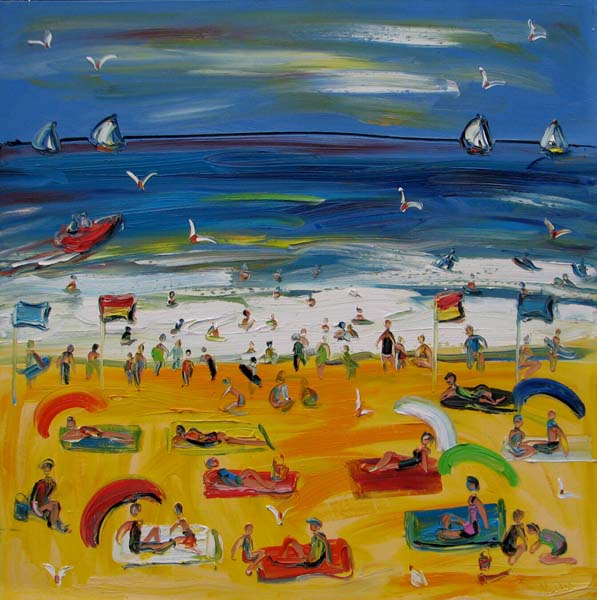
“…the waters stained yellow by sunscreen and human flesh.”

Who’d have guessed that such a line would ignite a debate?

For more than half an hour we debated the merits and drawbacks of that one phrase, the eight students of my Advanced Fiction Workshop and I.

It started as such debates always start, with a student singling out a phrase or sentence for praise or damnation. This time the student was Sheila, and the first volley consisted of praise. I asked her to specify.

“I like the rhythms of the sentence, and the vivid image it summons of a crowded public beach.”

Others, though not everyone, agreed.

Now my turn to play devil’s advocate. “But do you really see YELLOW water? Do you WANT to see yellow water? What sort of a public beach are we talking about here, one along the Ganges? Does sunscreen really stain water? Does it stain it yellow? If so, how much sunscreen is required to stain a whole beach?”

Sheila objected. “We’re writing fiction here!”

“So?”

“As a reader I know exactly what the author means,” Richard, another of my students, said.

“What does the author mean?”

“He means that the water seemed to be stained yellow with sunscreen.”

“If that’s what he meant, why didn’t he say so?”

“But that IS what he said?”

“No, he said the waters are stained yellow, not that they seem that way.”

“What’s the difference?”

“The difference is that one statement is true, and the other is false.”

“So,” said Sheila, “if TJ had written, ‘…the waters seemed to be stained yellow by sunscreen and human flesh’ that would be okay?”

“That would be a solution, though not a great one.”

“Why not?” asked Warren.

“Because ‘seemed to’ is a wishy-washy cop-out. Why say what something seems like when you can say what it really is?”

Heads shaken.

“But how do you know the original statement is false?” Sheila again. “How do you know the waters weren’t stained yellow?”

“You’re right,” I said. “I don’t know. But I’m not convinced. In fact I have serious doubts. I have never seen a public beach stained yellow by sunscreen, or by anything else, for that matter. Nor have I ever seen water stained by human flesh.”

“But I think he’s talking about the water being ‘stained’ by the reflections of human flesh,” said Gwen, who usually stays out of these things.

“Then maybe he should have said so, in that case.”

“But it’s implied,” Warren said with a gotcha look on his face. “You’re always saying, ‘Don’t state what you can imply.’ Aren’t you always saying that?”

“On the contrary, he’s not implying that the waters are figuratively stained with reflections of flesh. He’s stating that they are stained with flesh.”

“The implication is implied!”

“A fact was stated—an inaccurate and unconvincing fact, in my opinion—and yours, apparently, since you feel the need to convert it into a figurative statement. But it shouldn’t be the reader’s job to make such conversions.”

“Why not?” asked Sheila.

“Because in the moment in which such conversions are made, the action of the story, however briefly, is frozen, stopped; as readers we are no longer having the experience described; instead, we are pressed into service as editors, doing damage control, however subliminal.”

“You’re crazy,” Warren concluded not for the first time.

“Maybe so.”

At this point TJ, the author, spoke up. “I was at that beach. The water had a yellow tinge. I asked a lifeguard about it. The lifeguard said the yellow tinge was from sunscreen washed off of people’s bodies.”

Warren smirked. Sheila smiled. Looks of satisfaction spread around the conference table, as they usually do when I am made to eat my pedantic words.

“So, Professor,” said Sheila, “now what do you think of the line?” (Note: if and when my students elect to call me “Professor” it’s usually with a touch of sarcasm, to indicate that I’m being an ass.)

“If the description is factually true, then the author is completely right to insist on such a phrase, since, though it may raise doubts like mine, it’s nevertheless accurate.”

Warren: “Are you saying that it’s okay to write something no one will believe, as long as it’s true?”

“I’m saying the author is within his rights in doing so. That doesn’t necessarily make it a wise decision, but it makes it a justifiable one. And one could argue, too, that in describing water stained yellow by sunscreen the author is telling us something about the world that we—or at least I—didn’t know. That’s worth something.”

“Yes,” said Tom, who’d made a valiant effort to shut up until now. “But you didn’t believe it!”

“Now I do,” I said.

Sheila looked exasperated. So did everyone. Eight pairs of eyes rolling. Since throwing marbles as a kid I’d never seen so many bright shiny objects revolving.

“Let me explain. First, if I were reading this story, say, as published in the pages of the New Yorker, or a literary journal, with that phrase in it, certain things would be true that are not true here, now. First, the story would, presumably, be working well as a whole (it isn’t now). By the mere fact of its being published my confidence in the author would be preordained, so to speak, and would only grow as confirmed by my reading. By the time I reached that phrase in the story, assuming all has gone well up till then, my confidence in the author’s authority being by then well-established, I would surrender any and probably all doubt and immerse myself—if not luxuriate in—those yellow-stained waters.

“That isn’t the situation we find ourselves in here. No such authority has been earned. By telling us that the description in question is indeed based on fact, the author has won the right to stick by his guns: here, now, in this room, among us, his peers. However, he still faces the problem of authenticity—or of the appearance of authenticity—with readers not privileged by his immediate presence and attendant charm, good-looks, etc., and to whom he can present his case and make his explanations apart from the text in question. In other words, once the rest of his story works, when it is convincing as a whole, then his earned authority will buy him yellow-stained beaches and whatever else it can afford. Until then, TJ can’t get away with it—or he can, but in a limited way, with a few readers, and that’s not good enough.”

“So what should TJ do?” asked Tom.

“If this were my story, and that were my phrase to tinker with, the solution, for now, for me, would be to cut the word ‘yellow’ and add the word ‘reflected’ and write:

‘…the waters stained by sunscreen and reflected human flesh.’ ”

There were those in the room who didn’t agree. But no one said a word. But then they’d had enough of me and my pompous sophistry, and you have, too.

Posted in Dreaming on Paper, Uncategorized | Leave a comment

Dissonant Music

Music—the literal music of singers and instruments—but also the music of words as conveyed through Joyce’s writing itself, plays a key role in his long story, “The Dead.” Music is referenced throughout the story, beginning in the first paragraph where the “wheezy doorbell” clangs, a harsh and already dissonant note foreshadowing dissonance to come. A page and a paragraph later we learn that Mary Jane had “had an organ in Hadington Road” and that she gives concerts every year. Aunt Julia is a soprano, and her older and more feeble sister, Kate, gives music lessons “to beginners on the old square piano in the back room.” The event in preparation is billed as an annual dance, but clearly music lies at its core.

Metaphorically, on page two, Joyce sounds two more dissonant notes (if one counts the clanging doorbell as the first). These are expressed by the aunts’ distress over the tardiness of two of their guests, Gabriel Conroy and his wife, Gretta, and over the possibility that another guest, Freddy Malins, will turn up “screwed.” The first fear is quickly put to rest as the Conroy’s arrive, with Gabriel “scraping snow from his galoshes.” The first mention of snow arrives with its own special dissonance. That, like music, snow is to play a key metaphorical role in the story is made clear by Lily’s stating portentously, “I think we’re in for a night of it”—words that could be applied with equal accuracy to the snow, to music, or to other, darker things. No sooner does Lily speak these words than Gabriel, fresh out of his overcoat, looks up at the ceiling shaking with the stampings and shuffles of other guests’ feet, and hears the muted piano notes drifting down (like the snowflakes later), and casts the first of many glances at his wife, who already seems distanced from him—a glance that sounds it own dissonant note here, however muted like the piano notes from above.

In describing Gabriel, Joyce notes that his eyeglass lenses and frames “scintillated” restlessly on his hairless face: another musical reference. Having rather condescendingly tipped Lily, and been subtly rebuked by him, he makes his way to the threshold of the drawing room, where while waiting for the waltz to end he listens to the music of the dancers’ swishing skirts. As he waits, he muddles over a quote for his speech, concerned (again condescendingly) that he may choose something over his listeners’ heads, that he “would fail with them just as he had with the girl in the pantry.” Now the dissonance is borne of the clash of classes. Gabriel feels superior, but his superiority renders him insecure. Presently the two aunts arrive, with Aunt Julia, the elder, drawn and gray and her younger sister “all pucker and creases,” a “shriveling red apple.” It’s hard not to see the sisters as variations on a theme of living death, with Gabriel “their favorite nephew.”

On the next page, discussing his wife, Gabriel says, “she’ll walk home in the snow if she were let.” The foreshadowing here is clear when we reach the story’s end, by which time the falling snow and Greta’s dead and buried lover have been thoroughly linked—and she does indeed “walk home” with him—in fact she will go to bed with him, at least in Gabriel mind. But for now Greta lets out a “peal” of laughter, and all join her, and the talk turns to galoshes.

The story’s next movement sees Freddy Malin’s arrival, delivering its promised comical dissonance. A break follows in the wake of his “bronchitic” laughter, and then we have Gabriel unable to listen to Mary Jane’s academic playing which has “no melody for him.” Mr. Conroy has little tolerance for dissonance, whether in music or in his own marriage. As he listens, or tries not to, his eyes wander to a picture of the balcony scene from Romeo and Juliet, with the perfect harmony of their death-united love contrasting sharply and ironically with events to follow later in the story.

The next note of dissonance is struck on page 188 (Penguin edition) when Gabriel is taken to task by Miss Ivors for having written a book review for The Daily Express, “a rag,” as she calls it. Gabriel, unwilling to risk a highbrow or haughty response, tries to smile and murmur his way out of it. But he is clearly caught off guard and disarmed and made to feel ill at ease. Miss Ivors then takes his hand and changes the subject, inviting him and his wife on an excursion of the Aran Isles, which offer he fends off, betraying his lack of patriotism—in fact, he is above such sentiments, and even admits to being “sick of my own country”—a confession that sounds a dissonant note indeed, and leaves its speaker hot with emotion. To sublimate his agitation, Gabriel joins a dance in progress, avoiding Miss Ivor’s eyes and the sour look on her face. But he can’t escape her when she boldly calls him a “West Briton.” If this hasn’t spoiled the party for him, what could?

The dissonance is this confrontation with Miss Ivors is born again in the scene between Gabriel and his wife later, when Gretta urges him to take the trip, and he responds, coldly, “You can go, if you like,” adding yet more distance between himself and the person supposedly closest to him. Things are getting very cold around Gabriel. Now begins his steady withdrawal, which will deepen and darken. He retires to the window to prepare for his speech, thinking “how cool it must be outside,” and wishing, in a paragraph that will be recalled almost verbatim at the story’s close, that he were “out there” alone in the falling snow and not at the dance party: he will be.

He is called out of his musings when Aunt Julia takes her place at the piano to play Arrayed for the Bridal, another set-up toward the story’s climax. In the wake of her singing Gabriel applauds loudly, but only to achieve the excitement and escape of “swift and secure flight.” He doesn’t want to be there. By now his very presence sounds a harsh, dissonant note within himself and in the story as a whole. Meanwhile others—including the drunken Freddy Malins—agree that Aunt Julia’s voice has improved greatly as memories of her youthful promise are rekindled, and the refrain of distant or lost music (grace) is heard not for the first time, or the last: the refrain will haunt the rest of the story.

Miss Ivor’s exits laughing—a laugh that Gabriel can’t help feeling is somehow at his expense. To break free of its implications, he applies himself boldly to the task of carving the goose, plunging the carving knife firmly into its fatty flesh (need we guess where the laughing Miss Ivor’s has gone?). With Miss Ivors symbolically slices to pieces Gabriel’s mood improves considerably, to where he is even fit to make jokes about stuffing. Gabriel resists both literal sweets and those of small talk; he sits at the head of the table literally and figuratively, placing himself above others. The divide reasserts itself as the theme of death rises to the fore, with the monks sleeping in coffins so as to remind themselves “of their last end.” The association between bedrooms and death will, too, have its pay-off in the final episode. Death has sounded its first dithering, dissonant chord. With it still resonating Gabriel, his fingers trembling on the tablecloth, looks up to the chandelier, hearing a waltz played again on the piano, drifting once again mentally outdoors to where the air is “pure” and the snow continues to fall. Here, too, the final paragraph is telegraphed (at the top of page 202), with a mention of the park and the trees “weighted with snow.” The music Gabriel hears is no longer simply that of the waltz, but the haunting music of the falling snow, the waltz of death.

It’s time for Gabriel’s speech. It’s a haughty, reactionary speech, one that harks back to the old days and summonses the memories of the dead, the “gone great ones whose fame the world will not willingly let die,” words that will certainly ring true for him later, if they don’t as he speaks them. Joyce pays careful attention to the cadences and intonation of the speaker, whose voice is described as “falling into a softer inflection”—using the words “falling” and “softer” that will echo in the final paragraph. Gabriel promises not to “linger in the past”—a promise soon to be broken. The speech concludes with a volley of stentorian acclamations and requisite toastmaster puffery, with Freddy Malins the fool with fork. His speech—however unctuous— has served its purpose, gluing Gabriel back to “his people.” He tells the story of the mill owner, Johnny, and his horse, arousing laughter, ending the evening, as far as the dance party goes, in good form. Now all he needs to do is get his wife back to their room. Before leaving he catches a glimpse of Gretta listening to Mr. D’Arcy sing The Lass of Aughrim, and a “sudden tide of joy” leaps out of his heart, a joy to be crushed later when he learns about the boy whom she first heard sing that same song, and a pleasing melody turns again to dissonance. From there everyone knows where the story goes, falling faintly and faintly falling, toward its final, deadly glissando.

Posted in Dreaming on Paper, Uncategorized | Leave a comment

My Lake Loves Me

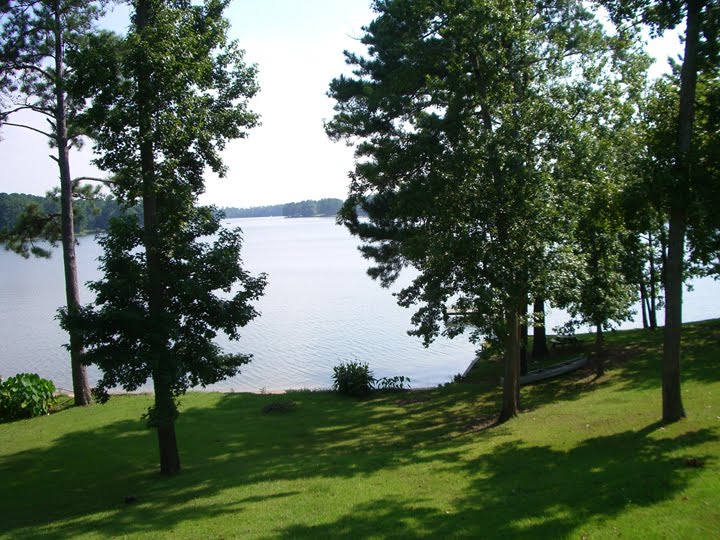
Sometimes the lake is white, sometimes gray, sometimes blue. Sometimes it mixes those colors. Today the lake is blue-gray. I sit there now, on the dock, with my striped drawstring pants rolled and my feet in the water. (If I could sit on the water I would.) As I sit, a heron—the same gray as the water—soars by, skimming the lake’s wrinkled skin. It lands on a neighbor’s dock.

When I cannot write, when I have nothing to say, when all of the books on the shelves have been read and often twice, when there is nothing to snack on in the refrigerator, when I’ve already had my quota of coffee, when it’s too early or I don’t feel like having a drink, when I have reached my saturation point with NPR and cannot take another note of Bach or Glenn Gould, then the thing to do, the only thing to do, is to walk down to the lake.

That’s what I do here, mostly, in my new home: I go to the lake. First thing in the morning, when the day is barely lit, I put on my bathing suit, my dinky rotting Speedo, grab the gray-blue towel (the same color usually as the lake and as the blue heron that soared to my neighbor’s dock) and make my way in bare feet down the sharp pine-needle covered lawn that slopes down past an overturned aluminum canoe and dilapidated picnic table to the dock.

The morning and the evening, dawn and dusk: those are my two favorite times to visit the lake. But also in the afternoon, when it’s terribly hot. When I’m sad, lonely, depressed, worried, eager, anxious, confused, frightened, happy, or simply and totally at a loss: those are all good times for a visit with my watery friend.

This morning the lake wears a mantle of gray clouds. On the far shore somewhere a dog barks. Sounds: waves lapping, water slurping, bubbles breaking. A motorboat in the distance. Trees rustle. The wind sings into my ears while rubbing my shoulders.

Usually I get in the water. I swim. To the opposite point of land and back. Or around the point where I live, to the right or to the left—either way is fine. I count the neighbors’ boathouses and docks that I pass. Six docks makes for a decent swim. I never see my neighbors. Their houses look abandoned. Their boats hang unused from gantries. Their lawns are manicured and their docks are sturdy, but cobwebs droop from ladder to post, from rudder to propeller.

The ghosts wave to me as I swim past.

In three weeks here I have seen only one neighbor. She was out watering some plants. I walked to and introduced myself. We made small talk. About the weather. About the water in the lake. It’s such beautiful water, I said. Very clean, I said. Supposed to be the cleanest lake in Georgia.

Is it? said the woman.

That’s what I read on the Internet.

Oh, the woman said. Really? I didn’t know that.

That’s what I read.

Oh.

One day I heard the rasp of lawnmowers in my yard and went out to inspect. An elderly man sat on a rumbling lawn tractor. He introduced himself as “Old Man Howard.” We chatted for a bit. When our chat was over Howard said, “Why you’re just the nicest person I’ve met in a long time. I meet a lot of folks, and you’re one of the nicest. I’m so glad you’re living here.”

And yesterday morning the postman knocked on my door. I’d forgotten to put a return address on a parcel I left for pickup in the box. We spoke for a few minutes. Robert, his name. Said he’s pushing sixty and thinking of retirement. Doesn’t really want to retire. Said that the average life expectancy of men after they retire is twenty-four months. Imagine that? he said. Said his father has just been diagnosed with colon cancer. “He’s eighty five,” Robert said.

I asked if he’d pull through.

“Oh, yeah. They’ll cut out a piece ’bout this big.” Robert showed me. “But you know, eighty-five, it’s not one thing it’s another.”

I am glad for these encounters, but more glad for being alone with my lake. It’s a good thing I didn’t take a place in town. I’d feel landlocked; I’d feel lost. For all the people who’d surround me, I’d feel more, not less, lonesome. Oh, yes, I do still feel lonely at times. I miss my girl, my friends, the people I’ve known who’ve been good to me for years. And I have regrets that just won’t leave me alone, too many to even list here. In fifty-two years I’ve made some terrible mistakes, with more to come. Like Mr. Wright on his hammock, I, too, have wasted my life.

But when I am with my lake I feel none of those things. I sit on the dock and look at the water, and I am comforted. My lake loves me. It forgives me. Better still, it will not desert or abandon me. It understands me. I sit there with my feet touching the water, waiting for the heron to take off from my neighbor’s dock, thinking that moments like these have an important lesson to teach: namely that of doing nothing.

I think the problem with life, one of the problems (if I may generalize boldly) is that too many things happen. If we could prevent things from happening, or anyway, if we would all, each of us, try from time to time to do our best to make nothing happen, then I say on the whole things would improve. What the world needs—what we all need—is a place in which to do nothing, a place where doing nothing is not only allowed, but is the only thing that makes sense.

I have found such a place here, with my lake. I can’t meditate. At all enlightened acts I am an abysmal failure. But I know how to sit with my lake doing nothing, or maybe just swimming (which is doing nothing in motion). For all my ambitions and hopes and failures and deeds worthy or noble, this sitting by the lake feels as worthy and noble as anything. It’s my way of paying tribute, I guess: to love, to life—to god, if you like.

It is the only form of worship that I know and trust.

Posted in Dreaming on Paper, Uncategorized | 2 Comments

How to Love Yourself

To love yourself it is not necessary to be tall, beautiful, buxom (or muscular), to have strong features or good hair. All of these things, however recommended, are not necessary. Although on the whole to love yourself it is better to be a woman, on occasion men have been known to do it; I have seen them. (That said, sightings of men who loves themselves realistically, despite or even against their egos, are increasingly rare).

To love your self it helps to have a good diet. Eating frozen foods or peanut butter out of the jar is not recommended, nor is sweeping food crumbs off the counter into your hand and then tossing them into your mouth. I suggest a moratorium on cheese Doritos and buffalo wings.

If you are serious about loving yourself—and many people are—then it helps very much to commune with nature now and then. If you live in the country, this is easy. You simply walk out the door and keep walking, beyond the mailbox, a half-mile will usually do.

For city dwellers the situation is less simple. Typically, you can resort to parks. If, for example, you know of an area of a park where there is a shady grove or the equivalent, I suggest you spend some time there, preferably with your back against a tree. Otherwise a pond inhabited by large swans or white geese will do. For some reason other kinds of animals always make us feel better about ourselves. I don’t know why.

Avoid going to the movies alone. Too much TV, too, is a bad idea. If you must surf the Internet, then surf away, by all means, but avoid pornography as it will bring you nothing but self-loathing and the attendant grief. The point is to love yourself, yes? How can you love yourself and fill your eyes with filth? Answer: you can’t.

To love oneself, one does not need to be a monk. In fact though good at loving God monks are not especially disposed to love themselves, so let’s drop that whole notion, okay?

An extra-firm mattress does not for self-love make. It may not hurt, but don’t think of it as THE answer.

Finally, if you really want to love yourself, I suggest that you engage in one or more of the following activities:

1. make a cup of tea
2. sautée vegetables
3. wear carpet slippers
4. call and joke with your mother

Posted in Dreaming on Paper, Uncategorized | 2 Comments